
Weather
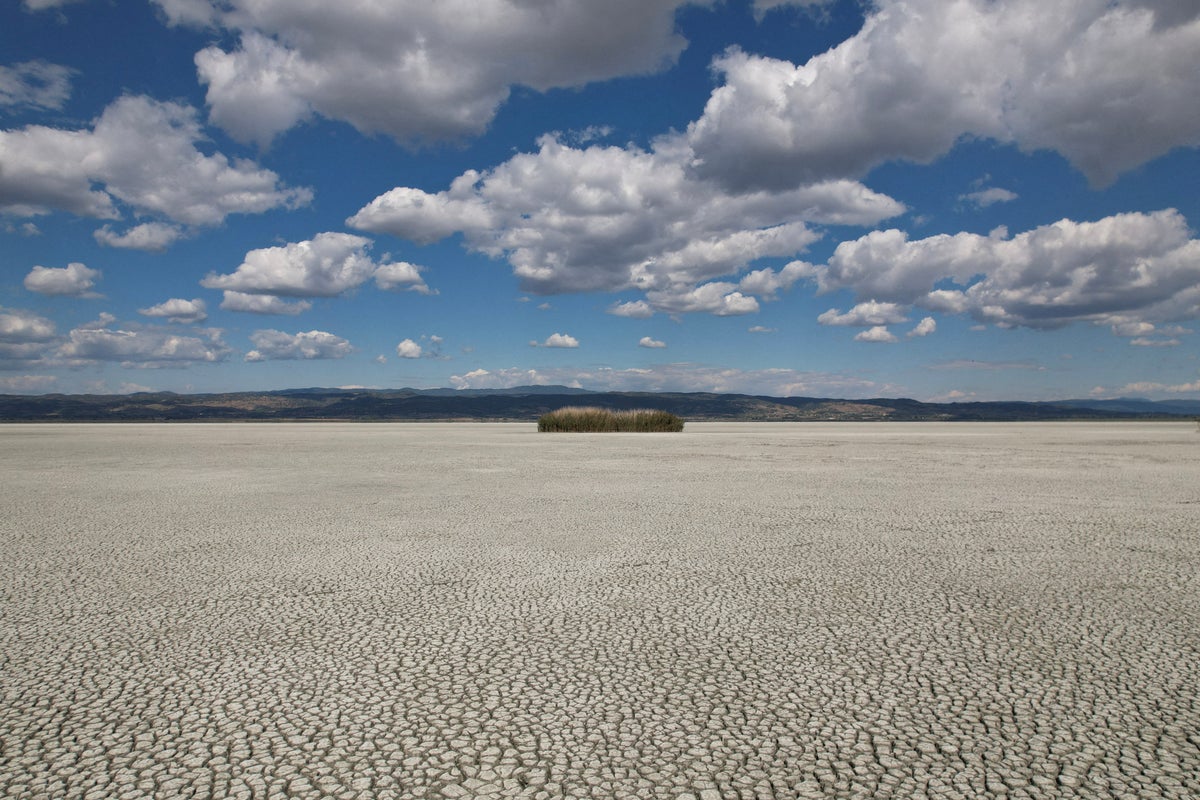
One of Greece’s largest lakes shrinks to a tenth of its original size
Key Points
One of Greece’s largest lakes shrinks to a tenth of its original size The water that remains at Koroneia Lake in northern Greece is collected in a series of murky ponds - Bookmark - CommentsGo to comments Become an Independent member to bookmark this article Already a member? Log in Koroneia Lake in northern Greece, once the fifth-largest lake in Greece, has shrunk to less than a tenth of its original size, according to data from the National Observatory of Athens. Before a decade of low...
One of Greece’s largest lakes shrinks to a tenth of its original size
The water that remains at Koroneia Lake in northern Greece is collected in a series of murky ponds
- Bookmark
- CommentsGo to comments
Become an Independent member to bookmark this article
Already a member? Log in
Koroneia Lake in northern Greece, once the fifth-largest lake in Greece, has shrunk to less than a tenth of its original size, according to data from the National Observatory of Athens.
Before a decade of low rainfall and over-irrigation, the lake was a protected wetland, a refuge for thousands of migratory and water birds, including flamingos, and a magnet for tourists, as well as local fishermen and farmers.
The water that remains now is collected in a series of murky ponds, and the exposed lake bed is a vast mud plain cracked and bleached by years of baking sun.
The area has become a symbol of how climate change and drought are impacting northern Greece, where rainfall has become more erratic and where farmers are increasingly desperate to pump lake water onto their crops.
The problem affected much of Europe this summer, when heatwaves and low rainfall shrank rivers and lakes to levels not seen in decades.
"We knew the lake in its good days, with fishermen, with plenty of water, a wonderful park, and beautiful scenes with birds. Today, what we see is a disappointment," said Costas Hatzivoulgaridis, the head of the lakeside community of Agios Vassilios.
Scientists say the lake's water resources started dwindling after a rainy 2015 to 2016 season.
Years of low rainfall and above-average heat have since evaporated not only the lake water but also the springs that used to feed it.
Satellite images published by the National Observatory of Athens show that its surface has shrunk to 2.7 square kilometres from 34.4 square kilometres in 2016.
"The main factor behind the lake's falling level is certainly annual rainfall in its catchment, which has averaged about 400 millimetres (15.75 inches) over at least the last five years. That is about 150 millimetres less than in previous decades," said Dimitris Papadimos, head of water resources management and climate change at the National Wetland Centre, from his office in Thessaloniki.
Moreover, as average local temperatures have climbed in recent years, evaporation has increased by 100 to 150 millimetres a year, he said.
The problem is partly man-made.
Farmers desperate for water for their cattle and crops have long used the lake to make up for less rainfall, locals and officials said.
When a reporter visited last month, a farmer was using a giant pump to suck water from what is left of the lake onto his fields.
Authorities say they have taken action since a European Union court ruled in 2013 that Greece had failed to protect Koroneia against over-irrigation, illegal water drilling and pollution.
The secretary general for water resources at the Greek Environment Ministry, Petros Varelidis, said that greater monitoring was now in place to reduce irrigation.
Join our commenting forum
Join thought-provoking conversations, follow other Independent readers and see their replies
Comments
Greece (LOCATION)
Koroneia Lake (LOCATION)
Independent (ORG)
the National Observatory of (ORG)
Athens (LOCATION)
Europe (LOCATION)
Costas Hatzivoulgaridis (PERSON)
Agios Vassilios (LOCATION)
the National Observatory (ORG)
Dimitris Papadimos (PERSON)
the National Wetland Centre (ORG)
Thessaloniki (LOCATION)
European Union (ORG)
Koroneia (PERSON)
the Greek Environment Ministry (ORG)