
Business & Finance
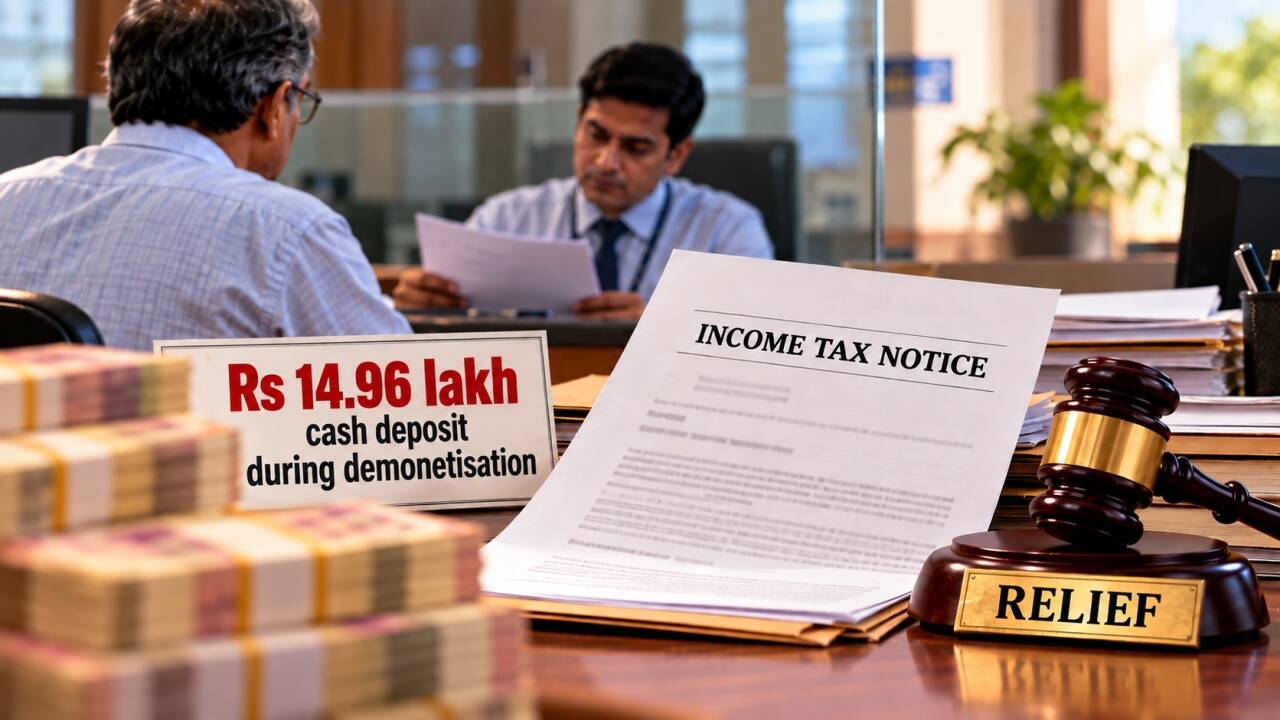
How landlord won tax relief on Rs 14.96 lakh demonetisation cash deposit
Key Points
When it comes to income and taxation, documents and money trail form an important part of the process. This is particularly important when income from any of your sources is in cash. In one such case, a landlord faced income tax scrutiny due to cash deposits made on account of rental income that he received.
When it comes to income and taxation, documents and money trail form an important part of the process. This is particularly important when income from any of your sources is in cash. In one such case, a landlord faced income tax scrutiny due to cash deposits made on account of rental income that he received.
The Bangalore bench of the Income Tax Appellate Tribunal (ITAT) recently held that rental income already disclosed to the income tax authorities can be considered as an identifiable source of cash deposited into a bank account at a later date.
Even where a landlord claims to have collected rent in cash, the subsequent deposit of that money cannot be disregarded merely because the rental earnings have already been taxed.
In this case, the tribunal clarified that disclosed rental receipts must be considered while examining the taxpayer's cash flow.
What the case is about
A man in Bengaluru owned properties that he rented out and collected the rent in cash. He also received substantial amounts as rental advances, but again in cash. During
demonetisation, when Rs 500 and Rs 1,000 notes ceased to be legal tender, the landlord in this case deposited Rs 14.96 lakh in cash into his bank account.
The man had income from three sources: salary, house property and other sources. Between November 9 and December 30, 2016, he deposited as much as Rs 14.96 lakh into his bank account. This prompted the
Income Tax Department to select his return for scrutiny to establish the source of the cash.
The Assessing Officer (AO) at Koramangala subsequently issued a tax notice requiring him to explain where the deposited cash had come from.
The man on his part submitted that the deposits were on account of the money that he had accumulated over a period from income sources already disclosed to the department.
His cash position included an opening balance of Rs 10,05,793 on April 1, 2016, in addition to rental income, advances received from tenants, bank withdrawals and other receipts during the financial year.
He supported his explanation with cash books, bank statements, cash-flow statements, financial statements and records showing how the cash moved over time. The AO remained unconvinced and classified the entire deposit of Rs 14,96,500 as 'unexplained money' under Section 69A.
The tax officer rejected the man’s explanation, following which he challenged the decision before the Bangalore ITAT.
The Commissioner of Income Tax (Appeals), or CIT(A) also sustained the addition.
The concerns underlying the decision included the substantial cash balance claimed by the man, his comparatively modest household withdrawals and certain receipts recorded shortly before demonetisation.
The landlord ultimately succeeded before the tribunal in August 2026.
How did the landlord win the case?
The ITAT Bangalore ordered the deletion of the entire addition of Rs 14,96,500 made under Section 69A. With that addition removed, the issue of applying Section 115BBE to the amount also became irrelevant. The man’s appeal was accordingly allowed.
Chartered Accountant Suresh Surana told ET that the man faced an 'unexplained cash' notice under Section 69A after the AO refused to accept his explanation for the cash deposited during demonetisation.
The Bangalore ITAT took a different view after examining the records. It found that the man had established a continuous trail demonstrating the availability of cash.
His cash-flow statement reflected an opening balance of Rs 4.72 lakh as of April 1, 2015, followed by cash received through rent, bank withdrawals and other disclosed sources. These transactions resulted in a cash balance of Rs 10.05 lakh on April 1, 2016. Additional cash inflows were also documented for the period from April to October 2016, according to the ET report.
Surana says: “Thus, the explanation was not based on a sudden cash entry immediately before demonetisation but on a running cash-flow extending from the preceding financial year.”
Surana said one of the key considerations in the man’s favour was that the Assessing Officer had based the assessment on a mistaken assumption that the cash deposits arose from business transactions or “cash sales”.
The man had never stated that he was engaged in such a business. His explanation throughout was that the money had accumulated from rental collections, advances received from tenants, bank withdrawals and other sources already disclosed to the tax authorities.
The ITAT Bangalore, therefore, found that rejecting his explanation because he could not establish cash sales or produce business books did not deal with the actual source of funds he had put forward.
Surana said the tribunal also disagreed with the argument that rental earnings could not be treated as a source for the bank deposits simply because they had already been taxed under the head “Income from House Property”.
Significance of what ITAT said
The ITAT clarified that whether a receipt is taxable and whether it can explain the availability of cash are two distinct issues. Where rent declared to the tax authorities was genuinely collected in cash, those receipts could subsequently be deposited into a bank account.
Surana says: “Similarly, there was no statutory requirement requiring an individual to immediately deposit cash receipts into a bank merely because the Income Tax Department considered the amount retained in cash to be high.”
In other words, suspicion over the amount of cash accumulated by a taxpayer cannot, by itself, justify an addition.
Surana said that when a taxpayer identifies the source of funds and submits a cash-flow statement along with supporting documents, the department must assess the material objectively. It must also produce affirmative evidence to establish why the taxpayer's explanation is incorrect.
In this matter, there was no evidence to establish that the cash-flow statement was fabricated, that the declared rental receipts had not actually been collected, that the rental advances were fictitious or that the cash available with him had already been utilised for other purposes.
Surana said the ITAT Bangalore consequently held that the man’s explanation could not be discarded simply because the tax authorities regarded his accumulated cash balance as unusually large.
The taxpayer succeeded because he demonstrated a credible and consistent trail explaining both the origin of the money and its continued availability. In contrast, the department's decision to reject his explanation rested largely on doubts and assumptions, without evidence contradicting the records he had submitted.