
Business & Finance
Just four hours from Singapore, Sri Lanka offers two very different safari experiences
Key Points
Just four hours from Singapore, Sri Lanka offers two very different safari experiences Yala may be famous for its big cats, but elephants, mouse-deer, crocodiles and birdlife make the journey just as memorable when the star attraction fails to appear. Spoiler alert: After four days on safari in Sri Lanka, I ended up not spotting a single leopard. Not a shadowy blur, a whisker or the lazy flick of a tail.
Just four hours from Singapore, Sri Lanka offers two very different safari experiences
Yala may be famous for its big cats, but elephants, mouse-deer, crocodiles and birdlife make the journey just as memorable when the star attraction fails to appear.
Spoiler alert: After four days on safari in Sri Lanka, I ended up not spotting a single leopard. Not a shadowy blur, a whisker or the lazy flick of a tail. But as it turned out, I had such a good time in the wild that it did not feel like much of a loss.
It certainly was not for lack of trying. I arrived at Yala National Park with high hopes, as the park is regarded as having one of the highest leopard densities in the world. But leopards are among the most elusive of big cats, so the rangers were careful to manage expectations.
Yet I did everything possible to improve the odds. I dragged my late-rising self out of bed before sunrise, downed double espressos and clambered into rickety safari jeeps with irrational, caffeine-fuelled optimism.
For hours, we scrutinised trees, shrubs, waterholes and dusty tracks while the driver traded radio intel with other guides. Once or twice, a spotted shape flickered in the undergrowth, only to reveal itself as a spotted deer. Adorable, yes. Leopard, sadly no.
But the more time I spent in Yala, the more obvious it became that fixating on one animal missed the point of a safari, which, after all, means “journey” in Swahili. The deer looked like escapees from Bambi as they darted through the scrub. Peacocks roamed in full colour, while cheeky macaques peered at every vehicle as if calculating which snack bag might be worth raiding.
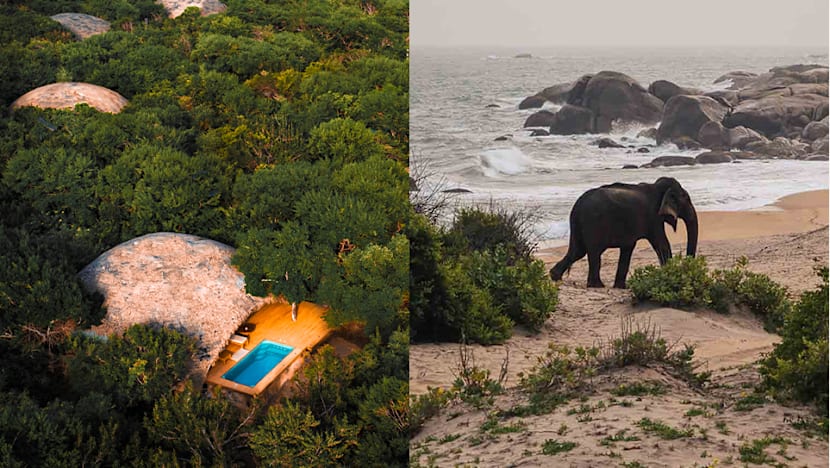
At one waterhole, where a leopard had apparently been seen nearby and might emerge for a drink, a matriarch Sri Lankan elephant instead led her young into the mud to wallow. It was a tender moment that had everyone scrambling for their phones.
At another, our sharp-eyed ranger pointed out an eagle scanning the water, only for it to be repeatedly dive-bombed by tiny fan-tailed flycatchers defending a nearby nest. They ricocheted off its head with the manic determination of Angry Birds, while the larger predator endured the indignity with regal irritation. Who needs a big cat sighting when nature is so effortlessly comedic?
Even on the drive back to Uga Chena Huts, the safari continued. An elusive mouse-deer darted across the dirt track in front of us, so delicate that the entire jeep collectively melted. “So cute” may not have been the most scientific naturalist response, but in my defence, it really was.
While there are many lodges near the national park, I chose Uga Chena Huts for its close connection to the wilderness. Set between scrub jungle and the ocean, the boutique property comprises earthy, cocoon-like huts connected by elevated pathways. At check-in, guests are firmly instructed not to wander off the walkways because the jungle is alive. This is very sound life advice indeed.
Even in my cabin, I got up close but not too personal with grey langurs, which leapt onto my patio to sneak a drink from the private dipping pool. Thankfully, I kept my door locked as instructed. Still, watching them run free while I peered out from behind glass made me wonder whether I was the zoo animal.
During a private drive, we escaped the crowds of leopard-chasing vehicles and slipped onto a quiet plain for sundowners. As I sipped a gin and tonic, the ranger drew my attention to the warning calls of spotted deer and a pair of stags standing about 20m away.
A few minutes later, an entire herd emerged from the shadows and crossed the plain with barely a sound. The first deer, the ranger explained, were probably scouts, checking whether we posed a threat before signalling for the rest to move into the relative safety of the woods. It was a small drama of survival that made me feel as though I had stepped into a Nat Geo documentary.
This variety of experiences is what makes a Sri Lankan safari so compelling. The island offers big-ticket sightings, of course, including the so-called Sri Lankan “big five”, which includes the sloth bear and blue whale. But it is also easy to fit a safari into a wider holiday – from Singapore, Colombo is about four hours away by direct flight.
“What makes Sri Lanka so appealing is how easily safari can become part of a much broader holiday,” said Sophie Newland, Lightfoot Travel’s head of Singapore. “For those living in Asia, you can combine a few days of excellent wildlife viewing with the Cultural Triangle, Hill Country and the south coast all within one trip. It is a completely different wildlife experience that fits very naturally into a varied Sri Lankan holiday.”
While Yala may be the best-known option, particularly for leopards, it is only one part of Sri Lanka’s wildlife map. Newland also recommends elephant spotting in Minneriya and Udawalawe, exploring the quieter wilderness of Wilpattu or venturing somewhere more remote such as Gal Oya, where the pace and perspective shift completely.
In eastern Sri Lanka, Gal Oya National Park feels like the antithesis of bustling Yala, where hundreds of vehicles can line up at the gates at opening time. In contrast, Gal Oya is one of the island’s quieter wilderness areas, centred on Senanayake Samudraya, Sri Lanka’s largest inland body of water, and surrounded by vast stretches of forest and grassland where human presence feels pleasingly incidental.
The region is so remote that Gal Oya Lodge, an eco-luxury retreat nestled in protected jungle, has no Wi-Fi. The dense forest, I was told, makes connectivity almost impossible, which is either a logistical inconvenience or a profound act of hospitality for those who need an excuse – we mean reason – to stop refreshing their inbox.
There are classic jeep expeditions here, though they can feel more atmospheric than sighting-driven because the animals are less accustomed to human presence – which is, of course, a good thing. The highlight is the boat safari on the reservoir, where only four boats are licensed to operate.
We set off at dawn, watching birds lift from the trees as the first light illuminated the water. The ultimate sighting would have been an elephant swimming between islands, its trunk raised like a periscope above the surface. But that depends on timing and water levels, and luck was not on our side.
We did spot several wild elephants grazing along the banks, but our closest encounter was with another apex predator: the mugger crocodile. Several glided through the water, only their beady eyes visible above the surface. Then our guide spotted one stretched out in the sun on an island shore, looking utterly content with its place in the food chain.
Our boatman pulled closer for a better look. The crocodile did not so much as open one lazy eye to acknowledge us. It remained magnificently unbothered as we sat there gawking.
Back at the lodge, life moved at a similarly unhurried rhythm. The rooms are pared back and earthy, though recent additions such as air-conditioning above the bed area offer a small zone of climate-controlled mercy without losing the sense of being close to the forest.
By my final afternoon, I had finally learnt the subtle art of waiting and observing. While daydreaming in my cabin, a small ball of fur darted right up to my door. It was not a leopard but a semi-feral village cat, sharp-eyed and stalking prey. After days of searching for Sri Lanka’s most elusive feline, I got my cat sighting after all. It may not have been the one I came for, but out here in the wild, it still counted.