
Sport
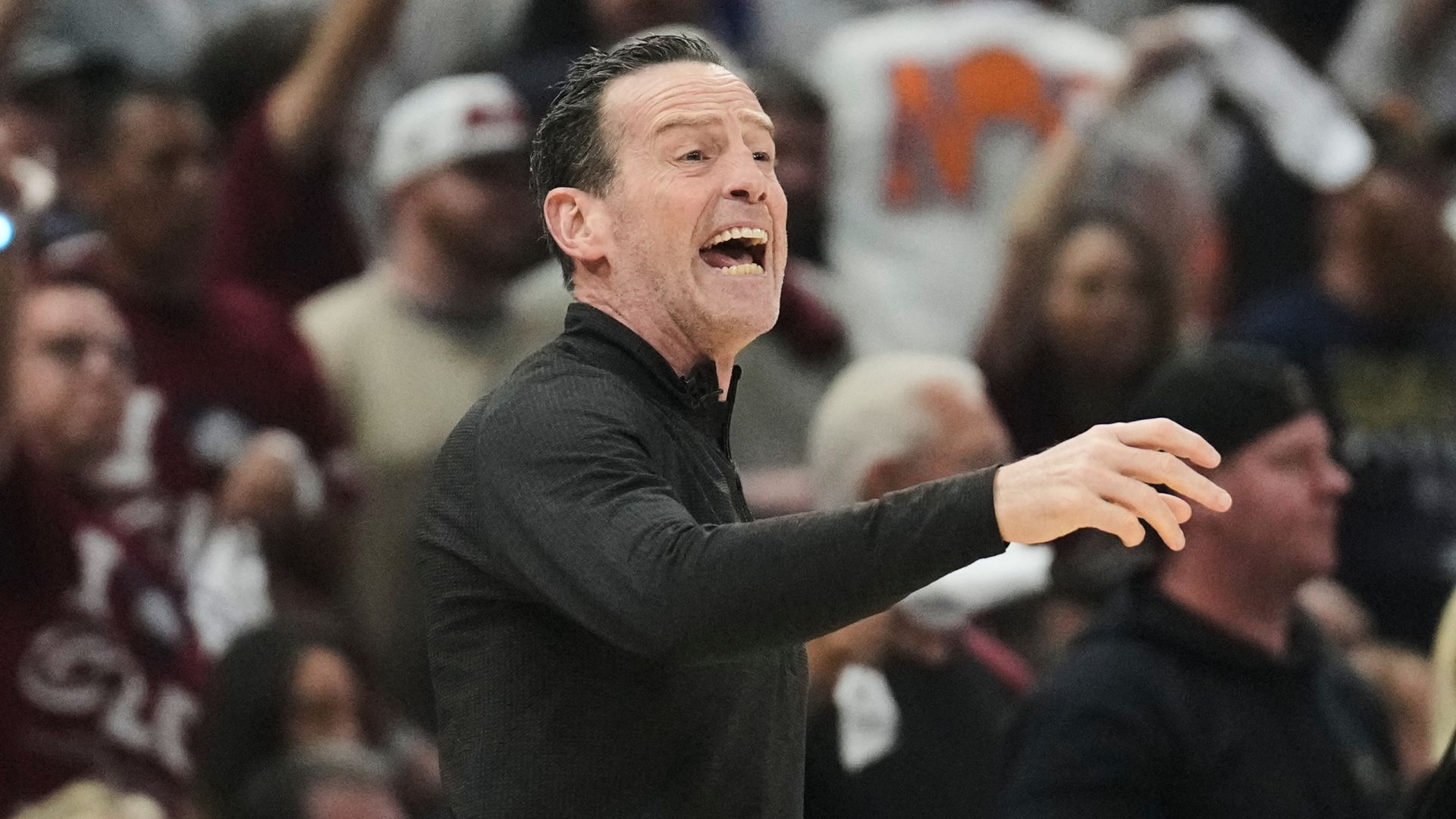
Cavs coach Atkinson backs NBA Europe and praises European player 'mentoring'
Key Points
Stuart Hodge Kenny Atkinson backs NBA Europe as Cleveland Cavaliers coach praises European player 'mentoring' Cavaliers coach backs the NBA's planned European league and praises how club systems put teenagers against men in a way the US college game never will; NBA targets London and Manchester for franchises in league set to launch in October 2027 Last Updated: 05/10/26 1:25pm Kenny Atkinson has backed the NBA's plan for a European league and said the American system does not develop young...
Stuart Hodge
Kenny Atkinson backs NBA Europe as Cleveland Cavaliers coach praises European player 'mentoring'
Cavaliers coach backs the NBA's planned European league and praises how club systems put teenagers against men in a way the US college game never will; NBA targets London and Manchester for franchises in league set to launch in October 2027
Last Updated: 05/10/26 1:25pm
Kenny Atkinson has backed the NBA's plan for a European league and said the American system does not develop young players the way European clubs do.
The Cleveland Cavaliers head coach, the reigning NBA Coach of the Year, was speaking at the end of his team's training camp in Malaga last week. He spent most of a decade playing in Europe and began his coaching career there.
Atkinson said: "I love the NBA. I love that we are in talks with FIBA to create this NBA Europe. It's going to bring more opportunity for players across the globe."
- Jokic, Doncic, Wembanyama? Amaechi insists UK can produce NBA superstar
- Magic guard Black reveals how Man City striker Haaland inspires him
- Download Sky Sports app for analysis, video and more
- Get Sky Sports or stream with contract-free with NOW
Asked what European players arrive with that the American system does not produce, he pointed to how the two systems are built.
"The European system is a club system and we just don't work that way," Atkinson told Sky Sports. "We have the university system, the scholastic system, and it's just different."
"They might be playing for the under-16 team or under-17, but they also train with the older guys. Or like in France, the INSEP team, the young team, they play in the third division of France, so they're getting to compete against older players. I think that mentoring system is really important."
He was explicit about where the American model differs from the European one.
Atkinson said: "In the American system we're much more playing against your peers and at the same age, and our young players don't compete against more mature players as much. You learn a lot from veteran players."
"But they both have their benefits. It's hard to say this one's better than this one. Definitely two completely different ways of developing players."
The detail he cited holds up. The INSEP side, entered by the French federation as Pole France, plays in Nationale 1, the third tier of French men's basketball. Its squad last season ran from 15 to 18 years old, and it can be neither promoted nor relegated.
Atkinson knows the ground better than most Americans in his job. He played at Montpellier, Mulhouse, Nantes and Evreux in France, with spells in Spain and Germany, and began coaching as an assistant at Paris Basket Racing in 2004. He was on Vincent Collet's staff when France took Olympic silver in Paris.
Asked whether a European league might bring the two systems closer together, he said: "I love that. I think it's going to be better for global basketball, because that cross-pollination, you're going to see the best of both worlds."
"You already see in the coaching world the mix of the European influence on the NBA, right? FIBA influence. And I think vice versa, the NBA has influenced Europe, so we have that in the coaching community. It'll be great to see it with the players too."
Atkinson has an example of the European model on his own roster.
Khalifa Diop was playing in Spain's fourth tier at 15 and in the ACB at 19. Cleveland drafted him 39th in 2022 and left him in Spain for four more years before signing him last month.
The NBA and FIBA have been jointly exploring a new pan-European league since March 2025. The NBA's plan is for a league comprised of 16 teams, 12 permanent franchises and four annual qualifiers, launching in the autumn of 2027, with target cities that include London and Manchester.
New Orleans play San Antonio at Co-op Live on Sunday January 17, the first NBA regular-season game staged in Manchester.
Merrill: NBA Europe would have been a great option
The idea already has an audience among players.
Cavaliers guard Sam Merrill, asked the previous day whether a European league would have been a realistic option for him coming out of Utah State, said it would have been.
"I had a point in my career where I felt like I was going to end up coming overseas," he said. "And if that had been the case, something like NBA Europe would have been a great option."
Merrill went 60th in the 2020 draft, the last pick, and spent two years in the G League before Cleveland signed him. He has been following the project as it takes shape.
He also raised an important point in terms of the finances associated with the respective pathways.
Merrill said: "You got all these guys making so much money in college now. I'm interested to see how that conflicts with NBA Europe."
Since July 2025 American universities have paid their players directly. The cap for 2026-27 is $21.58m a school, with men's basketball programmes averaging around $4.2m of it, and Forbes reported last month that a power-conference roster now costs $7m to $10m a season.
Since then the traffic has run one way. Egor Demin left Real Madrid for BYU and Dame Sarr left Barcelona for Duke. Whether a new league changes that depends on money nobody has yet put a number on. Sportico reported bids for NBA Europe franchises within and beyond the $500m to $1bn range but neither the NBA nor FIBA has said anything about what the league would pay the players it hopes to keep.
Merrill, for his part, has watched the European game closely from a distance.
"I love the physicality of the leagues over here," he said. "It's much more college-like, where you have your two games a week, and you practice a lot more, and every game feels almost much more important, kind of like a playoff game."
"I think people underrate how good, especially EuroLeague and the top leagues domestically, how good those things are."
EuroLeague summit set to shape Europe's next move
The next move belongs to the clubs. EuroLeague shareholders meet at Villa d'Este in Cernobbio, on Lake Como, on Monday, with the competition's own future on the table alongside the NBA's interest in it.
La Gazzetta dello Sport reported last month that the assembly would weigh a proposal from the NBA against the EuroLeague's own expansion plans. No agenda has been published and the EuroLeague has made no statement on the meeting.
The two routes are to evaluate an NBA proposal to acquire the EuroLeague and fold it into the new competition, or to press ahead with chief executive Chus Bueno's own plan to expand to 24 teams, with 21 permanent franchises, from 2027-28. Eight new franchises are expected to be named.
Bueno told The Athletic in September that nothing had yet arrived. "As of today, we have not received anything from the NBA about what a potential partnership or collaboration could look like."
Since then, though, Eurohoops has reported that an offer was on the table, although both the NBA and the EuroLeague declined to comment.
Adam Silver has said the NBA will proceed either way. "We began on this path saying that our plan was to go forward regardless of where the EuroLeague stood," he said, back in July.
"But it was always our hope that we would be able to create some sort of consolidation of European basketball. I remain optimistic that we are going to be able to accomplish that."