
Education
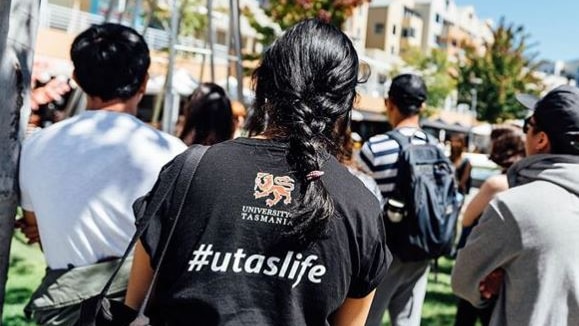
UTAS debts mounting after CBD move 'turned sour', economist says
Key Points
UTAS move to CBD 'turned sour' in wake of COVID, now financial issues mounting, economist says In short: The University of Tasmania's finances face twin problems of large debts and little revenue coming in, an economist who fronted a parliamentary inquiry says. UTAS had tried to move into the Hobart CBD and sell off its Sandy Bay campus to raise funds, but has had to largely abandon those plans. A parliamentary hearing into the university's 2025 annual report will be held next week, with...
UTAS move to CBD 'turned sour' in wake of COVID, now financial issues mounting, economist says
In short:
The University of Tasmania's finances face twin problems of large debts and little revenue coming in, an economist who fronted a parliamentary inquiry says.
UTAS had tried to move into the Hobart CBD and sell off its Sandy Bay campus to raise funds, but has had to largely abandon those plans.
What's next?
A parliamentary hearing into the university's 2025 annual report will be held next week, with UTAS officials, including vice-chancellor Rufus Black, expected to answer questions.
The University of Tasmania faces a liquidity crisis, with $355 million in borrowings and financial pressure mounting from loss-making operations, a state parliamentary inquiry has heard.
One economist involved in the inquiry has told the ABC that UTAS's plan to shift into the Hobart city centre from its nearby Sandy Bay campus was based on "expecting blue sky to last forever", but the COVID pandemic put an end to that.
A closed briefing last week heard from invited organisations and individuals, including the National Tertiary Education Union, the Save UTAS campaign, independent economist John Lawrence and UTAS Papers blogger Robert Hogan, who has campaigned for greater transparency at the university.
The briefing will inform committee members ahead of a public hearing with university officials next week, including vice-chancellor Rufus Black, who will answer questions about the 2025 annual report, tabled in state parliament in June.
The hearing will be the first of its kind and held annually, to provide the same ongoing scrutiny to the university as is given to government business enterprises.
Economist John Lawrence said the university's 2025 accounts revealed "a decade of financial engineering" had left it with little room to manoeuvre.
UTAS announced its plan to spend $600 million to relocate from its Sandy Bay campus to the Hobart CBD in 2019, buying up multiple city properties for redevelopment.
It later released controversial plans to develop 2,500 homes plus aged care and tourism precincts at Sandy Bay.
Pandemic scuttled CBD plan for sell-off and move
John Lawrence told the ABC that UTAS' key financial decisions were made before the COVID pandemic.
"All the decisions were made expecting blue sky to last forever," he said.
"They were going to accumulate a big pool of cash, they were going to spend it, they were going to redevelop Hobart, and then they were going to sell Sandy Bay.
"They would just be overflowing with riches as they sold off something like 2,000 apartments.
"But when COVID struck, the whole thing turned sour. The build-up in international students just ceased.
"They had no plan B."
Mr Lawrence, who is a public policy analyst retained by independent Member for Murchison Ruth Forrest, said the 2025 accounts showed UTAS had $1.3 billion in net assets, but a steep decline in cash and so-called "unrestricted assets".
Unrestricted assets are available to sustain operations, service debt obligations and fund maintenance and development, while restricted assets, such as research grants, scholarships, bequests and endowments, which are essentially held in trust and can only be used for the intended purpose.
UTAS's unrestricted assets fell from $530 million in 2022, according to Mr Lawrence's estimates, to just $112 million in 2025.
"UTAS has always appeared to have had lots and lots of cash and not to be in any danger, but it has transpired that a lot of the cash that they have is actually restricted, that it is not available.
"[To me] that was the most stunning thing that came out of the 2025 annual report.
"They've got plenty of assets, they're solvent, but they don't have a lot of usable assets. And there is a danger that in the next few years that they will run into real strife."
Mr Lawrence also said the university had borrowed too heavily, raising $350 million through "Green Bonds" due to be repaid from 2032 and another $203 million in a one-off sale of the right to collect future rents from student accommodation to an external provider, Spark Living.
Given interest rate rises since the Green Bonds were issued, the cost of servicing this debt is likely to increase sharply when the first tranche of $280 million falls due in 2032.
Refinancing costs loom
Dr Robert Czernkowski, senior lecturer in accounting at the University of Technology, Sydney, told the ABC that UTAS was "an outlier" in terms of debt levels, with borrowings as a proportion of assets hovering around 16 per cent.
"It's definitely near the top end of unis in the same size category by assets," Dr Czernkowski said.
"They're not going down the tube, but neither are they growing or showing a lot of potential to improve their position."
Credit rating agency Moody's, which recently upgraded UTAS' rating from negative to stable, counts these student accommodation arrangements as a form of debt, lifting the university's effective borrowings to more than half a billion dollars.
Moody's analysis assumes that UTAS' debts would be guaranteed by the state and/or federal governments if it went into serious financial strife.
Dr Czernkowski said that with interest rates rising, the issue for UTAS was not whether it could refinance its Green Bonds, but how much it would cost.
"Even a one per cent move is going to push them back into deficit," he said.
UTAS rejected suggestions that it was an outlier in terms of debt levels, pointing to the recent Moody's credit ratings upgrade and to its preferred ratio of debt to equity, which was sitting at 26 per cent — in line with the sector average and below the 30 per cent limit imposed by the university's governing council.
This compared favourably to the University of Wollongong (68 per cent), University of Western Sydney (59 per cent) and Macquarie University (39 per cent).
UTAS argues that, like other regional universities, it faces higher operating costs due to its smaller scale and greater distances between campuses.
In a written statement to the ABC, the university's chief financial officer Ben Rose said UTAS had been "very clear about the impact of a volatile operating environment for universities on our financial position, particularly the impact of sharp drops in international students caused by COVID and changes in government policy".
"Our 2025 Annual Report shows that we remain on track to return to a long-term sustainable position that will enable us to meet current obligations and support future capital investment."
Mr Lawrence said the university's core earnings were negative, and that unrestricted or usable assets had collapsed while restricted assets had surged.
"You can rearrange the balance sheet, refinance debt, sell assets or exchange future income for cash today," Mr Lawrence wrote.
"Each may buy time or create options. What you cannot do indefinitely is transact your way out of an earnings problem."
Beginning in 2024, UTAS changed tack on student accommodation, selling off landmark Hobart CBD sites it had bought for future development, at the Midcity and Fountainside hotels and the K&D site up in Melville Street.
Earlier this year, the state parliament passed legislation allowing the university to sell off part of its Sandy Bay campus, above Churchill Street.
The original intention was to use the proceeds to part-fund a new $500 million STEM (Science, Technology, Engineering and Maths) precinct, a development scheme which depended on $400 million in Commonwealth funding.
However, the federal government's Infrastructure Australia has not earmarked any funds for the precinct.
In May, the university's governing council noted a possible way forward "involving partnership and repurposing" rather than UTAS "acting as developer".
The council will shortly receive an options paper on the future model for STEM and Sandy Bay.
New staff pay deal
While the new STEM precinct is under review and parliament is holding its short inquiry, UTAS has been negotiating a new enterprise bargain with the National Tertiary Education Union, which took industrial action last month.
Last month the union announced an in-principle agreement had been reached on a new four-year deal, including an average 3.4 per cent per year pay rise, a $1,500 bonus for employees earning less than $150,000, 17 per cent superannuation for casuals and AI protections.
Incoming NTEU state secretary Paige Kelly told the ABC the agreement was a significant improvement on the university's original offer of a 3.1 per cent rise with no bonus, but fell short of the 5 per cent rise needed to close the pay gap with comparable mainland universities.
Ms Kelly said the university's financial predicament was "self-inflicted" and it was "not the responsibility of the core staff body to keep on paying out of their own pocket quite literally and sacrifice an adequate pay increase."
UTAS' Ben Rose said he would discuss the university's financial performance with the Legislative Council committee next week.
Committee chair Rosemary Armitage declined to comment ahead of the public hearing.
UTAS (ORG)
CBD (ORG)
COVID (ORG)
The University of Tasmania's (ORG)
Hobart (LOCATION)
Sandy Bay (LOCATION)
Rufus Black (PERSON)
The University of Tasmania (ORG)
ABC (ORG)
the National Tertiary Education Union (ORG)
John Lawrence (PERSON)
UTAS Papers (ORG)
Robert Hogan (PERSON)
the Hobart CBD (LOCATION)
Lawrence (PERSON)