
Politics
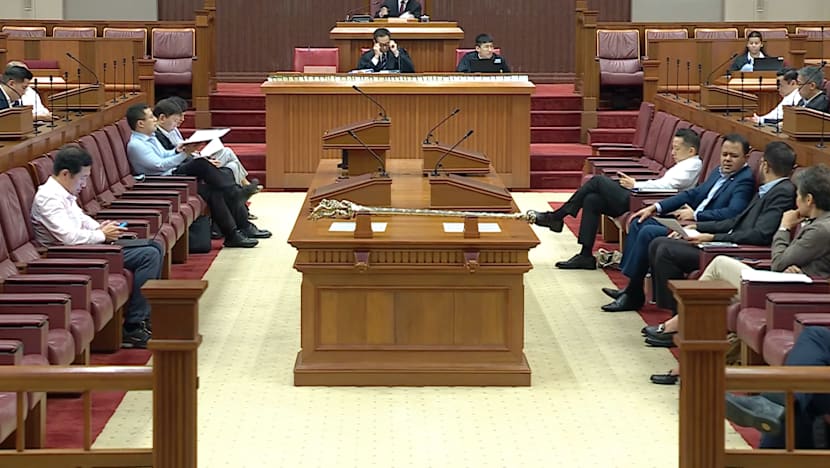
Parliament in brief: 'False' report on Israeli visit and other highlights from Oct 7
Key Points
Parliament in brief: 'False' report on Israeli visit and other highlights from Oct 7 MPs also raised questions about the impact of tighter regulations for data centres on competitiveness, and debated new transport laws that would strengthen rules governing the sale of active mobility devices among other changes. Parliament on Wednesday (Oct 7) covered a range of issues, from efforts to help the public verify government officers to Singapore’s borrowing costs. The House heard that changes to...
Parliament in brief: 'False' report on Israeli visit and other highlights from Oct 7
MPs also raised questions about the impact of tighter regulations for data centres on competitiveness, and debated new transport laws that would strengthen rules governing the sale of active mobility devices among other changes.
SINGAPORE: Parliament on Wednesday (Oct 7) covered a range of issues, from efforts to help the public verify government officers to Singapore’s borrowing costs.
The House heard that changes to the Primary 1 registration framework will go ahead from 2027 without a transition period, despite calls from several MPs to give families more time to adjust. The changes include increasing the number of Phase 2C places at most primary schools from 40 to 60.
MPs also raised questions about the impact of tighter regulations for data centres on competitiveness and sustainability, and debated new transport laws that would strengthen rules governing the sale and advertising of active mobility devices, among other changes.
Here are six other issues discussed in parliament on Wednesday.
WHY NO POFMA OVER REPORT ABOUT ISRAELI DELEGATION VISIT
A Protection from Online Falsehoods and Manipulation Act (POFMA) correction direction was not issued over an Israeli media report about a meeting between Singapore and Israeli security officials because the public interest threshold was not met, Senior Minister and Home Affairs Minister K Shanmugam said in a written parliamentary reply.
Mr Shanmugam said the Haaretz newspaper’s claims about the meeting were “categorically false”, but his ministry’s assessment at the time, based on legal advice, was that the public interest grounds for issuing a direction under Singapore’s online falsehoods law were not met.
“This does not, however, preclude the subsequent issuance of a POFMA direction should circumstances materially change and warrant a different assessment,” he said.
Mr Shanmugam, who is also coordinating minister for national security, was responding to Workers’ Party Aljunied MP Fadli Fawzi, who asked why a POFMA correction order was not issued against Haaretz. He also asked whether Singapore had requested that the meeting be kept secret and whether illegal settlements and settler violence in the West Bank were discussed.
Haaretz reported in September that a delegation from Israel’s Prison Service and National Security Ministry had made a “secret visit” to Singapore and that the subject of the death penalty came up during the visit. The Ministry of Home Affairs (MHA) subsequently rejected the report, saying that the meeting involved the sharing of best practices in areas such as emergency response, crime prevention and forensics.
On Wednesday, Mr Shanmugam said Singapore’s exchanges with foreign counterparts are confidential and generally not publicised because of security concerns. Since January 2025, MHA has held 11 officials-level bilateral exchanges with foreign counterparts, including several from the Middle East, and issued a press release for only one, at the counterpart’s request.
Mr Shanmugam added that if Mr Fadli believes MHA should use such engagements to raise concerns about a country’s policies or conduct, he should clarify whether this should apply “only to Israel, or consistently to all countries with which MHA engages”.
“For example, when MHA holds operational discussions with other Middle Eastern or Asian countries, should we also raise the concerns Singapore may have with their conduct or policies?” the minister asked.
“If that is the member’s position, the government would be interested to understand how he proposes that such an approach would serve Singapore’s overall interests.”
STREAMLINING OF GOVERNMENT DIRECTORY
Contact details for quality service managers of agencies have been made more prominent after the streamlining of the Singapore Government Directory, Senior Minister of State for Digital Development and Information Jasmin Lau said.
This lets members of the public verify the identity of an officer who contacts them. For follow-ups on existing issues, they may use the contact details in earlier official correspondence with the agency, said Ms Lau, who is also acting minister for manpower.
Some public officers' names, email addresses and office phone numbers were removed earlier this year to curb misuse by scammers.
To help the public identify legitimate calls, the government will introduce a common phone number prefix and a recognisable caller name for calls from its agencies later this year, she said.
BORROWING COSTS
Interest rates in Singapore have risen less than in other countries, reflecting strong fiscal fundamentals that have kept demand for Singapore Government Securities healthy, Monetary Authority of Singapore deputy chairman Chee Hong Tat said.
Mr Chee, who is also national development minister, was responding to a question on how sustained rises in US Treasury yields have affected Singapore's borrowing costs and credit availability.
He said borrowing costs remain broadly in line with historical levels. The 10-year Singapore Government Securities yield is at 2.5 per cent, against its 10-year average of about 2.2 per cent.
The three-month compounded Singapore Overnight Rate Average, a benchmark for domestic loans, is at 1.2 per cent, below its 10-year average of 1.5 per cent.
MEDICAL BENEFITS FOR EMPLOYEES
The Ministry of Manpower and its tripartite partners are studying how to encourage employers to offer healthcare benefits beyond statutory requirements, Acting Minister for Manpower Jasmin Lau said.
Such benefits include reimbursing medical expenses beyond consultation fees and providing paid sick leave without requiring a medical certificate.
About 30 per cent of employers surveyed by the ministry offered paid sick leave without a medical certificate in 2024, up from around 27 per cent in 2023.
IMPACT OF AUTONOMOUS VEHICLES ON DRIVERS
The roll-out of autonomous vehicles (AV) is not expected to have "any immediate impact" on driver jobs and livelihoods, Minister for Transport Jeffrey Siow said in a written parliamentary reply.
"The number of autonomous vehicles is a very small percentage of the total number of active taxi and private hire car drivers, which currently stands at 72,000," he said.
By end-2028, there may be several hundred autonomous passenger vehicles in Singapore, deployed across various "constrained use cases" as the country remains in the phase of safety validation and establishing market demand and acceptance, Mr Siow added.
"While it is not possible to predict how many autonomous vehicles will be in Singapore in five years, it is almost certain that the majority of point-to-point transport will be provided by human drivers," he said in response to questions from several MPs on support for taxi and private-hire drivers amid AV deployment.
MP Yeo Wan Ling (PAP-Punggol) had asked about safeguards such as a cap on AVs to pace the roll-out. To this, Mr Siow said: "We should not do so as our transport needs are still growing."
PREGNANCY-RELATED DISCRIMINATION COMPLAINTS
In a written parliamentary response, Acting Minister for Manpower Jasmin Lau said the Tripartite Alliance for Fair and Progressive Employment Practices (TAFEP) received 49 pregnancy-related discrimination complaints between 2019 and 2025.
"Where there is evidence of discriminatory employment practices, TAFEP will refer the complaints to the Ministry of Manpower (MOM) for investigation," she said, adding that the ministry could take enforcement action depending on the severity of the case.
This includes requiring employers to rectify the lapses in their human resource processes or suspending their access to foreign workers.
Ms Lau was responding to Workers' Party Aljunied MP Fadli Fawzi, who asked about the number of complaints made to TAFEP regarding pregnancy-related discrimination every year since 2017.
CNA reported in late September that a woman who was wrongfully dismissed because of her pregnancy and upcoming maternity leave was awarded S$19,800 (US$15,500) by an Employment Claims Tribunals (ECT).
Ms Lau said on Wednesday that employees who are dismissed because of their pregnancy may also file a wrongful dismissal claim at the Tripartite Alliance for Dispute Management (TADM).
Between April 2019 and 2025, 387 claims for compensation or reinstatement for wrongful dismissal during pregnancy were filed at TADM. Of these, 301 – or 78 per cent – were resolved at TADM, said Ms Lau.
The remaining 86 were issued with case referral certificates, allowing claimants to file claims with the ECT, she added. The ECT awarded compensation in favour of employees in 27 – or 38 per cent – of the 72 claims filed.
Under the Workplace Fairness Act, which is scheduled to take effect by the end of 2027, it will be unlawful for employers to make adverse employment decisions based on protected characteristics, including pregnancy.