
Health
Caring for her dying father at 17 shaped how this veteran nurse cares for breast cancer patients today
Key Points
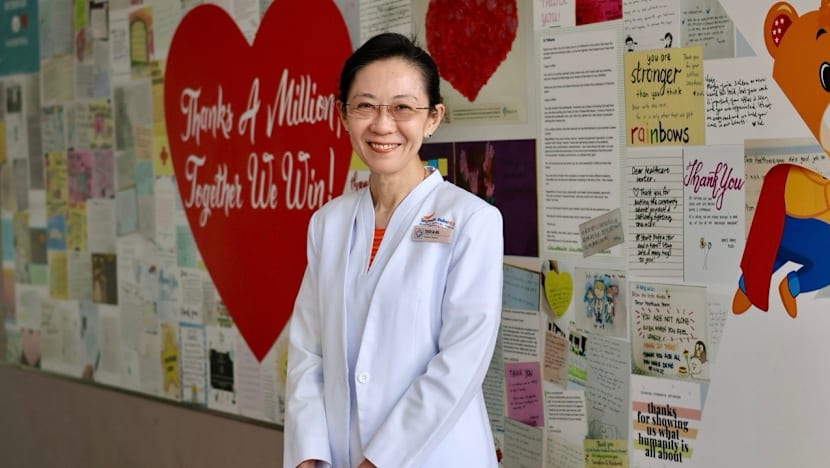
Caring for her dying father at 17 shaped how this veteran nurse cares for breast cancer patients today KKH oncology-trained nurse Teresa Ng learnt early that breast cancer patients and their families need more than medical care. For decades, the 61-year-old has helped women and their families navigate the fear, uncertainty and challenges that come with the disease – even after treatment ends. Veteran oncology-trained nurse Teresa Ng was talking to CNA Women about her late father and patients...
Caring for her dying father at 17 shaped how this veteran nurse cares for breast cancer patients today
KKH oncology-trained nurse Teresa Ng learnt early that breast cancer patients and their families need more than medical care. For decades, the 61-year-old has helped women and their families navigate the fear, uncertainty and challenges that come with the disease – even after treatment ends.
Veteran oncology-trained nurse Teresa Ng was talking to CNA Women about her late father and patients when her voice faltered.
Tears filled her eyes. Dabbing at them, the 61-year-old apologised for the sudden emotion.
After decades in nursing, the assistant director of nursing at KK Women’s and Children’s Hospital (KKH) is no stranger to the emotional weight of caring for cancer patients.
As a teenager, Ng cared for her father who had terminal cancer. She also knows what it feels like to return from a day off to find that a patient receiving palliative care has died.
“Over the years, I tried to divert my attention and do my own debrief, tell myself that illness and death are part and parcel of life, that tomorrow is not guaranteed,” she said.
That ability to care deeply has shaped much of Ng’s work with breast cancer patients at KKH, where she has spent years supporting and advocating for them and their families.
Ng joined KKH as a staff nurse in 1993. After taking time off for postgraduate studies and to start a family, she returned in 2004, working in gynaecological oncology before moving to breast cancer care in 2009.
“Over the years, I have come to understand that patients need much more than good medical care. They need someone who will listen, explain things honestly and recognise the person behind the diagnosis,” said Ng.
CARING FOR HER FATHER WITH TERMINAL CANCER AT 17
The kind of support Ng now provides is what she wished her family had while navigating her father’s terminal liver cancer in the early 80s.
The eldest of four siblings, she tried her best to help care for her father. She watched how he slowly became weaker and eventually died at home.
Ng remembers the uncertainty and helplessness that came with watching someone she loved at the end of his life. “Sometimes, being near him, I would feel very sad not knowing what I could do for him,” she said.
Watching her father become thin and frail over the course of his illness made her heart ache, Ng said.
“Looking back, I wish that someone had explained to me and my family that that was part and parcel of the disease process, and how to manage at the end of life.”
Her first encounter with oncology nursing was in 1993 when she worked in a ward caring for patients with gynaecological conditions and gynaecological cancer. As she spent time caring for cancer patients, she realised it was something she wanted to do.
“It gave me an appreciation for the human side of medicine and a lasting understanding that caring for a patient also means caring for the people around them,” she said.
SUPPORTING PATIENTS THROUGH DIAGNOSIS AND TREATMENT
Fears about dying, self-blame and burdening their family are common among breast cancer patients, Ng said. She gives them time and space while being honest about what lies ahead.
“I make sure they understand what we know, do not know yet and what the next steps are, without overwhelming them with information all at once. I encourage questions and remind them that they do not have to make sense of everything on the first visit,” Ng said.
Ng also walks breast cancer patients through the potential side effects of treatment, such as fatigue, appetite changes and hair loss, and how pre-treatment medications may help prevent or reduce them. This helps reduce uncertainty and anxiety.
“If we don’t pre-empt them, explain what’s to be expected, they may get very worried (during the treatment),” she said.
For Ng, supporting women with breast cancer also means understanding that treatment may not be their only concern.
She has seen families become anxious to help and want to “fix” things when the patient needs time to process her diagnosis and treatment options.
“Beyond the medical decisions, the patient’s mind was elsewhere too… on her children, on how they would take the news and on how she would ever find the words to tell her own parents,” said Ng.
“What the spouse saw as urgency, the patient experienced as being rushed. What she needed most, before anything else, was simply the space to be heard.”
Ng encourages families to be supportive without taking away the patient’s sense of control.
CARING BEYOND THE HOSPITAL WARD
Ng also heads the Department of Advancing Nursing and Education, which looks after nursing professional development and clinical training. She is also involved in population health projects, helping to raise public awareness on breast health.
Over the years, Ng has started or contributed to initiatives that support women through the practical and emotional toll of breast cancer. These challenges are not always visible, she said.
For younger women, for example, issues such as fertility and sexuality can impact them deeply but do not always receive enough attention.
“Completing treatment does not necessarily mean that a patient feels ‘back to normal’. For me, advocacy means looking at the whole person, not just the cancer,” she said.
She has chaired the KK Alpine Blossoms Breast Cancer Support Group since 2009. The group runs a peer support programme called Blossom Buddy, where breast cancer survivors share their experiences with newly diagnosed patients.
Ng has also worked on projects such as The Yarn Wonders and Knitted Knockers.
Knitted Knockers are lightweight, hand-knitted breast prostheses for women who have undergone mastectomies.
The Yarn Wonders are hand-knitted sling bags that allow patients to discreetly carry surgical drainage bottles used after breast cancer surgery. The bags also make it easier for patients to move around without having to hold the bottles, said Ng.
Ng said the handmade gestures tell patients that they are not alone and someone is thinking of them.
“Some patients are surprised that someone has taken the time to make something especially for them, while others become emotional or simply hold onto it as a source of comfort.
“When someone is going through a vulnerable and frightening period, a small, personal gesture can provide a sense of comfort and connection that goes beyond the clinical environment,” she said.
WHAT PATIENTS HAVE TAUGHT HER
For all the support Ng has offered patients, she has also learnt a lot from them, professionally and personally.
“It taught me not to take good health, time with loved ones or the simple things for granted,” she said.
Ng has seen how powerful love can be in the face of a life-threatening diagnosis. She recalls a young mother who was initially in denial about her cancer diagnosis and delayed treatment.
Eventually, she decided to undergo treatment for the sake of her four young children.
“What struck me was not that she never felt afraid; she was. She reminded me that courage is not the absence of fear, but finding a way to keep going despite it,” said Ng.
“We often think we are there to care for our patients but they teach us just as much how to live.”
The emotional demands of healthcare work can be heavy, but what keeps her going is looking back at the reason why she went into nursing in the first place.
“My father’s experience as a patient had a profound impact on me, and when things feel overwhelming, I think about that… and what it means to be there for someone at their most vulnerable state. That always helps put things back into perspective,” she said.
Looking ahead, Ng hopes to continue developing initiatives that strengthen patient education, support cancer survivors and encourage early detection.
She is especially interested in projects that connect patients with the right resources and address needs that may be overlooked after treatment.
“For me, the most meaningful projects are those that can create a lasting difference in a patient’s journey. Not just medically but also emotionally, socially and in terms of their overall quality of life,” she said.
CNA Women is a section on CNA Lifestyle that seeks to inform, empower and inspire the modern woman. If you have women-related news, issues and ideas to share with us, email CNAWomen [at] mediacorp.com.sg.
[Image text:] Fonrs A Milien
stronger
rainbows
Lor showing
aamanityis
allahoul