
Technology
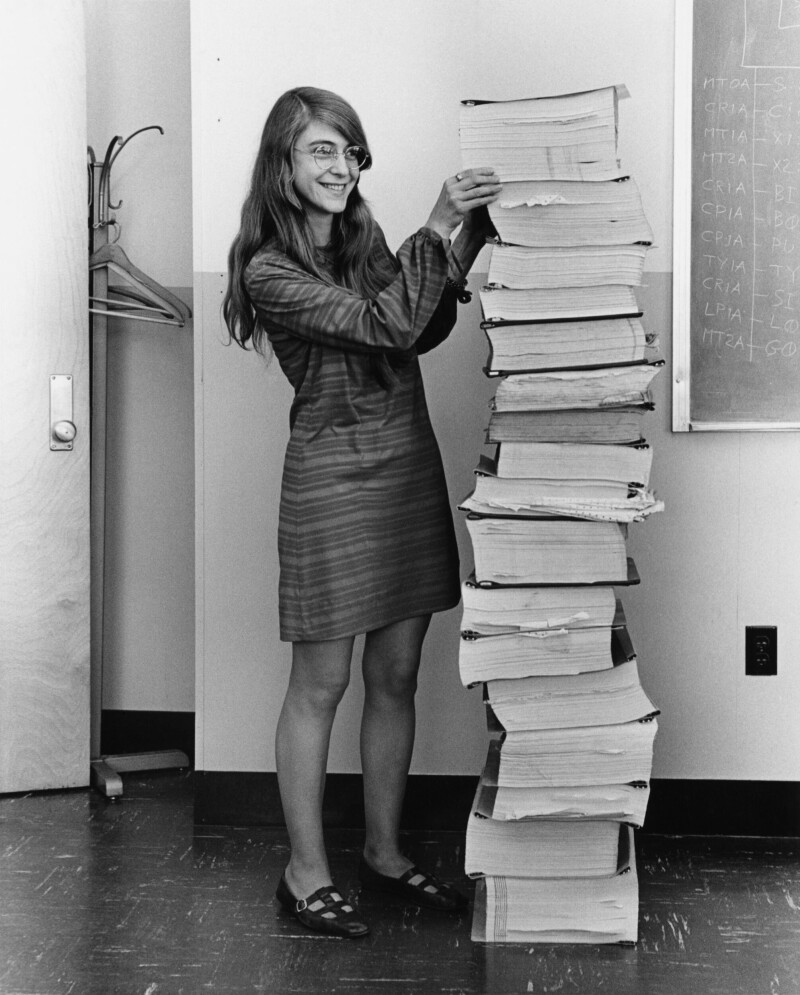
Margaret Hamilton, software pioneer who helped put humans on the Moon, dies at 90
Key Points
"Forget It" was the name of a small computer program never thought to be needed, which will nonetheless go down in history along with its author, Margaret Hamilton, the American software engineer who died on September 30, aged 90. Hamilton led development of the onboard flight software for Apollo's command and lunar modules, helping astronauts reach the Moon in 1969. Among her early jobs after joining the MIT Instrumentation Laboratory in 1965 was to write the software for the Apollo abort...
"Forget It" was the name of a small computer program never thought to be needed, which will nonetheless go down in history along with its author, Margaret Hamilton, the American software engineer who died on September 30, aged 90. Hamilton led development of the onboard flight software for Apollo's command and lunar modules, helping astronauts reach the Moon in 1969. Among her early jobs after joining the MIT Instrumentation Laboratory in 1965 was to write the software for the Apollo abort procedure. "Everybody said that was never going to happen, [so they said] 'Oh well, good. We'll give this one to Margaret because she's a beginner,'" she told the Computer History Museum. However, an unmanned flight did abort, raising Hamilton's standing within the team. "It went to [run] this program I had written, which I named Forget It. All of a sudden, I became an overnight expert," she said. Hamilton was born in Paoli, Indiana. Moving with her family to Michigan, she graduated from high school in 1954. She studied mathematics at the University of Michigan and Earlham College, where she graduated in 1958 with a minor in philosophy. She planned to pursue graduate studies and an academic career, but decided to go to Boston in 1959 with her husband, who was studying law at Harvard. She got a job at MIT with Edward Lorenz – who went on to pioneer chaos theory – and programmed the LGP-30 and DEC's PDP-1 computers for weather forecasting. She worked on other projects at MIT, including aerospace systems, before hearing of the Apollo missions in 1965. She immediately applied to join the MIT team supporting them. She initially wrote software for uncrewed Apollo missions, later leading development of flight software for the crewed program. The team's software played a crucial role in the first lunar landing as the Apollo 11 module approached the Moon's surface in 1969. During the final minutes of descent, the guidance computer raised several unexpected alarms, leading the astronauts to question whether it was safe to land. The alarms showed "executive overflows," meaning the system could not complete all its tasks. Hamilton had also pressed for safeguards against operator error. Her daughter, four years old at the time, crashed a command-module simulation by activating a pre-launch program during a simulated flight. Hamilton proposed protection against that mistake, but was initially overruled because astronauts were considered unlikely to make it. An astronaut subsequently did so during Apollo 8, prompting changes to the software. For Apollo 11, the software's restart protection allowed essential landing tasks to continue despite the overload. Computer engineer Jack Garman advised guidance officer Steve Bales that the alarms did not require an abort. "We're go on that alarm," Bales confirmed. The crew made it safely to the Moon's surface and later returned to Earth. The overload was traced to unwanted inputs from the rendezvous radar system. While working on the Apollo missions, Hamilton began to call herself a "software engineer" because writing code was not taken as seriously as other engineering disciplines. The term is now standard. She also features in an iconic photograph, standing beside a stack of her team's Apollo software listings almost as tall as she was. Following the Apollo missions, she founded and co-founded a number of technology companies focused on fault-tolerant software. She created the Development Before the Fact (DBTF) methodology to prevent errors early on, along with the Universal Systems Language (USL) for systems design. In 2016, President Barack Obama awarded her the Presidential Medal of Freedom. Computing pioneer Grace Hopper received the same honor posthumously. The White House described Hamilton as a mathematician and computer scientist who contributed to concepts of asynchronous software, priority scheduling and priority displays, and human-in-the-loop decision capability, which set the foundation for modern, ultra-reliable software design and engineering. Hamilton's legacy is a reminder to design for the mistakes users supposedly won't make – and the failures no one expects. She is survived by her daughter, a son-in-law, two grandsons, four great-grandchildren, and three siblings, according to MIT. ®
[Image text:] CPIA
CPIA
CRIA
LPIA
MT2A
Margaret Hamilton (PERSON)
Moon (PERSON)
American (ORG)
Hamilton (PERSON)
Apollo (ORG)
the MIT Instrumentation Laboratory (ORG)
Margaret (PERSON)
the Computer History Museum (ORG)
Paoli (LOCATION)
Indiana (LOCATION)
Michigan (LOCATION)
the University of Michigan (ORG)
Earlham College (ORG)
Boston (LOCATION)
Harvard (ORG)