
Education
Accountability or a witch hunt? Doxxing blurs the line, and it's getting more common
Key Points
Accountability or a witch hunt? Doxxing blurs the line, and it's getting more common From viral call-outs to crowdsourced sleuthing, exposing someone's identity online can quickly have consequences far beyond the original post. Greater awareness is needed of the harm that can follow when people join in public shaming or online vigilantism.
Accountability or a witch hunt? Doxxing blurs the line, and it's getting more common
From viral call-outs to crowdsourced sleuthing, exposing someone's identity online can quickly have consequences far beyond the original post. Greater awareness is needed of the harm that can follow when people join in public shaming or online vigilantism.
Hell has no fury like a lover scorned – especially if they have an internet connection and enough of their partner's personal information. That was the case for one 60-year-old man whose extra-marital affair blew up in his face spectacularly.
When the man spurned his mistress early this year, the woman took to Facebook to dox him, laying their sordid affair bare for all and sundry. When he tried to avoid her, she took to calling his office.
And she didn't stop there. The woman also approached the man's wife by pretending to be a customer of her business and befriending her.
Mr Ray Louis, founder of Ray Louis Law Corporation and the lawyer who represented the man, said that his client had to get a court order to stop the doxxing and harassment.
It's the type of case that might come to mind if one were to think about what doxxing means: one party splashing another's identity and personal information online to shame and harass them.
But sometimes, simply venting frustrations publicly can inadvertently mobilise an online mob.
When university student Mabel Kee took to YouTube to unpack her ex-fiance's alleged infidelity in a 50-minute video, there was no intention to dox the parties involved, she told CNA.
In her video, the 22-year-old used nicknames instead of the full names of her ex and the alleged third party, and generic terms such as "Block ABC" to refer to the woman's public housing unit.
Ms Kee, who posted the video after friends and followers had asked about her breakup, expected the talk around her relationship to die down. Instead, her gripping tale, complete with chat logs and Grab receipts, quickly amassed over a million views.
At first, Ms Kee found the online responses validating. She had been second-guessing if the red flags she had spotted in her relationship were normal.
"Everybody kept giving me all the support that I really needed at that time," she said.
Soon, however, things got out of hand. Despite Ms Kee's attempts to obscure identifying details, people soon figured out the alleged third party's name and address from innocuous clues, such as a dim sum restaurant near the woman's home.
Some two weeks after Ms Kee posted the video, the Online Safety Commission (OSC), a government agency which helps victims of online harms, reached out to inform her that she would have to edit the video if she wanted to keep it live.
Ms Kee said she was told that mentioning the other woman's neighbourhood could be considered doxxing, and that it would need to be removed from the video.
Rather than painstakingly edit every mention of the neighbourhood out – there were many – she decided it would be best to simply take the video down.
Looking back, Ms Kee acknowledged that it was fair for OSC to intervene. "I mean, people did find her (the woman) somehow, through my video, even though I didn't intend it," she said. "I thought I was being careful, but it wasn't enough."
Indeed, experts say doxxing has undergone a profound transformation over the years. In some cases, like Ms Kee's, a person might not even intend to dox another, but other internet users end up doing the dirty work.
It's a far cry from its origins: an academic said that doxxing began in hacker subcultures.
In its earliest form, in the 1990s, doxxing was used within underground piracy networks to expose individuals who violated community norms.
Associate Professor Brian Lee, from the School of Humanities and Behavioural Sciences at the Singapore University of Social Sciences (SUSS), said: "In those early years, doxxing required a degree of technical competence and was largely confined to niche online communities … The new media landscape today is very different."
Now, with the proliferation of social media platforms and the wealth of personal data people share about themselves online, doxxing has become easier and more commonplace. While it can be tempting to think that only those chronically online are at risk, the truth is that anyone can be targeted.
Early data from the OSC, which was launched on June 29, indicates that online harms in Singapore have a wide reach, impacting men and women, young and old in equal measure. The youngest victim OSC saw was a seven-year-old who was doxxed, while the oldest victim was a 68-year-old who faced online harassment.
Of the online harms the OSC helps to target, including intimate image abuse, online stalking and online harassment, doxxing has emerged as the top concern so far, making up 44 per cent of reports. The commission received a roughly equal number of complaints from both men and women.
The thing is, lawyers and online harms experts largely agree that existing doxxing laws are sufficient and that the creation of the OSC helps victims seek some recourse.
But they also believe doxxing is only going to become a bigger problem in society, because at its root are issues that are difficult to solve: the growing tendency among individuals to take grievances online and to participate in internet mobs playing the role of judge, jury and executioner.
WHAT COUNTS AS DOXXING
According to the Online Safety (Relief and Accountability) Act 2025, doxxing refers to "the publication of any identity information of a person that a reasonable person would conclude was likely to have been intended to cause harassment, alarm, distress or humiliation".
This "identity information" refers to anything that can identify a victim such as photos, videos, names, contact details, or even information about their family. This "essence" of doxxing hasn't really changed over the years, even as platforms have, said Mr Fong Wei Li, the managing director of law firm Forward Legal.
In practice, however, doxxing can serve as an umbrella term for a wide range of situations.
It can be as simple as just putting someone's full name online, which was what happened five years ago to a 32-year-old who wanted to be known only as Ms C.
She had picked up an item from a Carousell seller on her friend's behalf. After Ms C told her friend how the seller had left her waiting for over 20 minutes, her friend left a four-star review on the site.
This was enough to provoke the seller's ire. He posted Ms C's full name in response to the review.
Ms C believes that the seller obtained her name from her PayLah transaction as this was before names were concealed by the payment application.
“After this, I changed my PayLah name to my initials. I also got all my friends to do the same," she said. "I was afraid he would find my LinkedIn and my workplace because he had my name."
Even though Ms C was not harassed by other internet users, the seller's action is still considered doxxing. Fortunately, Carousell took down the comment revealing her full name, she said.
Doxxing can also happen within a closed group. Mr Louis, the lawyer, is handling a case involving a primary school boy who was falsely accused in a WhatsApp chat group of stealing a girl's pen. The girl's parents had taken to the chat to identify the boy and harass his parents, said Mr Louis. The boy's parents are considering legal action, he added.
Besides the straightforward disclosure of identity information, doxxing today can involve more subtle "detective work", noted Dr Chew Han Ei, Adjunct Senior Research Fellow at the Institute of Policy Studies (IPS).
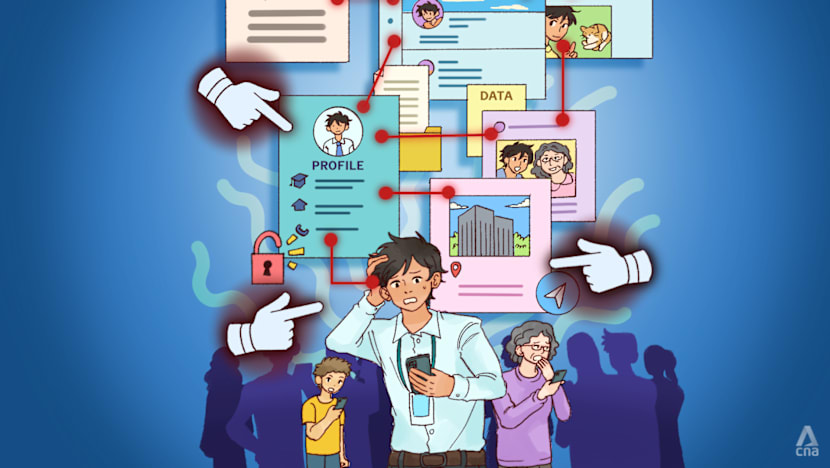
"Someone does not necessarily have to post your home address or phone number. A photograph, workplace, old username or location may be enough. Other people can then search across platforms and join the dots.
"So the risk increasingly comes from linkability. Little bits of information that look harmless on their own can become very revealing when somebody pieces them together. And once that information has jumped platforms, removing the original post may already be too late,” Dr Chew said.
Sometimes, a post can start out innocently enough, but then spiral out of control when other internet users pile on, said Dr Chew, who also sits on the board of SG Her Empowerment (SHE), a non-profit organisation that supports doxxing victims, among its other advocacy work.
As Mr Louis and Mr Fong pointed out, the intention to cause harm is one key element to meet the legal definition of doxxing. Yet, even a well-intentioned post can trigger harm that is remarkably similar to doxxing.
Mr Fong offered a scenario: Suppose a stranger pushes your elderly father to the ground and walks off. You do not know who the person is, so you post footage of the incident online and ask the public to help identify them. Your aim is to find the person so that police can act on the matter. If you have no intention of causing distress, this may not be considered doxxing, he said.
Once the video goes viral, however, strangers may track the person down, post their address and shame them online, Mr Fong noted. "The harm that follows looks exactly like doxxing, even if you never meant it."
Dr Chew added: "The larger lesson is that when we post about another person, we now also have to think about what clues we are leaving behind and what hundreds of other people may do with them."
In Mr Louis' view, the OSC is a step in the right direction when it comes to dealing with social media posts that spread misinformation or trigger harassment.
Under the Online Safety (Relief and Accountability) Act, which was passed on Nov 5, 2025, the OSC has the power to direct platforms, page administrators and content creators to take down harmful content.
When platforms receive online harm notices from the OSC, they are required to respond within 48 hours. In more serious cases, such as intimate abuse and child abuse images containing nudity, the deadline is six hours.
Before the OSC was set up, victims had to endure long waits of five days or more for platforms to remove offending content, according to the Online Safety Assessment Report released by the Infocomm Media Development Authority (IMDA) in 2025.
"It's a good thing for platforms to respond quickly and take down content that causes harm. You don't have to pay lawyers to do it," Mr Louis added.
The process also provides a good balance between addressing online harms and maintaining freedom of speech, he said, noting that there is an appeal process for content creators who disagree with the OSC's directions.
These content creators may first apply to the OSC for reconsideration of the initial decision. However, should the content creator remain dissatisfied, they may make an appeal to the Online Safety Appeal Panel, which acts independently of the OSC, said an OSC spokesperson.
VICTIMS LEFT WITH LONG-LASTING SCARS
Those on the receiving end of digital mobs can attest to the damage they cause.
For Ms Cherry Tan, 31, it has been nearly a decade, but when she sees similar doxxing incidents on her feed, the memories come rushing back.
In April 2017, videos spread of a couple arguing with an elderly man at Toa Payoh Lorong 8 Market and Food Centre over seats and pushing him. Facebook commenters somehow misidentified Ms Tan and her then-boyfriend as the couple. Before she knew it, the mob had dug up and publicised her pictures, name and the bank where she worked.
Angry commenters even took to her employer's Facebook page, calling for them to address the incident and take action on her. The harassment only died down after Ms Tan clarified she had nothing to do with the incident and her boyfriend wasn't even in Singapore at the time.
The actual couple involved in the incident were later fined by a court.
Ms Tan, who now runs coffee shop stall Kiang Kiang Taiwan Teppanyaki, told CNA: "I know how easy it is for people to hide behind a screen and cyberbully someone … An innocent person could suddenly face harassment, threats or have their personal information exposed, which can be extremely unfair and traumatic."
She felt so strongly about doxxing that she even spoke up in the wake of the viral Roxy Square altercation in August. When speculation swirled over the identity of the man who had pushed an elderly man to the ground — after the latter had patted the younger man’s child on the head — Ms Tan took to her TikTok to urge the frenzied internet mob to exercise temperance and empathy.
For Mrs Rasidah Caudal, a fitness instructor, the trauma is much fresher. In July, Mrs Caudal was wrongly identified as the woman linked to the resignation of then Minister-in-charge of Muslim Affairs Faishal Ibrahim.
Assoc Prof Faishal resigned from politics in July after his interactions with a woman "fell short" of the standards required of a political office holder and Member of Parliament, said Prime Minister Lawrence Wong then.
Mrs Caudal said the false rumours came out of nowhere, and she didn't even take them seriously at first.
"From WhatsApp, it went to TikTok, and when it went to TikTok, there were more than 2,000 shares and 400,000 views. I knew I had to do something because my son, who is living in Paris, heard about it."
People were spreading her name, photo and information on her family. Trolls also took to her social media accounts to leave comments making fun of everything from her looks to her French husband's nationality, she told CNA.
Even though she has issued a statement refuting the rumours, some people continue to think she was the reason Assoc Prof Faishal had to resign. Her friend's father recently overheard people gossiping about her at a coffee shop, and spoke up to defend her, Mrs Caudal said.
"People don't realise the impact something like this has on a person. The reputation that I built for myself as a woman, as a wife, as a mother – they don't think about that."
She approached the OSC for help, and was able to get the TikTok videos taken down. But it's frustrating because she still doesn't know who was behind the rumours.
Mrs Caudal said: "I'm not a vengeful person, but I think they must make an example for people like this …When people Googled me in the past, they would see my work. Now they see this."
Indeed, identifying the individuals responsible for online harmful activity has been a significant operational challenge for the OSC, said a spokesperson.
In some cases where OSC successfully identified individuals behind "prolonged and repeated online harm", it was able to interview these individuals and serve them with a direction to refrain from committing further online harm.
Still, unmasking these individuals requires "deep capabilities and extensive effort", said the spokesperson, adding that the OSC will continue strengthening its capabilities to do so.
'CROWDSOURCED SURVEILLANCE'
Mrs Caudal and Ms Tan were misidentified by internet vigilantes who did not know them personally. But in many cases, the doxxing is done by someone who knows the victim well.
Indeed, the online doxxing of exes appears to be a choice weapon of retaliation for those who feel they have been treated poorly or even abused. And in such cases, it may be tempting for internet users to pick up their pitchforks with a sense of righteousness.
But even then, experts say, the court of public opinion should take pause before delivering a verdict and sentence.
Mr Fong the lawyer recalled a case involving a young man whose former girlfriend posted about him on Instagram. She named him in full and called him a rapist. The incident she described was said to have happened many years earlier. No police report had ever been made. He had never been investigated, let alone charged or tried.
What made the case striking was how the line between seeking vindication and speaking responsibly became blurred, said Mr Fong.
For some people, he noted, social media feels like the only place where they may be heard. Perhaps they may feel let down by formal processes, or feel they will not be believed.
"That need to be heard is real and it deserves respect," Mr Fong said. "But 'rapist' is a very strong word. It is a legal conclusion that only a court can reach, after a proper investigation and a fair trial. When someone uses that word on social media, the public treats it as a verdict."
This is troubling as there is no investigator testing the evidence, no judge weighing both sides and no presumption of innocence, said Mr Fong. "(The ex-boyfriend's) name is simply tied to a serious crime for anyone who searches for him."
Mr Fong said there is a difference between attaching a label and stating a fact – and calling someone a rapist, a molester, or a thief is a label. He maintained that it is for the court to arrive at such conclusions after an investigation and a fair trial.
"Until then, I would advise anyone against using those words online. Compare that with a post that says, 'Here is CCTV (closed-circuit television) footage of a person taking items from my store without paying'. That is a factual statement you can prove. It lets viewers draw their own conclusions," he added.
A few months ago, an influencer, who requested anonymity due to the sensitive nature of the allegations, found details of his private life shared on Reddit by former flame, who accused him of abuse.
Netizens fanned the flames, resharing the allegations across several Reddit communities.
But the 29-year-old said her claims are false and the "proof" she shared was fabricated, with some of it AI-generated.
This was before the OSC was launched, so the man felt he didn't have much recourse. To complicate matters, the woman is not Singaporean and is based overseas, so filing a defamation suit, while possible, would be difficult, he said.
"I had no solutions ready for me. I had to do this by myself."
He made a police report, but was told that there wasn't a way for the police to get the post taken down on Reddit, he said. He approached the moderators of the Reddit community with the police report, but was unsuccessful in getting the post taken down.
Eventually, the original poster deleted the post, but the comments remain. The Reddit post was also screenshotted and shared on TikTok.
"I also filed a case with TikTok. No one did anything about it, so I felt like it was hopeless for me," the influencer said. "It could have been very easy for me to make my account private, but I just kept going on. I just kept going, posting, as if nothing happened because my conscience is clear."
While the incident left him "feeling very, very down", a part of him also treated it as "a comedy". He mused: "I'm relevant enough that a lot of people are interested in my life."
Perhaps part of the reason doxxing is hard to eradicate is that some doxxers genuinely believe they hold the moral high ground; and that they are doing something good for society, noted Assoc Prof Lee.
However, Dr Chew cautioned that good intentions, such as to call out alleged wrongdoing, do not automatically make a post harmless or lawful. This remains true even when such posts are shared in private groups, such as communities where women exchange information about men whom they've dated.
"The risk here is that peer-to-peer warning becomes trial by social media. Once names or photographs are sitting beside allegations, who checks whether those allegations are accurate? Does the person get to respond? What happens when something false gets copied out of the group?" Dr Chew said.
Part of this tendency for an online audience to slip into vigilante mode is due to the way social media platforms are set up, noted Assoc Prof Lee.
The participatory architecture of social media platforms transforms audiences from passive consumers into active investigators. When a post contains sufficient contextual clues — a neighbourhood, a timeframe, a relationship description — platform users can, and often do, collaborate to fill in the gaps.
"This is the 'crowdsourced surveillance' dynamic, which can be further enhanced by easily accessible online technology or AI tools," said Assoc Prof Lee. "On top of that, the algorithmic amplification of emotionally charged content ensures that such posts reach far beyond the original poster's intended audience."
A video that might have been seen by a few hundred followers in a pre-algorithmic era can now reach hundreds of thousands within days, said Assoc Prof Lee. The scale of exposure vastly exceeds what the original poster may have anticipated or intended.
DO EXISTING PENALTIES HAVE ENOUGH TEETH?
Since Jan 1, 2020, doxxing has been included as an offence under the Protection from Harassment Act (Poha). This means that perpetrators may face fines and jail time.
To offer victims more recourse, the OSC was launched in June, aiming to help victims of online harms by engaging platforms and removing offending content expeditiously.
In practice, Mr Fong said he's already seen the impact that the OSC's work has on victims. Now, it's easier for victims of doxxing to get redress quickly without going through a lengthy court process.
"In one of our cases, a harmful post stayed up for two months despite a court order. The OSC had it taken down within about a week."
While this is good progress, Mr Fong believes there's room for the law to be a little more explicit.
"The law should say clearly that doing something the public finds objectionable does not, by itself, make doxxing reasonable. Someone may have behaved badly. That still does not give strangers the right to expose their home address, workplace or family,"he said.
Firstly, this would give victims more confidence to seek help. Today, many hesitate because the public may say they are wrongdoers trying to silence their critics, he explained. A clear statement in the law would let them balance their right to due process against the fear of public backlash. Secondly, it would send a message to those who dox.
Mr Fong added. "Calling out bad behaviour is one thing. Taking vigilantism too far is another, and the law does not support it."
However, this is not a problem that the law can fully solve. There's also a need to tackle the root causes of doxxing, experts said.
Removing the harmful posts is helpful, but their impact often remains. Accusations or personal information may continue to spread, and victims' digital footprints often become indelibly linked to them, even after public clarifications.
The experts interviewed told CNA that public education is key if Singapore doesn't want the problem to get worse.
Mr Louis, the lawyer, said he sees worrying trends in the way the younger generation is posting on social media. "When you are angry, you vent to friends, and you calm down. Now, it feels like it's becoming the norm to vent online, and for people to be doxxing one another."
He added: " As a parent myself, I think schools and parents should be teaching kids social etiquette."
Individual accountability is also important because the law can deal with the original poster and with the platforms, but it cannot easily control a crowd, said Mr Fong. For example, in the case of a viral post, even if it's taken down, thousands of people may have saved it. What's to stop them from resharing later and harming the victim afresh?
"That is why public education matters as much as legal remedies. People need to understand that every share adds to the harm, even if they did not write the original post," said Mr Fong.
For a glimpse of what the future could look like if doxxing is not curbed here, Singapore could perhaps look at China, with its supercharged social media and internet culture, for a cautionary tale.
The "human flesh search engine” has emerged as a phenomenon in China’s internet culture, in which collective online communities mobilise to identify and expose individuals. This exemplifies how platform ecosystems in China have enabled crowdsourced surveillance on an unprecedented scale, said Assoc Prof Lee.
In some cases, these communities would even launch doxxing campaigns in an attempt to “enforce” what they believe to be justice.
The trouble, of course, is that justice can look different depending on where one is standing.
Nearly a decade since she was doxxed, Ms Tan, the hawker, still feels wary about the online vigilantism she sees online.
"What stayed with me (after the 2017 incident) was the reminder that behind every viral post are real people whose lives can be affected long after the online discussion has moved on. That's why I felt strongly about encouraging people to pause and consider whether they actually know the full story before sharing or identifying someone,” said Ms Tan.
For Mrs Caudal, posting about her family life online used to bring her joy, and was a way to show her clients that she was more than her career. After her personal life was subjected to intense scrutiny on the internet, however, she is now more cautious about sharing her kids and their schools publicly.
When asked if she had anything to say to the online mob that targeted her, Mrs Caudal said: "Before you write anything unkind, please think that this is not just one person you're writing about.
"Behind this person there is actually a family, a reputation, a job that the person has worked for maybe their whole life. Your simple few words can actually ruin relationships, marriages and reputations."