
Education
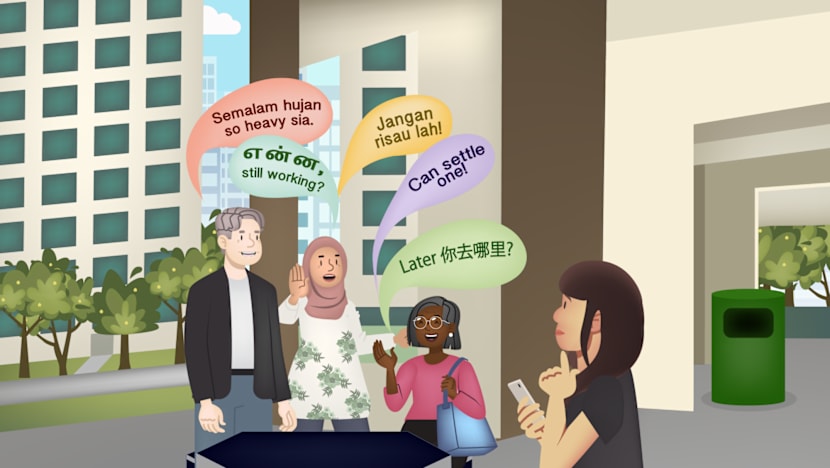
My parents speak at least 3 languages each; I can barely manage my mother tongue. What went wrong?
Key Points
My parents speak at least 3 languages each; I can barely manage my mother tongue. Like her polyglot parents, millennial Jillian Lim has socialised with people of many races and ethnicities all her life. She interrogates why this exposure hasn't made her more proficient with a variety of languages and dialects.
My parents speak at least 3 languages each; I can barely manage my mother tongue. What went wrong?
Like her polyglot parents, millennial Jillian Lim has socialised with people of many races and ethnicities all her life. She interrogates why this exposure hasn't made her more proficient with a variety of languages and dialects.
Growing up, my Hainanese father and Eurasian mother would often switch to Malay whenever they didn't want me and my sister to understand what they were saying.
I remember countless car rides with the two of them rattling away in Malay, mostly gossiping about relatives, friends and neighbours. Evidently, there was quite a lot they didn't want us to know.
Eventually, we began understanding quite a bit of the language despite not having any formal education in it. Even today, if I actively listen to a Malay conversation, I can usually understand the gist of it.
Unfortunately, we never moved on to actually practise speaking Malay, so that's where our linguistic development remains stalled.
"NO ONE TAUGHT ME"
Bilingual education has long been the norm in Singapore, but by 1987, English was established as the main medium of instruction across schools nationwide.
Going to primary and then secondary school in the 1990s and early 2000s, I have several distinct memories of teachers cutting us kids off firmly to remind us: "If you want to speak another language, save it for recess."
But given the diverse nature of the student population in the schools I attended, relying on break times didn't turn out to be much of a strategy for linguistic diversity.
My own group of close friends in primary/secondary school consisted of an Indian girl, a Malay girl, and two more of mixed-race heritage – Indian-Chinese and Chinese-Italian respectively.
Whenever we were all together, we looked like a poster for a Racial Harmony Day campaign.
With all of us studying different mother tongues, we had only English in common. There was almost no opportunity to speak Chinese, Malay or Tamil.
As a young adult, I became close friends with a girl I met through work who was of Malayali and Filipino heritage.
Her official mother tongue was Malay, but because the majority of her friends during her own childhood were Chinese, her Mandarin fluency and articulation far exceeded mine.
I must confess, I felt really inadequate every time she spoke Chinese around me. I had endured 12 whole years of Chinese lessons and tuition classes! How was I so easily outstripped in my own mother tongue by someone with no formal instruction?
To add insult to considerable academic injury, she also understood basic Tagalog and could converse smoothly in Hokkien.
After one evening where she once again left me speechless with her polyglot powers, I went home to do what any mature adult would do: I blamed my father.
Barging in on him dozing off in front of the television, I demanded: "Dad, we're Hainanese. Why didn't you at least teach me Hainanese?"
He remained maddeningly calm and smug. "Why didn't you learn?"
"How would I have learnt if you never taught me?" I cried.
Levelling me with an unimpressed look, my father said: "Jill, no one taught me Malay, Cantonese or the other dialects. I just mixed around with friends."
LANGUAGE, CULTURE AND IDENTITY
Multilingualism seems to be much more of a norm for older Singaporeans compared to those in my generation and younger.
In my experience, it's much more common to find older Gen X and Boomer Singaporeans who grew up speaking – or at least understanding – at least three languages: English, their family language or what we would now call mother tongue, and one other language or dialect picked up from friends, coworkers or neighbours.
Singapore itself hasn't necessarily grown less diverse. I myself have maintained friendships with people of many races and ethnicities all my life.
But, unlike my parents, this exposure hasn't made me more adventurous with languages. I often felt embarrassed when speaking anything other than English.
I even avoided speaking my assigned mother tongue, Mandarin, despite having spent more than a decade studying it.
Many of my peers did this too – replying to Chinese language teachers in English, claiming they didn't understand when food stall operators spoke to them in absurdly simple Chinese.
As I grew into adulthood, I would watch older relatives and their generational peers jump effortlessly between English, Malay, and dialects like Cantonese and Hainanese – and I would wonder if I was "less Singaporean" for not being able to do so.
It felt almost like my cultural identity was limited only to what I could express in English.
LANGUAGE AS SOCIAL SKILL
In his National Day Rally speech on Aug 23, Prime Minister Lawrence Wong encouraged Singaporeans to learn Malay and better appreciate Malay culture.
In the wake of his speech, many conversations were sparked on language learning in Singapore. Amid all the dialogue, I found myself dwelling on two questions:
Firstly, when did multilingualism become something we had to be reminded to embrace? And, more importantly, when did language become so attached to race or ethnicity?
My Hainanese father didn't learn Malay or Cantonese in a bid to boost his employability or socioeconomic standing.
His motivations were purely social: he had friends who spoke Malay and Cantonese. He learnt these simply because people around him spoke it.
He likely also did so to curry favour with the coffee shop aunties who always slipped some extra meat onto his plate when he bust out a well-chosen Malay or Cantonese phrase or compliment.
Language proficiency and cultural identity overlap, certainly. But they are not the same thing.
I would watch older relatives jump effortlessly between English, Malay, and dialects like Cantonese and Hainanese – and I would wonder if I was "less Singaporean" for not being able to do so.
You only have to look at younger Singaporeans to see the proof of this everywhere.
I see plenty of youths voluntarily learning Korean by looking up tutorials and learning resources online, and begging their parents to sign them up for classes.
They don't want an A1 in Higher Korean at the O-Level exams. They just want to understand the lyrics to their favourite K-pop songs, Korean shows and interview clips for which English subtitles may be hard to come by.
CONNECTION, NOT CATEGORISATION
In his National Day Rally speech, PM Wong also warned that Singapore "must not become a monolingual society".
Multilinguists like my parents – and hordes of teen K-pop fans – have taught me a simple but underrated secret: Language thrives most when it is part of everyday life.
If we genuinely want multilingualism to remain core to Singaporean identity, perhaps the shift needs to begin in early childhood.
Now, as a mum of two young children, I find myself wondering: Would it be too much to introduce some elementary Malay into kindergarten curriculums? Not another examinable subject but simple songs, greetings, numbers, food, games and everyday phrases.
As children get older, why not give them opportunities to practise what they've learnt, outside of Racial Harmony Day once a year?
Short courses of Malay classes throughout primary and secondary school, focusing on conversational proficiency rather than written examinations, could go a long way.
The objective behind these efforts shouldn't be producing yet another certificate. It should be producing Singaporeans who aren't afraid to connect with their cultural heritages – both their own and that of their friends.
This, to me, is the true value of encouraging Singaporeans to learn each other's languages.
For those of us long past our schooling days, it's not too late for us to make small efforts in our own daily lives.
Say "terima kasih" instead of "thank you" occasionally. Try ordering food in Chinese even if the stallholder decides to save everyone time by replying in English. Look up the Hokkien phrase your colleague keeps using.
Most importantly, don't let fear of embarrassment or failure prevent us from giving it a shot.
Maybe my father was right after all. You don't have to "learn" – you just have to try.
Jillian Lim has nearly two decades of experience in broadcasting and is now pursuing a degree in business marketing.