
World News
US charity plans to use AI surveillance in Gaza classrooms to monitor ‘hate speech’
Key Points
US charity plans to use AI surveillance in Gaza classrooms to monitor ‘hate speech’ The charity’s broader educational approach has also been challenged by advocacy groups arguing it operates without accountability to local or UN bodies that traditionally oversee Gaza’s schools - Bookmark - CommentsGo to comments Become an Independent member to bookmark this article Already a member? Log in A U.S. charity operating in Gaza plans to record classroom conversations and use artificial...
US charity plans to use AI surveillance in Gaza classrooms to monitor ‘hate speech’
The charity’s broader educational approach has also been challenged by advocacy groups arguing it operates without accountability to local or UN bodies that traditionally oversee Gaza’s schools
- Bookmark
- CommentsGo to comments
Become an Independent member to bookmark this article
Already a member? Log in
A U.S. charity operating in Gaza plans to record classroom conversations and use artificial intelligence to flag speech deemed "hateful" or "inciting," citing concerns that teachers could deviate from a curriculum designed to promote peace and tolerance.
The plans, outlined by the founder of the Gaza Children Village during a webinar last month, have drawn ethical, safety, and privacy concerns from Palestinian organizations, human rights advocates, and at least one of the charity's partner groups.
While there is no evidence suggesting the charity intends to share classroom recordings with third parties, anxieties over potential surveillance misuse remain high in Gaza after three years of war.
The Israeli military has used AI to analyze intercepted communications and identify targets for strikes.
Palestinian advocacy groups have also criticized the charity's broader educational approach, arguing it operates without accountability to local or UN bodies that traditionally oversee Gaza’s schools.
The question of who directs education in Gaza remains one of many unresolved issues surrounding its postwar governance.
It remains unclear when the classroom monitoring will start, what specific words will trigger alerts, or whether teachers, students, and their families have been informed of the strategy.
The charity's founder and CEO is Dr. David Hasan, a neurosurgeon born in Kuwait to Palestinian parents who currently teaches at Duke University Medical School in Durham, North Carolina.
Hasan developed the idea for the charity while volunteering in Gaza hospitals during the war, seeking to break cycles of violence between Palestinians and Israelis.
Hasan noted that he was raised to view Israelis and Jews unfavorably, only encountering alternative viewpoints after attending college in the U.S., perspectives he wants children in Gaza to access early in life.
Funded primarily by individual donors, including American Jews, the charity says it partners with aid organizations and medical institutions across North America, Israel, and Europe.
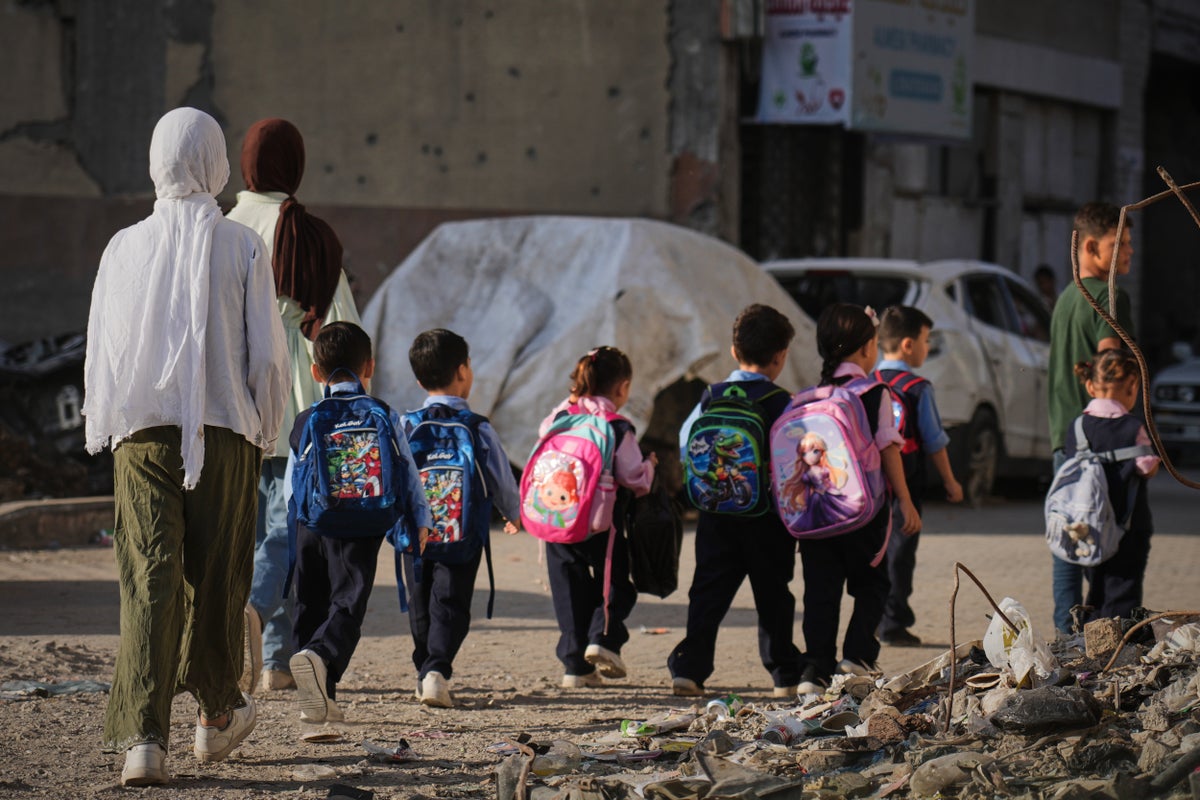
Operating under the name Academies of Hope, its schools offer meals, medical care, and psychological support alongside lessons, having opened its first facility last summer.
Lessons are largely derived from the Palestinian Authority curriculum, though Hasan stated that content glorifying violence or promoting anti-Israel or antisemitic views was excised.
Hasan declined to comment for this story or share examples of modifications to the curriculum.
However, a 2026 report by the U.S. Government Accountability Office evaluating problematic textbook content flagged by the UN in Gaza highlighted issues long cited by Israel, such as using "the number of martyrs" to explain math concepts, referring to "Jerusalem as the capital of Palestine," and citing a youth shot while protesting for Palestinian prisoners in Israeli custody.
Speaking on a webinar with humanitarian organizations last month, Hasan explained that monitoring classrooms aims to help train educators to adhere to a curriculum he previously described as focused on "de-radicalization."
"I know it’s controversial, but trust me, it’s the only way we feel for us to survive and deliver this curriculum," Hasan said.
Such efforts have faced obstacles before. The UN agency for Palestinian refugees, UNRWA, previously sought to modify the Palestinian Authority curriculum to eliminate material conflicting with neutrality, nonviolence, and nondiscrimination, but encountered opposition from teachers and local communities, according to the GAO report.
The system will flag language deemed ‘hateful’
Under the proposal outlined by Hasan, audio from classrooms would be analyzed by AI to detect "antisemitic," "inciting" or "hateful" terms.
If flagged words are detected, an alert goes to Hasan, who can follow up with the instructor to review context and provide feedback, Hasan explained in September.
He said recordings are retained for 72 hours.
The surveillance technology has been tested with plans for deployment across dozens of classrooms, according to a pre-August text message sent by Hasan and reviewed by The Associated Press.
In the text, Hasan claimed the system was built alongside PollyLabs, a New York nonprofit promoting tech solutions in crises. PollyLabs, however, stated it had no role in developing or deploying the technology.
Fear of surveillance is pervasive in Gaza following three years of conflict involving Israel's high-tech military.
"Israel has weaponized information to such a dystopian degree that many Palestinians feel they cannot utter a word, type a thought, or twitch an eye without fearing it could be seized upon," said Amjad Iraqi, senior Israel and Palestinian Territories analyst for the International Crisis Group.
Groups opposing the charity's curriculum argue Palestinians are being deprived of autonomy over their children's education.
"It is very concerning, they’re trying to control the minds of new generations," said Ines Abdel Razek, co-director of the Palestine Institute for Public Diplomacy.
Abdel Razek said support should focus on UNRWA and the Palestinian Authority—which holds limited autonomy in parts of the Israeli-occupied West Bank—to rebuild Gaza’s schools. Israel has alleged UNRWA is infiltrated by Hamas, a claim the agency denies.
Mohammad AbuAlrob, a spokesperson for the Palestinian government, said the Palestinian Authority curriculum emphasizes tolerance and justice. He noted he lacked sufficient information on the charity's curriculum to evaluate it, but stated that installing surveillance in classrooms would cross "an important line."
Fear of retaliation
A staff member at the Gaza Children Village said some teachers and workers fear questioning by Hamas over the curriculum or feel uncomfortable working for an organization backed by Israeli aid entities.
The staff member spoke anonymously due to lack of authorization to speak to media.
Two individuals linked to the charity expressed concern when informed of the monitoring plans.
"Cameras to monitor the performance of students and teachers is acceptable. But cameras to silence students and teachers from being able to have a free exchange in a classroom are not acceptable," said Bishara Bahbah, a Palestinian American political activist on the charity's board.
Bahbah said he was unaware of the monitoring initiative and noted it had not been discussed with the board.
Bahbah emphasized that given the shortage of functioning schools in Gaza, the charity's priority must be placing more children in classrooms.
An official at a partner aid group stated that using cameras could force a reconsideration of their partnership. Employing AI to monitor speech opens a "Pandora’s box," said the official, speaking anonymously for fear of compromising their ongoing work in Gaza.
Six current and former teachers at the Academies of Hope declined to comment.
UNICEF estimates hundreds of thousands of Gaza children are out of school, with most facilities damaged or destroyed in the conflict.
The Gaza Children Village says its schools in central and southern Gaza serve thousands of youth, many who lost family members during the war.
Join our commenting forum
Join thought-provoking conversations, follow other Independent readers and see their replies
Comments