
Politics
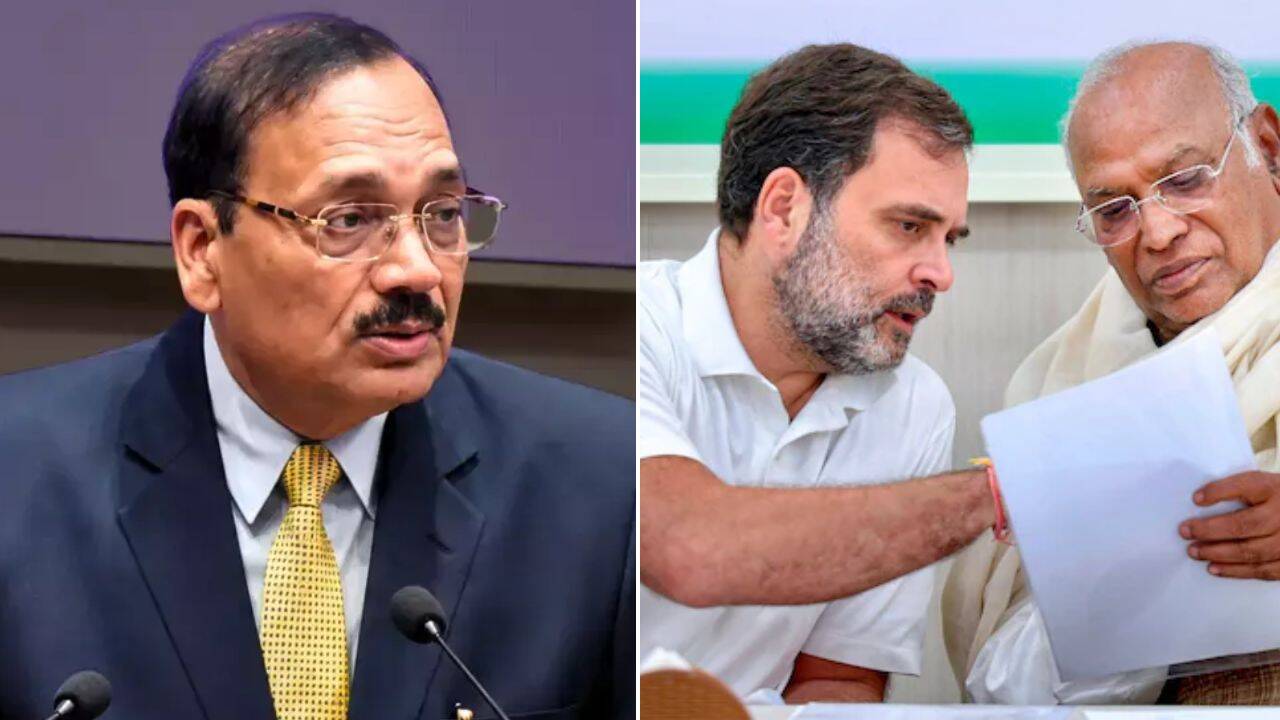
Why CJI Surya Kant declined to meet Rahul, Kharge amid anti-CEC protests
Key Points
CJI Suryakant, Rahul Gandhi and Mallikarjun Kharge NEW DELHI: Chief Justice of India (CJI) Surya Kant had declined a request from Lok Sabha leader of opposition Rahul Gandhi and Rajya Sabha leader of opposition Mallikarjun Kharge for a meeting to discuss issues arising from the ongoing protests in Delhi. He said the matters are already pending before the Supreme Court and discussing them administratively would violate the principle of separation of powers. In a letter dated October 11, the...
CJI Suryakant, Rahul Gandhi and Mallikarjun Kharge
NEW DELHI: Chief Justice of India (CJI) Surya Kant had declined a request from Lok Sabha leader of opposition Rahul Gandhi and Rajya Sabha leader of opposition Mallikarjun Kharge for a meeting to discuss issues arising from the ongoing protests in Delhi. He said the matters are already pending before the Supreme Court and discussing them administratively would violate the principle of separation of powers.In a letter dated October 11, the CJI advised the two Opposition leaders to approach the Supreme Court through the judicial process instead of submitting a memorandum on the administrative side. He also assured them that any petition filed on the issues would be heard at the earliest possible opportunity in accordance with the law.The request concerned allegations of irregularities involving the Chief Election Commissioner (CEC) and the Election Commission of India, alleged arbitrary arrests of students, the closure of metro stations and the cancellation of trains amid protests in the national capital.Explaining his decision, CJI Surya Kant said the issues raised by Gandhi and Kharge were “already sub judice before the Supreme Court of India.”“Therefore, convening a meeting to discuss pending cases would wholly contravene the principle of Separation of Powers, an intrinsic facet of the basic structure doctrine of the Constitution of India, and would be incompatible with the established ethics and judicial propriety,” the CJI said.
He also clarified that the Supreme Court did not have administrative powers to address the concerns raised in their letter, but could examine them through its judicial jurisdiction.“However, in the exercise of our jurisdiction under Article 32 of our Constitution, along with other plenary powers, including that of judicial review, we are duty-bound to consider on the judicial side the gravamen of issues affecting the citizens of India,” he said.The CJI reiterated the Supreme Court’s commitment to protecting citizens’ fundamental rights and said they could seek their enforcement through the legal process.“Supreme Court of India reiterates its commitment to preserve and protect the Fundamental Rights of every citizen of India and they are entitled to seek enforcement of such rights at all hours through the procedure known in law. It would thus be more appropriate on your part to invoke the judicial powers of the Supreme Court of India, instead of submitting a memorandum on the administrative side,” he said.Pointing to the court’s schedule, CJI Surya Kant said matters involving similar issues were listed for hearing on Tuesday, October 13, 2026. He invited the Opposition leaders to file a petition on Monday, either physically or through the court’s e-filing facility.“If so advised, you may submit your petition on Monday, either physically at the Supreme Court of India, between 10:30 A.M. and 04:30 P.M., or alternatively, by utilising the e-filing option, which permits filing at any time and on any day. You have my assurance that any such petition shall be heard at the earliest possible opportunity, in accordance with the law,” he said.Gandhi and Kharge had sought an appointment with the CJI amid Opposition protests demanding the resignation of Chief Election Commissioner Gyanesh Kumar over allegations of electoral irregularities, including what Congress has described as “vote chori”.
Kharge said in a social media post on Sunday that the Opposition would continue its fight and that he and Gandhi had written to the CJI seeking a meeting.“We will continue our fight. Tomorrow, we are also going to meet CJI. I have written a letter, and Rahul Gandhi has also written a letter. We have scheduled a meeting between 4-5pm, during which we will apprise him of the situation... Chaos is being created in the country by home minister and PM, and everywhere an undeclared emergency is imposed,” Kharge said.The CJI’s response leaves the Opposition leaders free to pursue their concerns through a formal petition, with the court indicating that related matters could be taken up through judicial proceedings.
Ayush Pandey is a journalist at The Times of India, covering breaking news, politics, defence, and major legal and policy developments across India and the world. His reporting focuses on elections, national security, and institutional affairs, tracking the decisions and conflicts that shape public life. He specialises in sharp explainers and in-depth feature stories that go beyond headlines to decode political shifts, defence strategy, geopolitical flashpoints, and changing public sentiment. His work combines speed, clarity, and depth for a fast-moving digital audience.