
World News
CNA Explains: How the new Huanggang Port will improve Hong Kong-mainland connectivity
Key Points
CNA Explains: How the new Huanggang Port will improve Hong Kong-mainland connectivity The revamped Huanggang Port becomes the first Hong Kong-mainland China checkpoint to use a joint clearance system, with passengers only having to show their documents once. The revamped Huanggang Port officially opened on Monday (Oct 12) after six years of redevelopment, becoming the first land border checkpoint between Hong Kong and mainland China to use a "joint clearance" system for immigration. Hong...
CNA Explains: How the new Huanggang Port will improve Hong Kong-mainland connectivity
The revamped Huanggang Port becomes the first Hong Kong-mainland China checkpoint to use a joint clearance system, with passengers only having to show their documents once.
HONG KONG: The revamped Huanggang Port officially opened on Monday (Oct 12) after six years of redevelopment, becoming the first land border checkpoint between Hong Kong and mainland China to use a "joint clearance" system for immigration.
Hong Kong’s Chief Executive John Lee on Sunday said the redevelopment of Huanggang Port is a "landmark undertaking built upon the close partnership and concerted efforts between Hong Kong and Shenzhen for joint contribution and shared benefits", according to a government press release.
The South China Morning Post reported that the Hong Kong and Macau Affairs Office said the revamped Huanggang Port is the world's largest single-building land port.
It replaces the older Huanggang Port in Shenzhen, which served Hong Kong residents arriving by shuttle bus or via private vehicle.
CNA explores what's new about the revamped border checkpoint and its importance to Hong Kong, Shenzhen and the Greater Bay Area.
What’s new about the revamped Huanggang Port?
Located in Shenzhen’s Futian district, the redeveloped Huanggang Port is positioned as the most important 24-hour passenger land checkpoint between Hong Kong and Shenzhen, according to Hong Kong’s Security Bureau.
The Lok Ma Chau and Huanggang control points - on Hong Kong's and China's side, respectively - were developed and commissioned in the late 1980s.
Decades on, however, authorities realised that the existing infrastructure provided limited room for expansion. The port was deemed unable to meet the growing demand for cross-boundary passenger traffic in the long run.
In 2019, the Hong Kong and Shenzhen authorities agreed to redevelop Huanggang Port on-site, transforming it into a sprawling multi-storey building.
While the old control point was used for both passenger and cargo clearance, the new Huanggang Port is solely used for passenger clearance.
According to state-affiliated publication China Daily, the new facility is the only land passenger crossing linking Hong Kong and Shenzhen that allows round-the-clock passenger clearance.
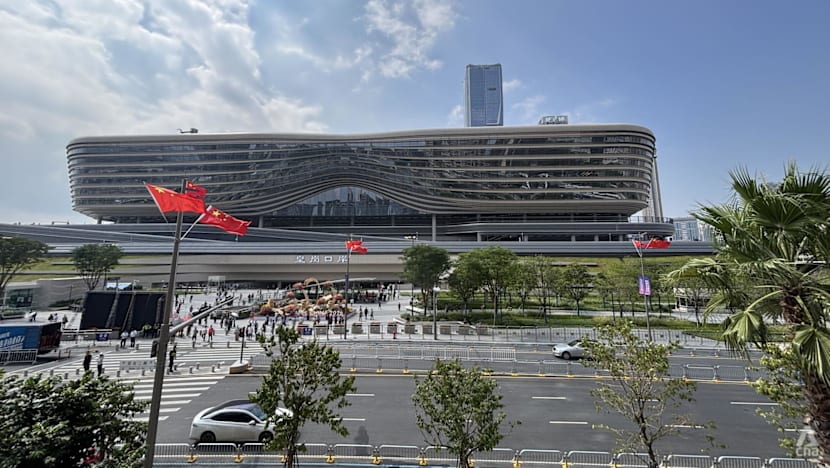
The new nine-storey building has a total floor area of nearly 690,000 sq m - a substantial increase from the 140,000 sq m at the old port, which began service in 1989.
The lower levels play the role of public transport interchanges, eliminating the need for the old cross-boundary shuttle buses and allowing direct access by franchised bus services - privately operated public buses running under government-granted franchises.
Previously, passengers arriving via public transport would have to take shuttle buses from the San Tin public transport interchange in Lok Ma Chau to Huanggang Port.
How does the new immigration system work?
The new Huanggang Port is the first land checkpoint between Hong Kong and Shenzhen to adopt the "collaborative inspection and joint clearance" mode, which combines two immigration checks - Hong Kong and mainland China - into one at a single checkpoint.
Passengers now wait in one line and are only required to show their documents once.
This replaces the old two-stop process where they were required to queue at the immigration checkpoints on either side of the border.
Under the new immigration system, both local governments have set up automated channels or counters within their respective jurisdictions at Huanggang Port.
When using the automated channels, passengers will only need to queue up once for document inspection and identity verification to complete the immigration procedures.
According to the Hong Kong Security Bureau, the time it takes to clear immigration at the new Huanggang Port has been significantly reduced - from 30 minutes to about five minutes.
For drivers, the clearance time is expected to be cut from 10 minutes to two minutes, the South China Morning Post reported.
Hong Kong’s Customs and Excise Department has introduced a “joint one-stop” system where departing vehicles undergo an initial customs risk assessment before entering the newly designed three-gate vehicle lanes.
The lanes are equipped with “integrated information collection devices” that simultaneously conduct body temperature checks, document scans and biometric data collection.
Vehicle drivers only need to present a single identity document to complete the “five-party inspection”, without having to leave their vehicles.
The data is collected by five agencies, including the immigration and customs agencies of both Hong Kong and Shenzhen and the Hong Kong Department of Health.
How do travellers get to Huanggang Port?
Travellers from Hong Kong can get to Huanggang Port via franchised bus services, green minibuses, cross-border coaches and taxis.
However, due to space constraints, no public car parks are available at the port.
For travellers in Shenzhen, public transport options from Huanggang Port include Shenzhen Metro’s Line 7, taxis and buses.
According to South China Morning Post, a high-speed intercity railway linking Shenzhen, Guangzhou and Dongguan will be connected to the new Huanggang Port in the future.
Currently, the redeveloped Huanggang Port is expected to handle about 200,000 passenger trips per day. However, this may be increased to about 300,000, with the commissioning of the Northern Link Spur Line by Hong Kong’s MTR Corporation.
According to MTR, the main Northern Link line will connect the existing East Rail Line and the Tuen Ma Line in Hong Kong, forming a railway loop in the northern New Territories.
Meanwhile, the Spur Line will provide direct connections between Hong Kong and Shenzhen - from the planned San Tin station in Lok Ma Chau to the revamped Huanggang Port.
Why is Huanggang Port important to Hong Kong and the Greater Bay Area?
Hong Kong's Lee has said that the official opening of the redeveloped Huanggang Port shows that connectivity within the Greater Bay Area has reached a new level.
It serves as a "faithful demonstration promoting ‘hard connectivity’ in infrastructure, fostering 'soft connectivity' of rules and mechanisms, and achieving ‘connectivity of hearts’ between the residents of mainland China and Hong Kong", Lee said.
One Hong Kong legislator, Chan Siu-hung, told China Daily in September that a seamless flow of people is vital for advancement within the Guangdong-Hong Kong-Macao Greater Bay Area.
The previous hassles that commuters experienced, such as long walks between checkpoints, shuttle transfers and queues at immigration counters, could stretch journeys to one or two hours, discouraging cross-boundary travel.
The vast reduction in clearance time could be extended to other ports if it proves successful, he said.
Former member of Hong Kong's Legislative Council Tam Yiu-chung told China Daily that having a port open around the clock removes time constraints.
"This is crucial for boosting the flow of people, logistics and capital - the lifeblood of the Greater Bay Area. The result is that many Hong Kong workers living in Shenzhen will benefit immensely."
The revamped Huanggang Port will also boost travel between Hong Kong and mainland China, said Ringo Lee, honorary life president of the Hong Kong, China Automobile Association.
The revamped port will make travelling back and forth between Hong Kong and Guangdong more convenient for pedestrians and drivers, he added.
Meanwhile, Huang Chuping, chairman of the Standing Committee of the Guangdong Provincial People's Congress, said he hoped Huanggang Port would develop into a benchmark for modern international ports, helping Guangdong expand channels for integrated development with Hong Kong and apply its experience to promote broader cross-boundary innovation.
CNA (LOCATION)
Huanggang Port (LOCATION)
Hong Kong (LOCATION)
China (LOCATION)
Hong Kong’s (LOCATION)
John Lee (PERSON)
Shenzhen (LOCATION)
The South China Morning Post (ORG)
Macau Affairs Office (ORG)
the Greater Bay Area (LOCATION)
Futian (LOCATION)
Security Bureau (ORG)
The Lok Ma Chau (PERSON)
Huanggang (LOCATION)
Hong Kong's (LOCATION)