
Science
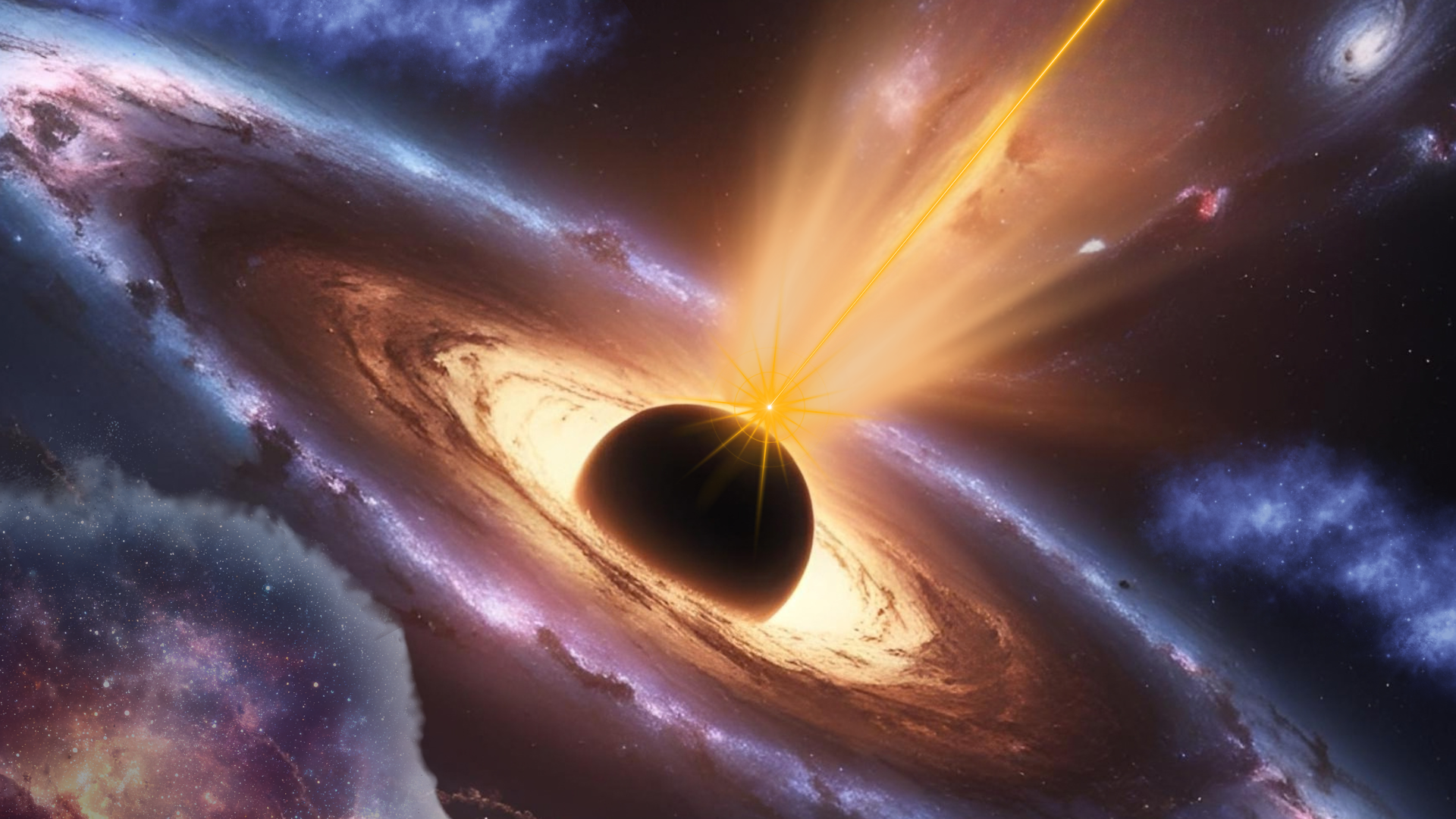
Astronomers witness supermassive black hole gorge on a cosmic meal before 'burping' radio jets 300 days later
Key Points
Astronomers witness supermassive black hole gorge on a cosmic meal before 'burping' radio jets 300 days later "NGC 1275 reveals the impact of black hole jets on large spatial scales better than any other system." Using the NASA X-ray spacecraft Swift combined with radio observations, astronomers have observed a supermassive black hole burping radio jets 300 days after a heavy cosmic meal. The team was also able to roughly estimate the mass of this feeding cosmic titan, which sits at the...
Astronomers witness supermassive black hole gorge on a cosmic meal before 'burping' radio jets 300 days later
"NGC 1275 reveals the impact of black hole jets on large spatial scales better than any other system."
Using the NASA X-ray spacecraft Swift combined with radio observations, astronomers have observed a supermassive black hole burping radio jets 300 days after a heavy cosmic meal. The team was also able to roughly estimate the mass of this feeding cosmic titan, which sits at the heart of the Perseus Cluster, a massive collection of thousands of galaxies.
The black hole sits at the center of the galaxy NGC 1275, located around 225 light-years away, and is the brightest galaxy of the Perseus Cluster. The supermassive black hole first flared in X-rays, which indicated an increase in the rate at which it was accreting matter. Actively feeding supermassive black holes sit in regions called active galactic nuclei (AGNs), with their immense gravity heating surrounding matter, causing them to glow brightly. These emissions are boosted by material channeled to the poles of the central black hole, from where it is blasted out as powerful twin jets that shine across the electromagnetic spectrum, particularly in radio waves.
The observation of the following radio jet from the AGN at the heart of NGC 1275 via flaring in radio waves is crucial for understanding the relationship between the disk of matter that surrounds and feeds the black hole, called an accretion disk, and the jets it launches. This so-called disk-jet coupling is key to developing a better picture of how black holes influence star formation in the galaxies in which they sit, and thus the growth of those galaxies.
Making these observations is no mean feat. The ideal spacecraft for observing X-ray emissions is Chandra, but it doesn't observe NGC 1275 frequently enough to observe its long-term behaviour. NASA's Neil Gehrels Swift Observatory may lack the power of Chandra, but having launched in 2004, it has collected a vast amount of data regarding NGC 1275 and its central supermassive black hole.
"It is fairly difficult to see the inner region of this AGN because NGC 1275 is at the center of the massive Perseus cluster of galaxies, which adds additional light to our observations," team leader Sarah Ketchum of the University of Michigan told Space.com. "We developed a model that allowed us to remove the cluster emission from archival Swift data, and in doing so, we were able to see the changes in the X-ray flux from gas accreting onto the black hole in NGC 1275, from 2007 to 2025."
Ketchum added that the capabilities of Swift were key to this investigation of NGC 1275, which is the ideal laboratory for the study of disk-jet coupling.
"There have been studies on other galaxies with AGN that show evidence of coupling between gas accretion traced in X-ray light and gas ejection in jets, traced in radio light. But NGC 1275 reveals the impact of black hole jets on large spatial scales better than any other system," the University of Michigan researcher continued.
This black hole didn't eat a star
Ketchum and colleagues saw the strongest ever X-ray flare from NGC 1275 in Feb. 2023. Lasting less than 60 days and consisting of two 5-day blasts, this episode saw a doubling of the X-ray brightness of the AGN at the heart of NGC 1275.
The flaring was so extreme that the team had to rule out a tidal disruption event (TDE) as the cause. These occur when an unfortunate star's orbit brings it too close to the immense gravitational influence of a supermassive black hole. This influence generates intense tidal forces that simultaneously squash and squeeze the star, "speghettifying" it and allowing the black hole to snack on some plasma pasta.
"We were able to rule out TDEs as a cause," Ketchum said. "Thus, the flaring was likely caused by a spike in the rate at which matter accreted onto the black hole."
Using Swift data, the team was able to infer the radius over which the AGN emits radiation. Because the size of a black hole is directly correlated with its mass, this meant that the researchers were able to constrain the mass of the black hole at the heart of NGC 1275. They determined that this supermassive black hole has a mass somewhere between 100 million times the mass of the sun and 1 billion solar masses.
The team then compared their data to known radio data to better understand the relationship between the X-ray emission and the radio jets that disrupt gas in NGC 1275.
Ketchum added that she and her colleagues found tentative evidence of around a 300-day delay between the X-ray flaring and the radio wave emission. This indicates the time it takes plasma to travel from the base of the jet to a knot or shock created when it hits surrounding gas or dust.
"This should be tested further in the future. Our X-ray data only sparsely sample the changes in NGC 1275," Ketchum said. "This makes it difficult to determine an exact relationship between the X-ray and radio radiation for large portions of our light curve, so we would need more X-ray data to further study this connection."
The researcher added that if the X-ray flares are produced close to the black hole, an echo of these flares should be seen coming from the accretion disk.
"An emission line from neutral iron is seen in data from NGC 1275, and this may be the echo. However, we likely need many observations with XMM-Newton and XRISM ( X-Ray Imaging and Spectroscopy Mission) to really establish that connection," Ketchum concluded.
The team's research has been accepted for publication in the Astrophysical Journal Letters, with a pre-peer-review version available on the repository site arXiv.
Robert Lea is a science journalist in the U.K. whose articles have been published in Physics World, New Scientist, Astronomy Magazine, All About Space, Newsweek and ZME Science. He also writes about science communication for Elsevier and the European Journal of Physics. Rob holds a bachelor of science degree in physics and astronomy from the U.K.’s Open University. Follow him on Twitter @sciencef1rst.
You must confirm your public display name before commenting
Please logout and then login again, you will then be prompted to enter your display name.