
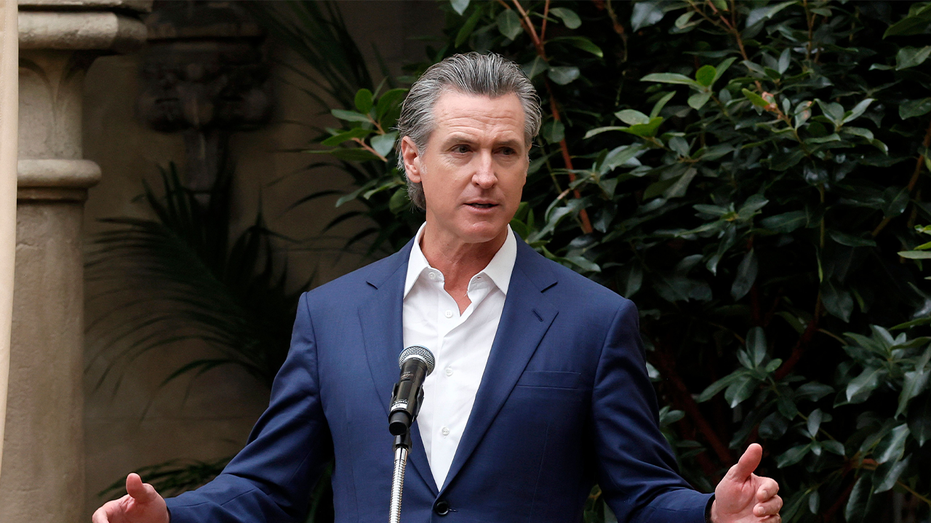
California advocacy groups are celebrating a "big, important victory" in their push for state-level reparations after Gov. Gavin Newsom signed a first-in-the-nation bill requiring large corporations to investigate and disclose historical ties to chattel slavery.
Kristin Nimmers, policy and campaign manager for the California Black Power Network (CBPN) and the Alliance for Reparations, Reconciliation, and Truth, told Fox News Digital that Newsom’s signature on Assembly Bill 2599 — the Truth in Disclosure Act — marks a significant milestone for corporate accountability.
"There are connections right now from slavery to current wealth of individuals and current wealth of corporations whose foundation and who built — the start of their companies off of slavery and off of benefits gained from slavery," Nimmers said.
Newsom signed AB 2599 into law on Sept. 30, a move Nimmers called a "historic moment" that forces qualifying businesses operating in California to scour historical records and publicly disclose slavery-era transactions.
California was the first state in the nation to establish a formal task force to study the legacy of slavery and recommend potential restitution measures.
"The California Reparations Task Force spent years documenting the state's role in perpetuating racial harm and outlining this path toward repair," Nimmers said. "AB 2599 is really starting the work of identifying who really benefited from this racial harm and from slavery."
Authored by Assemblymember Isaac Bryan, D-Ladera Heights, the law applies to businesses with more than $100 million in annual worldwide gross receipts that existed — or had a predecessor entity in operation — on or before Dec. 31, 1964.
Once funded by the state legislature, covered companies will be required to submit sworn affidavits under penalty of perjury to the California Civil Rights Department.
These disclosures must detail any historical involvement in the purchase or sale of enslaved people, the use of enslaved human beings as loan collateral, slave-related insurance policies, and other financial transactions. Covered entities have until Jan. 15, 2029, to submit their initial filings.
CASH PAYMENTS ARE NOT 'RULED OUT' AS CALIFORNIA COUNTY OFFICIALS PUSH REPARATIONS FOR BLACK LOCALS
The progressive governor's signing of AB 2599 comes despite his cautious stance on broader, high-cost reparations initiatives.
Most recently, Newsom vetoed Assembly Bill 2186, which would have exempted future state reparations payments from California's personal income tax. The bill's author, Assemblymember Tina McKinnor, D-Inglewood, told Fox News Digital on Friday that the veto was disappointing.
Newsom has also consistently resisted direct cash payments, which state task force recommendations estimated could cost millions per eligible recipient. He previously turned down a broader slate of cash-focused reparations measures backed by the California Legislative Black Caucus.
However, Newsom did approve state funding for California universities to research and establish verification methods for descendants of enslaved Americans to determine potential eligibility for future noncash benefits.
Despite those legislative setbacks, Nimmers remains optimistic about the future of reparations in the Golden State, noting that CBPN plans to leverage AB 2599 as momentum to turn the task force’s broader recommendations into law.
"It helps us move the work of the task force from recommendations toward implementation," Nimmers said. "This is really an important, big victory for our alliance and for our work with reparations task force members, but it is also just one step in a much greater movement and effort that we're trying to be a part of."
The California Black Power Network is a statewide coalition composed of 48 Black-led and Black-serving organizations operating across 14 California counties. Bringing together grassroots organizations focused on housing, education, and criminal justice reform, CBPN was established to combat systemic racism through policy advocacy and community organizing.
Central to the network’s mission is reparative justice. CBPN frames present-day economic disparities — including educational gaps, wealth inequality, and systemic injustice —as direct consequences of historical harms stemming from chattel slavery, segregation, and Jim Crow practices.
During the multi-year tenure of the California Task Force to Study and Develop Reparation Proposals for African Americans (established under AB 3121), CBPN served as an official state community anchor. The coalition facilitated grassroots civic engagement across California, hosting listening sessions to gather public testimony that directly informed the task force’s landmark 1,100-page final report issued in 2023.
With AB 2599 now on the books, CBPN is focused on expanding its grassroots base to push for full implementation.
"AB 2599 really represents a historic step toward corporate transparency and accountability," Nimmers said.
"We know for generations, corporations and financial institutions have really benefited from slavery and from the exploitation of Black people. AB 2599 is starting to establish a process for qualifying corporations doing business in California to really examine and disclose any historical ties they've had to slavery. This matters because we can't fully and meaningfully repair harms if we're not really willing to acknowledge and confront the truth," she added.
"When we're thinking about what repair looks like," she said, "it's important that we're tying it back to what the origin of it was so we can address those core issues."
Elsewhere in the country, localized reparations programs have moved forward with mixed success.
Black residents in Evanston, Illinois, received $25,000 housing grants as part of a municipal program aimed at rectifying historic housing discrimination. Similar local and municipal initiatives seeking to provide direct compensation or economic aid are being debated nationwide.