
Education
Malaysia’s haze-related school closures leave parents scrambling to keep children on track for exams
Key Points
Malaysia’s haze-related school closures leave parents scrambling to keep children on track for exams Uncertainty over when schools in Malaysia would reopen has caused inconvenience, parents tell CNA. The authorities can help by prioritising device loans for low-income families and having flexible work arrangements for parents, says an expert. Outside housewife Jacques Meena Micheal’s terrace home in Johor’s Pasir Gudang district, a thick haze lingers and the smell of acrid smoke is pervasive.
Malaysia’s haze-related school closures leave parents scrambling to keep children on track for exams
Uncertainty over when schools in Malaysia would reopen has caused inconvenience, parents tell CNA. The authorities can help by prioritising device loans for low-income families and having flexible work arrangements for parents, says an expert.
JOHOR BAHRU: Outside housewife Jacques Meena Micheal’s terrace home in Johor’s Pasir Gudang district, a thick haze lingers and the smell of acrid smoke is pervasive.
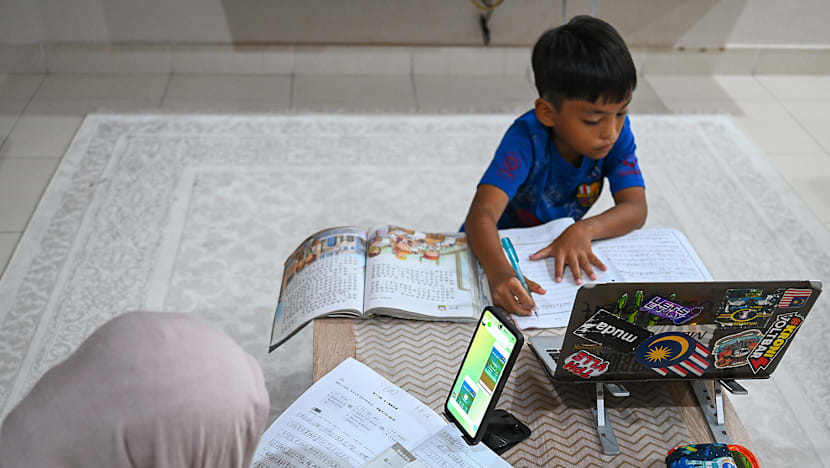
Inside, the 35-year-old has a different problem on her hands - keeping her five children focused on their lessons with just three electronic devices and a patchy internet connection.
The siblings are learning from home after Johor ordered schools and educational institutions across the state to remain closed until at least Oct 16 due to transboundary haze caused by widespread land and forest fires in Indonesia.
“It’s difficult for them to study because the internet connection where I live isn’t very good. They also have to share three phones among five of them to log in to e-lessons,” said Jacques.
“Some of them are falling behind, but they still have to complete their assignments because the teachers expect them to submit their work on time.”
Four of her children, aged 8 to 14, attend SJK(C) Ladang Grisek, a government-funded Chinese vernacular school and one of thousands of schools in Johor that have been shut since last Thursday (Oct 8). Jacques' youngest, aged 5, is in preschool, which has also been shut.
The closures were made in deference to the Regent of Johor, according to a state representative, and it is unclear when normal classes will resume.
Schools in Negeri Sembilan, Melaka, Selangor and Kuala Lumpur have also closed intermittently in recent days.
Under federal guidelines, educational institutions must close when the Air Pollutant Index (API) exceeds 180, or remains above 150 for three consecutive days. Both levels fall within the “unhealthy” range.
For parents like Jacques, the closures have brought a difficult trade-off: Minimising their children’s exposure to unhealthy air while trying to ensure their education does not suffer, particularly with year-end examinations approaching.
Some parents have also questioned whether Malaysia’s closure threshold is too cautious. They pointed to East Malaysia’s Sarawak state where, in August, schools were required to close when the API exceeded 200.
In Singapore, the Ministry of Education has said schools may close if the country’s Pollutant Standards Index (PSI) reaches the “hazardous” range of 300.
Taufiq, a father in Shah Alam, Selangor, told CNA the bigger problem is the day-to-day uncertainty.
He believes Malaysia could be “more realistic” about its closure threshold to minimise missed classroom time.
“I think the uncertainty of whether there is school tomorrow or not – that is difficult to manage,” said Taufiq, who asked to be identified only by his first name.
“My wife and I are both working, so we also have to manage who can stay home with our nine-year-old son.”
Education Minister Fadhlina Sidek has said the government’s day-to-day approach to school closures takes into account fluctuating air quality as well as the disruption prolonged closures can cause to students’ learning.
Health experts CNA spoke to said Malaysia’s thresholds are based on local health advice and must account for the risks posed by prolonged exposure to unhealthy air.
“The education minister has acknowledged that prolonged closures disrupt learning and must be weighed against health risks. But this does not mean the threshold (for school closure) should be (lowered),” said Malaysian public health expert Zainal Ariffin Omar.
“It means the focus should be on making e-learning more effective and ensuring indoor air quality in schools is actually adequate.”
EXAMS POSTPONED, PREPARATIONS DISRUPTED
A key concern of parents is that school closures, if prolonged, could disrupt their children’s preparations for year-end examinations.
Mother-of-three Arinee Nuranni said keeping her primary school-aged sons focused at home has left her “exasperated”, particularly when video games are only a distraction away.
“In school, they are afraid of their teachers. They will do their schoolwork and attend lessons diligently, but doing this online at home is just not the same,” said the 33-year-old, who runs a home-based business in Johor Bahru.
The disruption comes at a particularly critical time for her eldest son, 12, who has his religious school UPKK examinations in November. The assessment tests pupils on the Quran and other aspects of Islamic education, and will help determine the religious studies module he specialises in.
“It can’t be denied that his preparations are impacted. He is a bit weak in his religious studies and this is a crucial period to prepare him for the exams,” Arinee said.
For Jacques’ family, the haze has already disrupted an examination.
Her third child was due to sit the final paper of his Year 4 Learning Matrix Examination last Thursday, but the Chinese-language paper was postponed indefinitely after schools closed.
“Before this, he was hungry and determined to be ready for his final paper, but now with all the uncertainty, it’s challenging to keep him motivated,” she said.
A survey by the Johor Parents, Community and Private Sector Involvement Association found that more than 70 per cent of primary school pupils and 30 per cent of secondary school students in Johor did not participate in e-learning during the recent closures.
Yahya Jaafar, chairman of the association, told news outlet Utusan Malaysia the percentage for primary school pupils was mainly due to limitations faced by working parents and a lack of devices and guidance at home.
He suggested schools reopen with everyone required to wear masks while in class, and students restricted from being in open spaces, Free Malaysia Today reported.
The authorities could take steps to ease the disruption of school closures by prioritising device loan programmes for low-income families and considering flexible work arrangements for parents of young children, said public health expert Zainal.
“Schools should also conduct regular check-ins for students who miss sessions to prevent learning gaps from widening,” he said.
BALANCING HEALTH AND LEARNING
The federal government’s decision to change the API threshold for school closures has also raised questions.
On Oct 9, Anglican Bishop of Sarawak and Brunei Danald Jute noted the revision was made only after haze began affecting Peninsular Malaysia and called it a “glaring and unacceptable double standard”.
Experts said the authorities ultimately face a balancing act: Protecting children from harmful haze while minimising disruption to their education.
“Ultimately, the safety of the children here is the key issue, and the aim is to minimise harmful haze particles from affecting them,” said Malaysia observer James Chin, a professor of Asian Studies at the University of Tasmania.
Johor’s decision could have been influenced by concerns from the palace, he said.
Zainal, a former president of the Malaysian Association of Public Health Physicians, backed the federal government’s decision to close schools when the API exceeds 180, noting that children are particularly vulnerable to air pollution. This is because their lungs are still developing.
“Their airways are narrower, and they breathe faster – inhaling more pollutants per unit of body weight than adults,” he said, adding that haze exposure can increase the risk of respiratory infections, asthma attacks and eye irritation.
Zainal also cautioned against directly comparing Malaysia’s closure threshold with Singapore’s, saying the countries use different air quality frameworks and health advisories.
There are differences in categorisation and corresponding health measures between Malaysia’s API and Singapore’s PSI.
“In Singapore’s framework, PSI 300 is not the trigger to start protecting students. It is the final escalation when even indoor mitigation fails to be enough,” Zainal said.
“Before PSI 300, schools (would have) already implemented heavy protective measures.”
For mother-of-five Jacques, however, the concern is how long the disruption will last.
While she understands the need to protect her children’s health, she said the uncertainty over when schools will reopen has left her frazzled.
“I keep checking the API reading, and I saw that it’s still high today,” she said.
“On the one hand, I worry for the children’s health when it’s high … but if the threshold goes below 150, I’m hopeful they can resume school.”
Malaysia (LOCATION)
CNA (LOCATION)
Jacques Meena Micheal (PERSON)
Johor (LOCATION)
Pasir Gudang (LOCATION)
Indonesia (LOCATION)
Jacques (PERSON)
Ladang Grisek (PERSON)
Chinese (ORG)
Negeri Sembilan (LOCATION)
Melaka (LOCATION)
Selangor (LOCATION)
Kuala Lumpur (LOCATION)
API (ORG)
East Malaysia’s (LOCATION)