
Weather
Extreme rain, overwhelmed drains: Why Bangkok flooded and what could have been avoided
Key Points
Extreme rain, overwhelmed drains: Why Bangkok flooded and what could have been avoided Thailand has strengthened its flood defences since the catastrophic 2011 disaster, but recent extreme rainfall has exposed persistent weaknesses in drainage, urban planning and water management, say experts. BANGKOK: Wandee Kerdsai’s noodle shop sits on an island of dry ground, surrounded by the remnants of Bangkok’s recent floods. After being forced to close for 15 days, the aroma of her simmering tom yum...
Extreme rain, overwhelmed drains: Why Bangkok flooded and what could have been avoided
Thailand has strengthened its flood defences since the catastrophic 2011 disaster, but recent extreme rainfall has exposed persistent weaknesses in drainage, urban planning and water management, say experts.
BANGKOK: Wandee Kerdsai’s noodle shop sits on an island of dry ground, surrounded by the remnants of Bangkok’s recent floods.
After being forced to close for 15 days, the aroma of her simmering tom yum soup once again drifts across the street corner where the 62-year-old has set up shop for years.
Late last month, almost continuous torrential rainfall engulfed Thailand’s capital and overwhelmed its drainage systems, causing widespread flooding in multiple parts of the city.
More than 300mm fell in just 48 hours from Sep 24 to Sep 26, prompting an emergency to be declared in all 50 districts.
Approximately 329,000 households - around 700,000 Bangkok residents - were affected, according to a government assessment in the aftermath.
“The warning came too late. By the time they told us flooding was coming, the water was already rushing in. We didn't have time to prepare or save anything,” Wandee said.
In some low-lying areas, the water is yet to fully recede. And communities and experts alike have expressed concern not only about authorities’ capacity response to this event but also the risks of future disasters supercharged by climate change overwhelming Bangkok’s limited infrastructure.
Wandee’s small kitchen is back open. But her community in Lat Krabang on the city’s low-lying eastern fringe is still in the grip of dislocation and inconvenience.
The district’s housing estates, canals and urban sprawl sit on naturally flood-prone terrain, where the limits of the city’s drainage infrastructure is tested when the skies open. Flood levels reached more than 1m here during its peak, despite the installation of more water pumps as an immediate response by city officials.
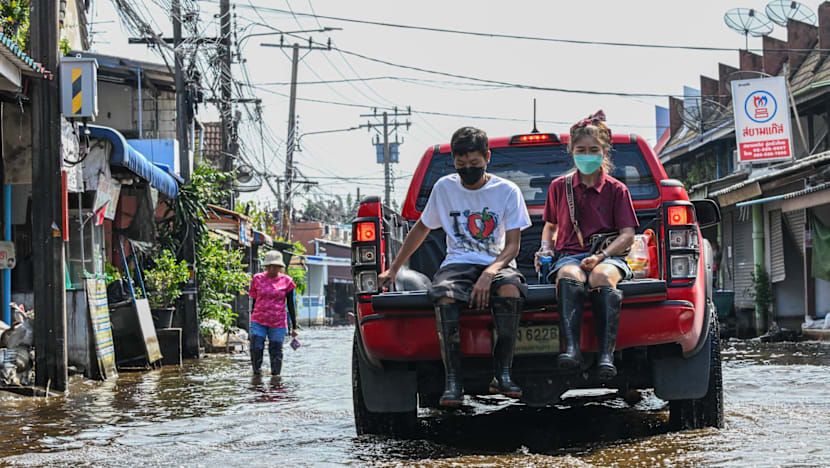
A fortnight on, small waves ripple and splash in the passing traffic. Deeper down residential streets, water still reaches the shins of residents making regular quests out of the flooded neighbourhood and out to dry ground for supplies.
Elderly people wearing gumboots are among them, clutching goods in plastic bags, some hitching rides on the back of pickups or lifting up their ankles on the back of motorcycles idling slowly through the deluge.
“The water just isn't going down. It has flooded the entire area beneath our houses and buildings, making it almost impossible for people to move around or even get back into their homes,” said Nongnoot Kerdsai, 55, a factory worker who lives in the area.
“Life has been extremely difficult, especially for families with elderly people or bedridden patients who can't move easily.”
Sandbags lie helplessly, futile obstacles to the hard rain that massed here late last month. The intense sun does little to evaporate the murky waters, which by now carry a briny smell, akin to seaweed washed up on a beach.
“I've lived through floods before, but this is the worst I've seen in this area,” said Phrot Choicharuek, 50, a local labourer wading along the street.
AN "EXCEPTIONAL" EVENT
Once called the “Venice of the East” for its reliance on a canal network more extensive than the iconic Italian fluvial city, Bangkok’s concrete development has largely filled its floodplains, hampering the ability to absorb rain and river flows from the north.
Over the past few weeks, the problem has extended far beyond the megacity. By Oct 12, flooding had affected 51 provinces and about 908,000 households.
Nationally, flooding has been “exceptional for its geographical extent, persistence and number of communities affected”, said Thanapon Piman, a senior research fellow at the Stockholm Environment Institute in Bangkok.
He said repeated rainfall left catchments saturated and river systems swollen, while high tides made it harder for floodwater to drain to the sea.
For many, the emergency situation drew comparisons with 2011, when monsoon rains and tropical storms triggered widespread flooding across northern and central Thailand. Then, large parts of Bangkok's outskirts remained inundated for weeks or months and 815 people died across the country.
This time, however, the flooding was different, experts explained. Bangkok's main driver was extreme local rainfall, rather than enormous volumes of water arriving from upstream down the Chao Phraya river and its tributaries as in 2011.
“This was not a single nationwide extreme event ... It’s extremely heavy and prolonged rainfall in some areas,” said Nuchanart Sriwongsitanon, a professor at the Department of Water Resources Engineering at Kasetsart University.
If such heavy rain was to occur again in the future alongside high river flows and high tides she warned of devastating effects that the country was not prepared for.
“There is a higher future risk from compound events. If everything happens at the same time, we will face problems for sure,” she said.
NOT DESIGNED TO COPE
For centuries, Bangkok has expanded across land where water naturally gathers and passes through.
Sitting low in the Chao Phraya basin and close to the Gulf of Thailand, the capital must now engineer the movement of water through a landscape dramatically altered by urban development.
Landscape architect Kotchakorn Voraakhom said Bangkok has shifted from a water-based to land-based city over the past half century, losing about half of its estimated 3,000 canals and its “porous capacity”, while becoming heavily dependent on pumps and concrete drainage.
“We still rely on a very outdated way of thinking of how to live with water,” said Kotchakorn, the chief executive officer of Porous City Network, a social enterprise that looks to increase urban resilience in Southeast Asia
Climate change is raising the stakes too, from rising seas at the city’s edge to heavier storms and increasingly volatile rainfall.
The consequences reach far beyond flooded homes and streets. Millions of lives, major centres of economic activity and the infrastructure and ecosystems that sustain them are increasingly exposed.
Preliminary estimates have put the economic losses from Thailand's late-September floods in the tens of billions of baht, with Bangkok bearing a disproportionate share. One Rangsit University assessment estimated economic losses of 25.3 billion baht (US$780 million) nationwide over just four days.
Urban expansion in and around the capital has filled natural flood-retention areas and drainage routes with roads, buildings and industrial development, said Nuanchan Singkran, associate professor at the Faculty of Environment and Resource Studies at Mahidol University.
“At the same time, Bangkok’s infrastructure was not designed to cope effectively with flooding on this scale,” she said.
Nuchanart said several factors kept the water from draining quickly: overwhelmed drains, high canal levels, local bottlenecks, low-lying terrain and continued rainfall.
Using a simplified calculation, Nuchanart estimated that Bangkok's reported pumping capacity alone would theoretically need three to four days to remove the runoff generated by 300mm of rain.
Bangkok’s Metropolitan Authority said pumping stations and floodgates were operating at full capacity throughout the emergency period, although major canals remained high because they were receiving water from surrounding districts.
But many drainage systems and canals are known to be obstructed with rubbish or other materials, reducing their effectiveness, Nuanchan said.
In Lat Krabang, local residents complained that clogged drains, construction debris and inadequate pumping were factors prolonging flooding in their area, well beyond that time scale.
“Instead of leaving us to deal with flooding on our own, the government should fix the problem,” Wandee said. “They should also make sure construction sites don't allow sand and debris to wash into the drains. Otherwise, this will just keep happening again and again.”
They also said flood warnings came only after water was already rushing in.
“When the weather department warns about heavy rain, officials should already be bringing in pumps and getting ready to drain the water. They shouldn't wait until everything is flooded,” Phrot said, adding that people in his community were already planning for the future by keeping extra food at home and considering raising their houses higher.
“I know flooding is partly a natural disaster, but I think poor water management has made things much worse,” he added.
Bangkok Governor Chadchart Sittipunt publicly acknowledged that issuing accurate flood warnings was difficult because of the precision required in rainfall forecasting.
He also explained that delays in issuing warnings were linked to difficulties predicting rainfall accurately.
The experts interviewed by CNA did not suggest that Bangkok could have avoided flooding altogether during such intense rainfall. But they said earlier warnings, better-maintained drainage and more coordinated water management could have reduced the damage and disruption.
Nuchanart said that improved modelling to identify inundation areas and depths in advance could at least allow residents to move vehicles and belongings and authorities to prepare responses.
“Of course, we can do something if we get our act together,” she said.
LIVING WITH WATER AND UNCERTAINTY
Following the devastation of the 2011 floods, Thailand implemented many changes to its flood management systems and infrastructure.
It established 12 central plains flood-retention areas, and upgraded canals, embankments and diversion projects in flood-prone areas. Bangkok raised sections of its Chao Phraya flood walls by around 0.5m and also expanded pumps, canals and drainage.
Thanapon said it also took positive steps through infrastructure, monitoring, forecasting and institutional reforms, but added that questions remain about whether improvements have actually produced effective basin-wide coordination.
He said that “fragmented decision-making and insufficient coordination” between upstream water regulation and downstream flood protection can limit the effectiveness of other measures.
He also warned that infrastructure designed around past rainfall patterns may not be adequate for more extreme conditions in the future.
“Uncertainty must be incorporated into planning,” he said.
Nuchanart advocated for stronger land-use and floodplain management, nature-based solutions, better forecasting and more integrated water governance.
For Kotchakorn, Bangkok needs to make a more philosophical shift, something inspired by its past instead of depending solely on pumps, tunnels and concrete drainage.
“This is not romanticised. This is about a reality that we need to accept that we're going to get wet. Right now, it's still business as usual,” she said.