
Science
Ancient Indigenous people in New Mexico lived through extreme climate change 23,000 years ago, study suggests
Key Points
Ancient Indigenous people in New Mexico lived through extreme climate change 23,000 years ago, study suggests Researchers have revealed the climate that some of the first people in North America experienced around 23,000 years ago, during the Last Glacial Maximum. Some of the first people in North America lived through extreme climate change at the peak of the last ice age, a new study suggests. Researchers studied ancient pollen locked in rocks at White Sands National Park in New Mexico,...
Ancient Indigenous people in New Mexico lived through extreme climate change 23,000 years ago, study suggests
Researchers have revealed the climate that some of the first people in North America experienced around 23,000 years ago, during the Last Glacial Maximum.
Some of the first people in North America lived through extreme climate change at the peak of the last ice age, a new study suggests.
Researchers studied ancient pollen locked in rocks at White Sands National Park in New Mexico, which houses an archaeological site thought to contain the oldest human footprints in the Americas. The researchers previously dated those footprints to around 21,000 to 23,000 years ago, though their age is the subject of some scientific debate because they are significantly older than other Indigenous sites in the Americas.
The new findings, published Wednesday (Oct. 14) in the journal Science Advances, suggest that humans kept using White Sands after temperatures warmed and thus saw the landscape undergo rapid changes during the coldest era of the last ice age, known as the Last Glacial Maximum (26,500 to 19,000 years ago).
"It's remarkable that early humans in the region were real-time witnesses to a rapidly changing environment discernible within a human lifetime — that is really food for thought," study co-author Kathleen Springer, a research geologist at the U.S. Geological Survey, said in a statement.
The White Sands footprints suggest that people from Asia reached the Americas via the region around the Bering Strait much earlier than scientists initially thought, challenging a long-held assumption that humans arrived on the continent around 13,000 years ago. While some scientists have disputed the methods used to date the footprints, evidence is building that they are around 23,000 years old.
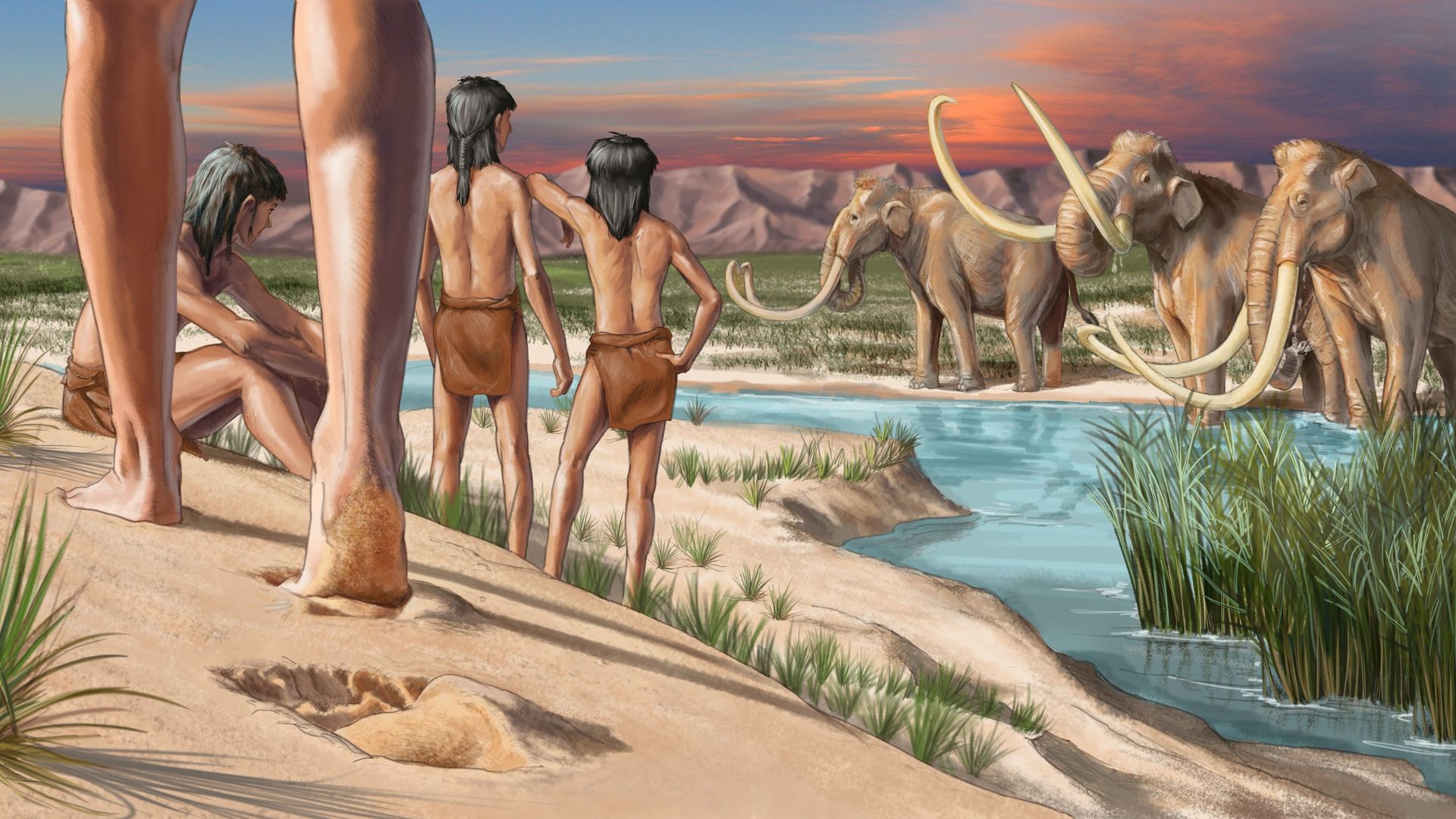
White Sands contains footprints from various time periods, including footprints of a caregiver and a toddler who were there 10,000 years ago. Over thousands of years, people trudged across the New Mexico landscape alongside iconic ice age animals, including mammoths and giant ground sloths. The researchers have also discovered sled-like drag marks alongside ancient footprints at White Sands, providing evidence for a kind of travois — a wooden frame made from two poles bound together — that people likely would have used for transporting goods.
By looking at ancient pollen for the new study, researchers could deduce which plants grew across the millennia when humans lived in the area. The site's rock samples also contained waxes from plant leaves, membrane lipids from bacteria, and other organic molecules that helped the researchers better understand the environmental conditions of the time.
Get the world’s most fascinating discoveries delivered straight to your inbox.
The analysis revealed that around 24,200 years ago, White Sands had a large lake and its surrounding mountains were coated in conifer trees (Pinus, Abies, and Picea). Then, over the next two millennia, temperatures rose, the lake began to shrink, and the conifer trees were replaced by oak trees (Quercus) and sagebrush, according to the statement.
RELATED STORIES
- Inuit figurine: A 700-year-old Indigenous carving of a European made a century before Columbus
- 'It gives us a glimpse of a different kind of Viking life': Archaeologist Neil Price on the sea-kings, sorcerers and Sámi who lived during the Viking Age
- Ancient Egyptians sacrificed pharaohs' servants so they could continue to serve their king in the afterlife, new study finds
"Throughout these periods of change, the people continued to visit and live in this area," study co-author Sally Reynolds, a paleoanthropologist at Bournemouth University in the U.K., said in the statement. "The sediments containing their footprints show us their environment changed significantly within individual human lifetimes."
The researchers speculated that people might have returned to White Sands at different times to benefit from the changing climate, with a shrinking lake potentially providing higher concentrations of animals and plants. However, while the footprints document that humans were present, they reveal little about their behavior.
"The footprints give us a snapshot of the people who lived there over 20,000 years ago," Reynolds said. "But they are not a continuous movie of their lives. They are individual frames — showing moments when humans, mud, water and chance came together."
Springer, K. B., Pigati, J. S., Tierney, J. E., Honke, J. S., Jiménez-Moreno, G., Bustos, D., Urban, T. M., Odess, D., Jolie, E. A., Smith, A. J., Hunt, A. J., Martinez, P. J., Santucci, V. L., Reynolds, S. C., & Bennett, M. R. (2026). Humans experienced abrupt environmental changes at White Sands during the Last Glacial Maximum. Science Advances, 12(4). https://doi.org/10.1126/sciadv.aeh0707
Patrick Pester is the trending news writer at Live Science. His work has appeared on other science websites, such as BBC Science Focus and Scientific American. Patrick retrained as a journalist after spending his early career working in zoos and wildlife conservation. He was awarded the Master's Excellence Scholarship to study at Cardiff University where he completed a master's degree in international journalism. He also has a second master's degree in biodiversity, evolution and conservation in action from Middlesex University London. When he isn't writing news, Patrick investigates the sale of human remains.
You must confirm your public display name before commenting
Please logout and then login again, you will then be prompted to enter your display name.
New Mexico (LOCATION)
Ancient Indigenous (ORG)
North America (LOCATION)
the Last Glacial Maximum (EVENT)
White Sands National Park (LOCATION)
Americas (LOCATION)
Science Advances (ORG)
White Sands (ORG)
Kathleen Springer (PERSON)
the U.S. Geological Survey (ORG)
Asia (LOCATION)
the Bering Strait (LOCATION)
Pinus (ORG)
Abies (LOCATION)
Picea (PERSON)