
Education
Cornell president admits he never read police findings on alleged gang rape during tense faculty meeting: report
Key Points
Cornell president admits he never read police findings on alleged gang rape during tense faculty meeting: report Cornell University President Michael Kotlikoff faced angry members of the school’s faculty Wednesday - Bookmark Become an Independent member to bookmark this article Already a member? Log in Cornell University's president faced an angry confrontation with faculty members Wednesday over his administration's handling of allegations that a female student was gang raped by fraternity...
Cornell president admits he never read police findings on alleged gang rape during tense faculty meeting: report
Cornell University President Michael Kotlikoff faced angry members of the school’s faculty Wednesday
- Bookmark
Become an Independent member to bookmark this article
Already a member? Log in
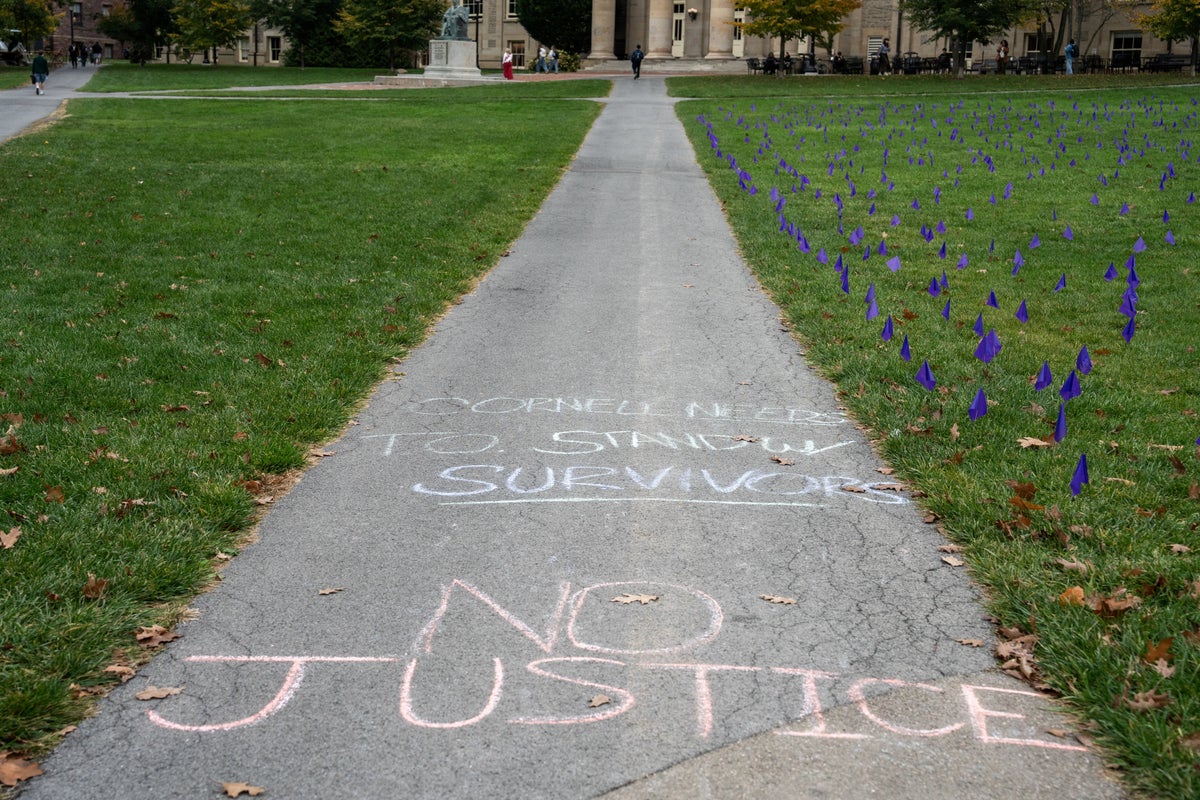
Cornell University's president faced an angry confrontation with faculty members Wednesday over his administration's handling of allegations that a female student was gang raped by fraternity members, as calls for a vote of no confidence in his leadership intensified.
Michael Kotlikoff acknowledged mistakes but defended his record during a tense Faculty Senate meeting, where professors questioned whether he was capable of addressing sexual assault allegations on campus.
During the meeting, Kotlikoff reportedly admitted he had not read the Cornell Police Department's report concerning the allegations.
The meeting was closed to reporters, but an audio recording obtained by The Associated Press captured Kotlikoff urging faculty to give him more time to introduce reforms and change the culture surrounding student social life.
He argued that Cornell needed experienced leadership to confront problems “that are not simplistic, they’re not easy, they can’t be brushed aside with a wave of a hand.”
Removing him would not solve the university's problems and could damage its reputation, he warned.
Kotlikoff also raised the possibility of sweeping restrictions on fraternities, saying the university needed to determine whether Greek life could operate safely.
“If, at the end of the day, fraternities cannot exist in a safe environment and we can’t be convinced that they can be safe, then we should make that decision,” he said.
He insisted that any decision should be based on research and evidence, not emotion.
On Tuesday, Kotlikoff announced a ban on fraternity parties through the end of the academic year, one of several measures introduced amid mounting criticism of the university's response to sexual assault allegations.
But his assurances appeared to do little to satisfy some faculty members.
“The faculty were extremely angry. They gave him a hard time, I think appropriately so,” government professor Richard Bensel said after the meeting.
President admits he never read police report on alleged gang rape
The controversy erupted after a woman identified in court documents as Jane Doe filed a lawsuit last month alleging that seven members of Cornell's Chi Phi fraternity sexually assaulted or exploited her in October 2024.
All seven men have denied the allegations, maintaining either that their encounters were consensual or that they were not involved.
A criminal investigation by Cornell's police department stalled after the local district attorney quickly determined that no crime had occurred.
Kotlikoff initially described the allegations as “deeply disturbing,” suspended the fraternity and announced that criminal and university investigations were underway.
He also established a presidential task force to examine Cornell's handling of sexual assault.
However, in an interview with The New York Times published Tuesday, the university president acknowledged that he had never followed up to discover what had happened to the woman or the criminal investigation.
During Wednesday's meeting, a faculty member pressed him on whether he had read the Cornell Police Department's report concerning the allegations.
Kotlikoff admitted he had not.
He defended that decision by citing the confidentiality of criminal investigations and university policies intended to prevent senior administrators from interfering in police work.
“I really reject the idea that I had no interest in it or was not concerned about it,” he said.
Kotlikoff disputed suggestions that he was unaware students had been expelled or suspended following the university's Title IX investigation.
He did acknowledge, however, that he had only recently learned the woman had dropped out of Cornell.
The revelations have intensified scrutiny of the university's handling of the allegations and prompted faculty members to question whether the administration has taken the wider problem of campus sexual assault seriously enough.
Professors turn on university leadership
After Kotlikoff left Wednesday's meeting, faculty members voiced frustration with the administration, though some cautioned against rushing into a no-confidence vote.
“The institution is split in significant ways,” said Grant Farred, a professor of Africana Studies and English.
He described a divide between humanities faculty, who believed they already had enough information to act, and colleagues in the sciences who wanted more evidence.
Iris Packman, a research and policy expert at Cornell's Climate Jobs Institute, said Kotlikoff appeared “defensive” during the questioning.
Labor history professor Paul Ortiz, who sponsored the no-confidence resolution, said the debate reflected concerns that Cornell's leadership was failing to confront “a perpetual ongoing crisis.”
Anne Marie Brady, a senior extension associate at Cornell's School of Industrial and Labor Relations, welcomed the university's decision to temporarily transfer investigations of sexual assaults from campus police to state police.
But she questioned why the change was announced just one day before the Faculty Senate debate.
Discussion of the no-confidence resolution is expected to resume October 28, with faculty members subsequently voting electronically.
Although the vote would be largely symbolic, it could increase pressure on Cornell's trustees, who have ultimate authority over the university's leadership.
Professor says reporting sexual harassment nearly destroyed her career
Among the faculty members expressing outrage was Ariana Kim, a Grammy-nominated violinist and associate professor of music.
Kim described Kotlikoff's admission that he had not followed up on the woman's case as “appalling.”
She told the AP that she had experienced bullying and sexual harassment from senior colleagues after joining Cornell about a decade ago.
According to Kim, the university failed to properly document her complaints and never clearly explained whether it took disciplinary action against those involved.
“I was asked what I had done to provoke the situation,” she recalled.
Kim said her attempts to avoid colleagues she accused of harassment subsequently became an issue during her tenure review.
In one instance, she said, a professor who voted against granting her tenure cited her refusal to accept his advice and her efforts to avoid him.
Her account added to concerns among some faculty members about how Cornell responds to complaints of sexual misconduct and protects those who report it.
Kotlikoff, who became interim president in July 2024 before taking the position permanently in 2025, has faced a series of controversies during his leadership.
Those include a strike by dining and custodial workers, criticism of the university's $60 million settlement of Trump administration civil rights investigations, and accusations from campus activists that his administration restricted protests.
The latest confrontation leaves him facing a potentially damaging faculty rebuke as Cornell continues to grapple with the fallout from the woman's lawsuit and questions about its handling of sexual assault allegations.