
Business & Finance
How AI guidance can help SMEs navigate cross-border trade
Key Points
With customers in more than 220 countries and territories, global shipping and logistics provider DHL has seen firsthand the trade compliance challenges businesses face when expanding internationally. Against a backdrop of shifting geopolitical dynamics and macroeconomic uncertainty, businesses must navigate evolving trade regulations, sanctions, export controls and customs requirements, as well as a growing number of free trade agreements (FTAs), said Mr Chee Yaw Chek, vice president...
With customers in more than 220 countries and territories, global shipping and logistics provider DHL has seen firsthand the trade compliance challenges businesses face when expanding internationally.
Against a backdrop of shifting geopolitical dynamics and macroeconomic uncertainty, businesses must navigate evolving trade regulations, sanctions, export controls and customs requirements, as well as a growing number of free trade agreements (FTAs), said Mr Chee Yaw Chek, vice president (commercial) at DHL Express Singapore.
Despite shifting trade policies and restrictions, global trade remained resilient in 2025, according to the DHL Global Connectedness Tracker. Mr Chee also pointed to opportunities in intra-Asia trade as companies diversify their supply chains and expand into new markets across the region.
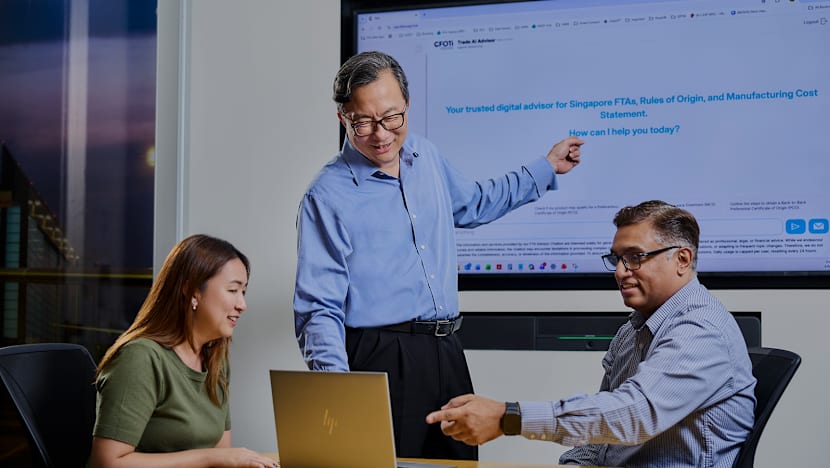
Trade AI Advisor helps businesses navigate trade requirements. (Video: Singapore Business Federation)
But entering new markets also brings practical questions around trade requirements. “Many of our customers approach us for guidance when exploring new markets,” he said. “They often have questions about market entry, duties and tariffs, and FTAs. Understanding how these affect international trade is important for managing risk and business continuity.”
Large companies may have dedicated trade and compliance teams to manage complex cross-border requirements. But small- and medium-size enterprises (SMEs) may have to spread the work across finance, operations or procurement teams that are already stretched, noted Mr Wayne Yap, CEO of Singapore Manufacturing Federation (SMF).
“These documentation bottlenecks can mean more administrative work, delays and costs,” he said. “They can also make it harder for smaller businesses to assess trade opportunities when exploring new export markets. For more complex questions, they may still need to seek specialist advice.”
To help Singapore businesses navigate cross-border trade, the Centre for the Future of Trade and Investment (CFOTI) at Singapore Business Federation (SBF) launched Trade AI Advisor (TAIA) at the Future of Trade Forum 2026 in September.
SCALING ACCESS TO TRADE GUIDANCE
Powered by generative artificial intelligence (AI), TAIA provides practical guidance on trade agreements, tariffs, market access, customs and documentation requirements, rules of origin and manufacturing cost statements. It helps businesses identify the information, rules and supporting documents that may apply, before seeking further specialist advice where needed.
Mr Heng Peng Kwang, executive director of CFOTI, said TAIA aims to make relevant trade information easier to search, understand and apply to specific business questions, reducing the need to consult multiple sources. TAIA is expected to provide 24/7 advisory support to 30,000 companies in Singapore, helping them navigate trade requirements as they expand internationally.
For example, before entering a new regional market, a Singapore manufacturer may need to determine its product’s Harmonised System code, the applicable tariff, the required origin documentation and whether the product qualifies for preferential treatment under an FTA.
TAIA also helps businesses work through more structured requirements, such as preparing a manufacturing cost statement to assess whether a product may meet the relevant origin criteria under an FTA. This helps businesses understand not only what information is needed, but also the steps and supporting inputs involved.
Businesses can enter these questions into TAIA, which provides responses with citations to curated trade data sources from SBF and its partners. These include SMF, an authorised organisation for issuing Ordinary Certificates of Origin.
“This gives businesses greater traceability, so they can understand where the information comes from and refer to the relevant sources when navigating requirements,” said Mr Yap.
COMBINING AI WITH HUMAN EXPERTISE
TAIA combines AI guidance with human expertise, with more complex trade queries escalated to specialists when needed.
“TAIA doesn’t replace professional judgment,” said Mr Heng. “It helps a company frame its question, identify the rules and requirements that may apply and see the sources behind the response.”
For example, a company may be assessing whether a product meets a specific rule of origin when production takes place across several countries and involves multiple manufacturing steps. TAIA can help identify the relevant agreements, rules and supporting information.
If further confirmation is needed, the matter can then be referred to an adviser at CFOTI or the relevant authority.
DHL was among the industry partners that tested TAIA. It drew on real-world questions from customers to assess how the platform addressed common concerns around market entry, duties, tariffs and FTAs, Mr Chee said TAIA could be especially useful for SMEs, which may have limited resources or in-house expertise to keep pace with changes in the global trade landscape.
TAKING TAIA TO THE REGION
TAIA’s reach is not limited to enterprises in Singapore. In July, at the Singapore-Indonesia Leaders’ Retreat, SBF and the Indonesian Chamber of Commerce and Industry (KADIN Indonesia) signed a two-year memorandum of understanding (MOU) to help SMEs in Indonesia trade more easily across borders. One of the first initiatives under the MOU is TAIA-ID, a version of the platform being localised for Indonesian businesses ahead of its launch later this year.
TAIA-ID is being developed in Bahasa Indonesia and designed for mobile access. It will provide guidance based on Indonesia’s trade agreements in areas such as tariff eligibility, rules of origin, export procedures and market access, with complex queries referred by email to trained trade advisers. Its first phase will focus on export-oriented horticulture enterprises.
The initiative combines the digital platform with support from trained KADIN Indonesia trade advisers, SME outreach and pilot export shipments, extending the programme’s reach while retaining access to human expertise.
“As Singapore assumes the ASEAN Chairmanship in 2027, we see an opportunity to work with ASEAN partners to adapt this approach for their markets, so SMEs across the region can more easily access support to trade and expand regionally,” said Mr Heng.
DHL (ORG)
Chee Yaw Chek (PERSON)
DHL Express Singapore (ORG)
the DHL Global Connectedness Tracker (ORG)
Chee (PERSON)
Asia (LOCATION)
Singapore Business Federation (ORG)
Wayne Yap (PERSON)
Singapore Manufacturing Federation (ORG)
Singapore (LOCATION)
the Centre for the Future of Trade and Investment (ORG)
SBF (ORG)
Trade AI Advisor (ORG)
the Future of Trade Forum (ORG)
Heng Peng Kwang (PERSON)