
Politics
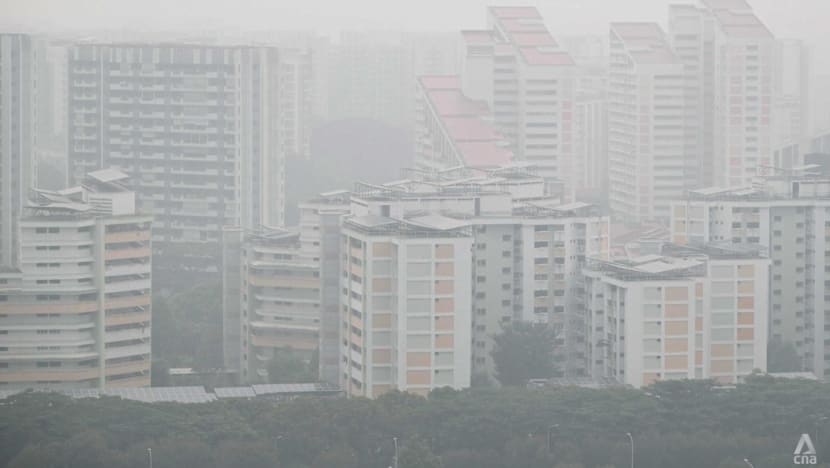
Legal action by Singapore against haze-causing firms in Indonesia may come with diplomatic implications: Lawyers
Key Points
Legal action by Singapore against haze-causing firms in Indonesia may come with diplomatic implications: Lawyers Minister for Sustainability and the Environment Grace Fu said Singapore will send preventive measure notices to seven companies in Indonesia responsible for fires causing the current haze. Singapore can take legal action against companies responsible for the ongoing haze situation, but there could be diplomatic implications, legal experts told CNA this week.
Legal action by Singapore against haze-causing firms in Indonesia may come with diplomatic implications: Lawyers
Minister for Sustainability and the Environment Grace Fu said Singapore will send preventive measure notices to seven companies in Indonesia responsible for fires causing the current haze.
SINGAPORE: Singapore can take legal action against companies responsible for the ongoing haze situation, but there could be diplomatic implications, legal experts told CNA this week.
The actions that Singapore can take are provided in the Transboundary Haze Pollution Act, said Associate Professor Jolene Lin of the National University of Singapore (NUS).
The Act came into force in 2014 and allows authorities in Singapore to hold companies responsible for causing or contributing to haze pollution in Singapore, even if the activities took place overseas.
On Friday (Oct 16), Minister for Sustainability and the Environment Grace Fu said Singapore will send preventive measure notices to seven companies in Indonesia responsible for fires causing the current haze.
The notices will require the recipient company to deploy firefighting personnel to extinguish or prevent the spread of any fire on land it owns or occupies, among other requirements.
Ms Fu also warned that the air quality in Singapore may deteriorate further and reach hazardous levels.
Taking legal action is not simply a legal decision, said Assoc Prof Lin, who is also director of the Asia-Pacific Centre for Environmental Law.
She noted that when Singapore previously tried to use the Act in 2015, there was some unhappiness in Indonesia.
"There were cries that Singapore was infringing upon Indonesia's sovereignty with this Act by trying to issue enforcement notices outside its jurisdiction," she said.
International law is "very clear" that Indonesia can do as it wishes with its natural resources as long as it does not cause harm to those outside its territory, said Assoc Prof Lin.
Being on the receiving end of harmful effects from the ongoing forest fires in Indonesia grants Singapore the right to use its own laws to tackle the issue, she said.
"The decision to do so, however, has diplomatic implications," she said.
Singapore Management University's Michelle Lim also highlighted the political sensitivities of Singapore taking legal action against companies operating in the territory of a "close and powerful neighbour".
The associate professor of law noted that Singapore does have jurisdiction – but with any moves made, how they are then perceived by Indonesia is another matter, she said.
DIFFICULTIES IN PURSUING RECOURSE
Ms Fu also said on Friday that past cases have given the government a better understanding of the practical challenges of investigating transboundary haze offences, and that it will learn from those cases as it assesses the current haze episode and the steps to take.
Investigations into four companies that began in 2015 are still ongoing, the NEA said this week, underscoring difficulty in taking action under the Act.
“It is not easy, I will be the first to admit, but we must try,” she said. “We must try in order to protect Singaporeans, try whatever that is within our control to bring the best outcome for Singapore, even if it may not be so effective.”
Assoc Prof Lim said there can be difficulty in establishing causation – or proving that conduct by a company caused the haze in Singapore.
"Due to the principle of sovereignty, Singapore's capacity to obtain this information depends on the extent to which Indonesia facilitates or even allows the fact-finding to occur," she said.
Mr Wilson Ang, partner at global law firm Norton Rose Fulbright, said the relevant data that Singapore needs would include air quality readings, satellite hotspot and smoke-plume data, as well as wind and weather data.
"Singapore may need to coordinate with other countries to obtain data to identify the parties involved and ascertain the causation links," he said.
If the companies are within the jurisdiction of Singapore, there would be a "direct nexus" that can expose them to enforcement action, added Mr Ang.
Directors and senior management of agri-plantation companies should take steps internally to investigate and obtain assurance that they are not responsible for or contributing to the haze, he said.
If they are, they should remediate the situation as best they can, he said. "Otherwise, legal liability, reputational damage and the inability to secure financing and investments may ensue," he added.
Singapore (LOCATION)
Indonesia (LOCATION)
Grace Fu (PERSON)
CNA (LOCATION)
Jolene Lin (PERSON)
the National University of Singapore (ORG)
Sustainability (ORG)
Ms Fu (PERSON)
Assoc Prof Lin (ORG)
the Asia-Pacific Centre for Environmental Law (ORG)
Singapore Management University's (ORG)
Michelle Lim (PERSON)
NEA (ORG)