
Science
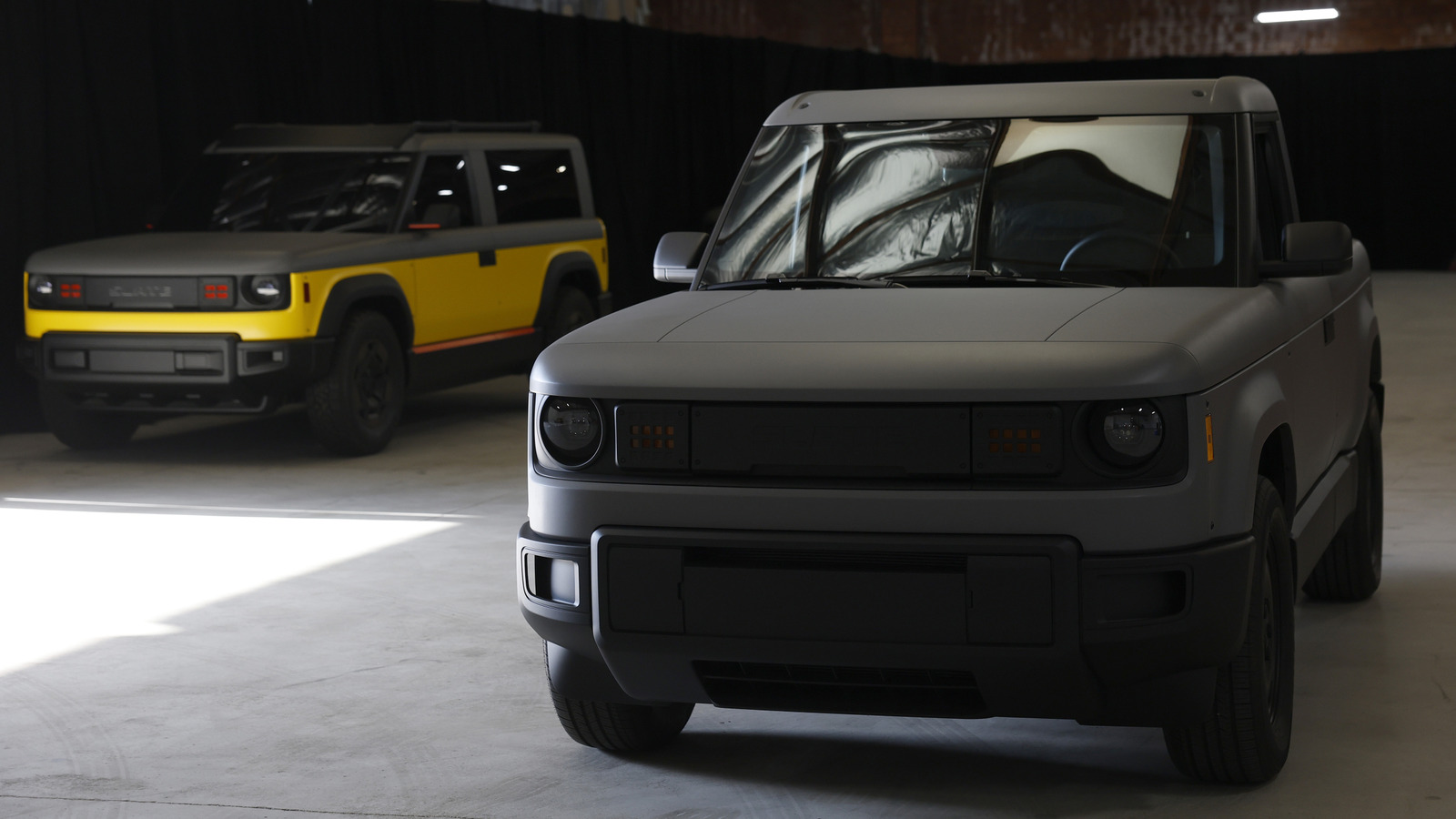
You might be surprised by how much the Slate truck can carry
Key Points
You might be surprised by how much the Slate truck can carry Don't underestimate this compact pickup. The perpetual cry of the growing number of EV fans is that most models are too expensive here in North America. A compact like the temporarily revived Chevy Bolt starts at $27,600 before any upgrades, and naturally, a lot of drivers need more passenger or cargo space.
You might be surprised by how much the Slate truck can carry
Don't underestimate this compact pickup.
The perpetual cry of the growing number of EV fans is that most models are too expensive here in North America. A compact like the temporarily revived Chevy Bolt starts at $27,600 before any upgrades, and naturally, a lot of drivers need more passenger or cargo space. An EV like the Rivian R2 might as well be a Ferrari in an economy where house ownership is a major hurdle.
Enter the Slate truck, shipping toward the very end of 2026. It not only starts at $24,950, but it also offers one of the most popular form factors in the US: the pickup truck. You do have to spend more than that if you want basic creature comforts, yet that price tag is actually better than most gas-guzzling alternatives. The cheapest Ford F-150 starts north of $40,000 — so even an upgraded Slate could be a smarter financial decision.
Naturally, a question potential buyers are going to have is how much cargo such a cheap truck can possibly carry. The answer is surprisingly reassuring, even if Slate isn't going to be replacing Ford or Dodge on the most demanding construction sites with the likes of a 2,000-pound towing limit.
The scoop on the Slate's towing and payload specs
Let's cut to the chase. The Slate has a 5-foot-long truck bed, capable of holding 35.1 cubic feet, assuming you don't install any mods to extend usable area. That's shorter than the 5.5-foot bed on the cheapest 2026 F-150, and shallower too, since the F-150 supports up to 52.8 cubic feet. The EV also has considerably smaller towing and payload ratings, coming in at 2,000 and 1,550 pounds, respectively, versus the Ford's 13,500- and 2,440-pound figures.
That's hardly the whole story, though, as you can probably guess. For one thing, the Slate has a sizable frunk, adding another 7 cubic feet. Gas trucks lack frunks, since that's where the engine is located. More importantly, a better comparison point is other compact pickups, rather than something a landscaping contractor might park when they're about to redo your entire front lawn.
Viewed in that light, the Slate is very competitive. The base 2026 Ford Maverick for instance is largely on par, equipped for 1,500-pound payloads and 2,000 pounds of towing capacity. It actually has a shorter truck bed, measuring 4.5 feet. For the average person's supply runs at Home Depot, a Slate is the better choice. Especially since you're not going to be spending hundreds of dollars on inflated gas prices.
This sort of vehicle could be a godsend for drivers who just have the occasional heavy load, such as bikes, PEVs, furniture, moving boxes or camping equipment. People do often buy SUVs for that reason, yet the Slate is cheaper than many of them, and a truck bed is clearly easier to load and unload. Besides, you can configure the Slate as an SUV if you're determined to get that form factor.
The upgrade and battery efficiency problems
The thing that may kill the Slate's appeal for cargo and towing among some drivers is a problem with any electric truck, and that's a massive drop in range. Consider the Rivian R1T, which with the Adventure Quad-Motor Large Pack gets up to 328 miles. If you exploit its 11,000-pound maximum towing capacity, range drops 50 percent to about 164 miles. The Slate has a maximum range of 205 miles under good conditions, so realistically, you may be looking at 100 miles or less if you're towing at its 2,000-pound limit. If you fill up the bed with cargo instead, range could still drop by as much as 25 percent, if the F-150 Lightning is anything to go by.
Regardless, the Slate is also extremely barebones in its default configuration, as we mentioned earlier. Even an integrated speaker is a paid add-on, never mind things like lifting or dropping the suspension. To meet your exact needs, you'll almost certainly be spending over that $24,950 entry price. SUV startup packs can easily start north of $30,000, though thankfully, pickups tend to be cheaper.
We'll have to wait for post-launch testing to truly judge the Slate's hauling capacity. At the moment, all we can say for certain is that if you can deal with the range hit and jettisoned luxuries, the EV appears to go toe to toe with other compact pickups. If you can keep the price low, it may be worth it.