
Politics
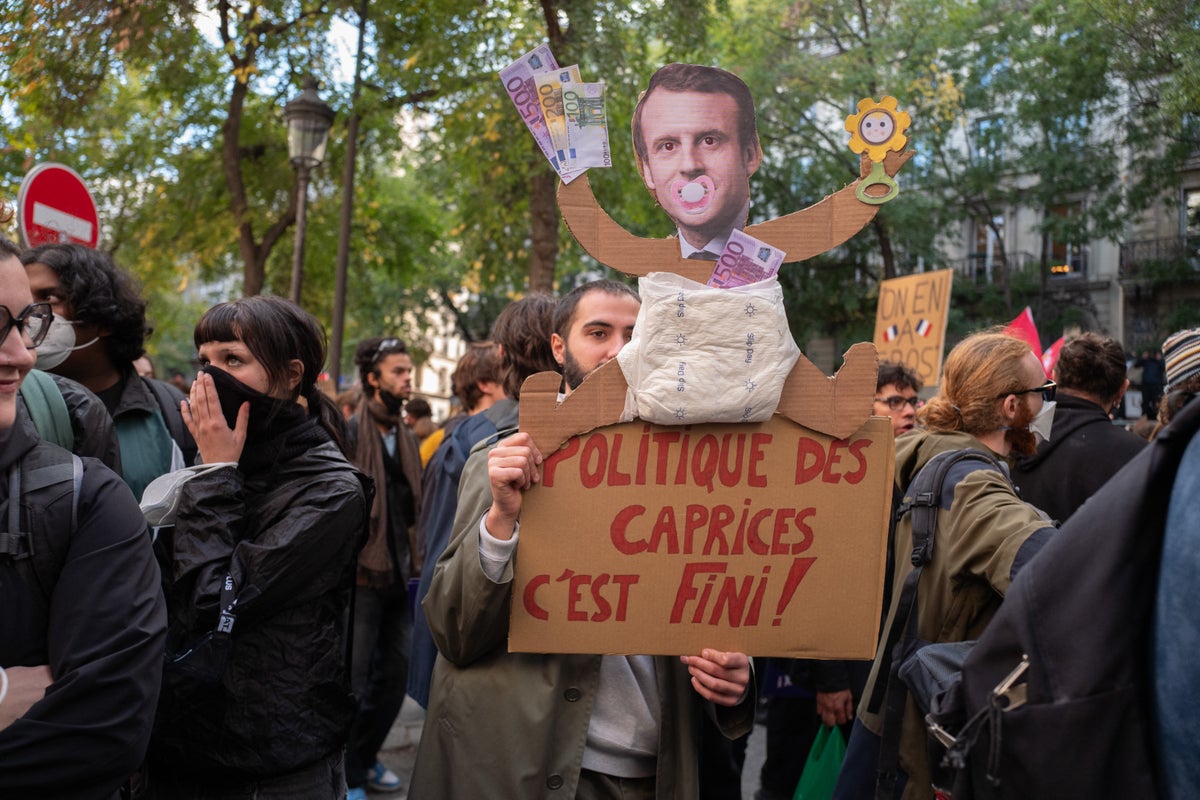
As France burns, Macron looks like a man who has lost control
Key Points
As France burns, Macron looks like a man who has lost control The French national debt is too big, its economy too sluggish and its parliament and president jointly unable to get state spending down to sustainable levels - the mirror image of the complaint of the protesters, who want more spending on subsidies and schools. And so it’s in gridlock - Bookmark - CommentsGo to comments Become an Independent member to bookmark this article Already a member? Log in In his last few months as...
As France burns, Macron looks like a man who has lost control
The French national debt is too big, its economy too sluggish and its parliament and president jointly unable to get state spending down to sustainable levels - the mirror image of the complaint of the protesters, who want more spending on subsidies and schools. And so it’s in gridlock
- Bookmark
- CommentsGo to comments
Become an Independent member to bookmark this article
Already a member? Log in
In his last few months as president of the French Republic, Emmanuel Macron looks more than ever a man who lost control of events, lost touch with the nation he leads, and lost the confidence of international investors with it. This is not a comfortable, confident position for any leader to be, but with a hung parliament hardly able to pass a budget and the very fabric of of the nation unravelling, this lame duck - who once promised so much with his unifying project of a radical centre - has been, and is, reacting in all the wrong ways to the malaise now enveloping his country.
Rather than through, say, a television interview or a speech delivered in person, President Macron, so inappropriately aloof, chose initially to react to the protests that have broken out across France over the weekend, sparking disorder, violence and hundreds of arrests in a rather terse statement on X: “Those who took part in the vandalism, attacked prefectures and stores, and engaged in looting, including in city hall buildings, will be brought to justice and will be punished.”
Unarguably, those who choose violence should take the consequences, but the government always had the choice between meeting the representatives of the protesters, the classic French mix of students and workers, now bolstered by the resurgent gilets jaunes, listening to their grievances and offering some sympathy and change. Instead, the Macron administration ordered the riot police to do their worst.
Originating in a secondary school protest in the Paris suburb of school in Creteil, southeast of Paris, over a lack of teachers, and culminating in well over half a million people on the streets, many suffering life-changing injuries from police weapons, the authorities have reacted with a counter-productive brutality. A police tear gas grenade shattered a 14-year-old’s jaw and many of his teeth. A 15-year-old lost a hand in an incident involving a police stun grenade. Other adolescents have also suffered life-changing injuries blamed on police weaponry during protests.
No wonder trade unionists and others have joined the protest movement, adding the cost of living, fuel prices (as in other western countries a triggering issue) and a general sense of national pessimism and insecurity. In this way, these disturbances combine some of the themes that caused such comparable disorder in 1958, 1968 and 2005, all of which similarly drained the governments of the day of authority. More than in most democracies, direct action has always been an informal clause of the French constitution, proof that sovereignty lies with the people, rather than any essentially ephemeral institutions or haughty ruler.
This time around, there is an additional issue facing M Macron. Just as ominous as this unrest, and potentially much more far-reaching, has been the other, simultaneous challenge, to the stability of the French state - an incipient sovereign debt crisis reminiscent of the one that spread across the Eurozone fifteen years ago. Of all the major advanced economies, it is France that has suffered the most, and see the largest rise in its bond yields, and the more precipitous fall in the value of French government bonds, known as OATs (Obligations assimilables du Tresor.
As things stand the markets think that the debt issued by the likes of LVMH is more likely to hold its bake and be repaid than the paper offered by the French state. This is because the French national debt is too onerous, its economy too sluggish and its parliament and president jointly unable to get state spending down to sustainable levels - the mirror image of the complaint of the protesters, who want more spending on subsidies and schools. Hence the gridlock in policy making.
As in the earlier Eurozone crisis as it hit Greece, Italy and Spain, the eventual consequence of this devaluation of OATs will be a shrinkage in the balance sheets of the big banks, who own vast quantities of OATs. That would lead to a credit crunch and, most likely, a recession and similar “contagion” across the Eurozone, but this time with the second largest European economy at risk of default. A rescue by the European Central Bank (in practice Germany) would again demand some austerity.
The origins of these multiple crises are long and complex. However, prime among them stands President Macron’s capricious decision to call premature elections to the French parliament in 2024, at a time when he still enjoyed a comfortable majority. It was designed to renew his mandate after his party had been snubbed in the European elections. Instead, it left France with an entirely dysfunctional domestic government, and contributed to more intense political polarisation - the rise of the far right and of the hard left.
France was left rudderless. This kind of “immobilisme” is not uncommon in French history, but it rarely ends well. Apres Macron, le deluge?
Join our commenting forum
Join thought-provoking conversations, follow other Independent readers and see their replies
Comments
[Image text:] DAZ
SPOLITIQUE DES
CAPRICES
C'EST FiNi