
Politics
Commentary: Could devastating Nepal floods catalyse action at climate talks?
Key Points
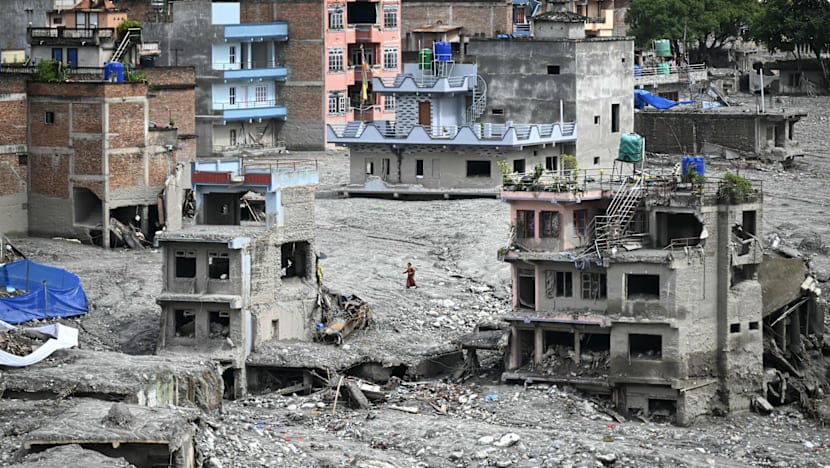
Commentary: Could devastating Nepal floods catalyse action at climate talks? Demands for compensation from climate-vulnerable countries are unlikely to yield outcomes soon, says COP30 special envoy and think tank founder Arunabha Ghosh. NEW DELHI: Still reeling from the catastrophic glacial flood, Nepal has been struck again by flash floods that destroyed homes and infrastructure on Oct 11.
Commentary: Could devastating Nepal floods catalyse action at climate talks?
Demands for compensation from climate-vulnerable countries are unlikely to yield outcomes soon, says COP30 special envoy and think tank founder Arunabha Ghosh.
NEW DELHI: Still reeling from the catastrophic glacial flood, Nepal has been struck again by flash floods that destroyed homes and infrastructure on Oct 11.
These back-to-back events highlight how vulnerable developing countries are to natural disasters, and how they bear the disproportionate brunt of climate change.
Nepalese authorities estimate that the August glacial flood incurred US$2.6 billion of property and infrastructure damage, and that reconstruction will cost US$4.8 billion.
Yet Nepal has requested only US$20 million from the United Nation’s Loss and Damage Fund – which is only about 0.4 cent of projected reconstruction costs.
The tragic loss of lives, infrastructure and livelihoods is compounded by the pitiful state of climate finance, especially to reduce risks and recover from climate change-induced disasters. With weeks to go before COP31 climate negotiations commence, what options do countries like Nepal have?
CLIMATE-VULNERABLE COUNTRIES
For a landlocked developing country like Nepal, climate shocks set back already very low levels of human development.
According to United Nations data, landlocked developing countries face double the freight rates for transporting goods compared to coastal states. When disasters damage roads and bridges, these costs can rapidly escalate making sustained recovery much harder.
The UN estimates that for least developed countries, disaster losses amount to about 1 per cent of gross domestic product, much higher than the global average of 0.3 per cent of GDP.
In some cases, the losses can completely overwhelm the economy: Hurricane Maria in 2017 caused losses of 226 per cent of Dominica's GDP.
In 2022, the Vulnerable Twenty – a bloc representing climate-vulnerable nations – estimated that climate change led to cumulative losses of US$525 billion for its members from 2000 to 2019.
CLIMATE COMPENSATION IS UNLIKELY
Despite rising sophistication of attribution science, which pinpoints the degree to which climate change is responsible for extreme weather events, demands from climate-vulnerable countries for compensation are unlikely to yield outcomes soon.
In July 2025, the International Court of Justice delivered a unanimous finding that states had binding obligations under international law, the UNFCCC and the Paris Agreement to prevent significant harm to the climate system.
However, the ICJ ruling is advisory and does not obligate developed countries or major emitters to provide additional resources. Developed countries have strongly pushed back against linking payments for loss and damage to any kind of legal liability for their historical responsibility in emitting greenhouse gases.
The Fund for Responding to Loss and Damage (FRLD) was announced at COP27 in 2022 and operationalised the following year. So far, the FRLD has struggled to deliver. As of 2025, against pledges of US$822 million, only US$585 million had been contributed—with no project approvals or disbursements.
Least developing countries and small island states have pointed to disproportionate bureaucratic obstacles to accessing funds. Moreover, China and India do not have any obligations to contribute to the FRLD because they classified as developing countries. They can make voluntary contributions, but they are also eligible to receive funds.
This non-delivery of funds for loss and damage stands in stark contrast to the demands. The Council on Energy, Environment and Water found that just 0.08 per cent of GDP contribution from developed countries could provide US$60 billion to the FRLD.
Insurance schemes have also proven inadequate. At COP27, the Global Shield against Climate Risks was launched, but it does not fund resilient infrastructure or risk-reduction measures.
Finally, climate resilient debt clauses allow countries to suspend debt service payments when pre-agreed disaster thresholds are crossed. These have been adopted or piloted by the World Bank and other financial institutions but they don’t eliminate pre-existing debt burdens, only postpone them.
The International Monetary Fund's Resilience and Sustainability Trust, funded through voluntary contributions by IMF members, offers longer-term loans on favourable terms. However, this facility is neither a grant nor a compensation mechanism.
NEAR-TERM OPTIONS
The architecture of financing loss and damage and increasing resilience remains fragmented. Because compensation remains politically difficult, developing countries may have greater leverage in demanding funds for climate adaptation.
A more pragmatic route for vulnerable countries like Nepal would be to seek support in building multi-hazard early warning systems. Data cooperation will be critical in climate-fragile regions such as the Himalayas. To this end, Nepal’s prime minister suggested a Himalayan Climate Resilience Mechanism with India and China last month at the UN General Assembly.
Increased regional trade in clean energy could be a source of revenue and resilience. Investing in a jobs-intensive green economy – from sustainable tourism in mountainous regions to mangroves to seaweed cultivation in coastal areas – could attract new investment and yield climate co-benefits.
The Nepal disaster will surely play on negotiators’ minds at the forthcoming COP. Nepal’s foreign minister suggested a “Sagarmatha to Sea” partnership at the Pre-COP Leaders’ Event in Fiji in October, seeking to link the Himalayas with climate-vulnerable Pacific Island states.
But there is no dedicated agenda item for COP31 negotiations. The best bet would be a collective, vigorous demand for the replenishment of the FRLD due in 2027—as well as a more efficient mechanism to disburse funds.
When development assistance is on the decline, even these demands might not be met. The climate-vulnerable can make their demands but should be ready for disappointment. Climate justice delayed is climate justice denied.
Dr Arunabha Ghosh is COP30 Special Envoy, representing South Asia, and member of the UN Committee for Development Policy. He is founder and was CEO (2010-2026) of the Council on Energy, Environment and Water (CEEW). Views are personal.