
Science
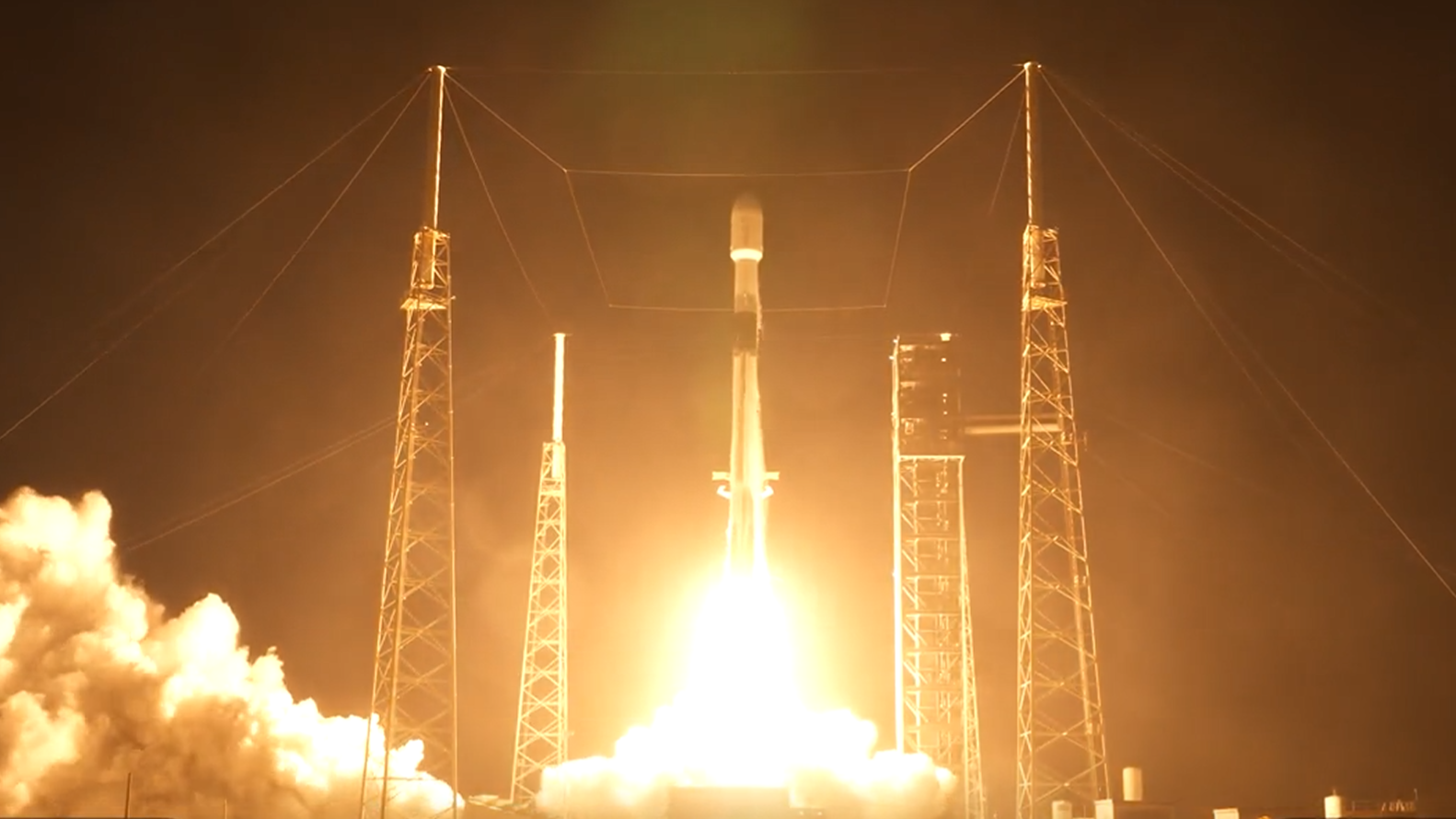
SpaceX launches its 'Starfall' return capsule for 2nd time ever
Key Points
SpaceX launches its 'Starfall' return capsule for 2nd time ever SpaceX just launched its mysterious "Starfall" return capsule for the second time ever. Starfall was one of 32 payloads on the company's Bandwagon-5 rideshare mission, which launched atop a Falcon 9 rocket at 7:04 a.m. EDT (1104 GMT) today (Oct. 20) from Cape Canaveral Space Force Station in Florida. SpaceX has been relatively quiet about Starfall, which debuted this past June on a Falcon 9 launch from the Cape.
SpaceX launches its 'Starfall' return capsule for 2nd time ever
SpaceX just launched its mysterious "Starfall" return capsule for the second time ever.
Starfall was one of 32 payloads on the company's Bandwagon-5 rideshare mission, which launched atop a Falcon 9 rocket at 7:04 a.m. EDT (1104 GMT) today (Oct. 20) from Cape Canaveral Space Force Station in Florida.
SpaceX has been relatively quiet about Starfall, which debuted this past June on a Falcon 9 launch from the Cape.
That June 23 flight was a dedicated demonstration mission for Starfall, designed to show that the capsule can fly in a controlled fashion and survive the harrowing downward trip through Earth's atmosphere.
And those will be Starfall's main jobs. The vehicle "will enable affordable, routine access to the microgravity environment for scientific research and in-space manufacturing," SpaceX in a June 23 X post, one of the few public statements the company has made about Starfall.
Indeed, most of the details that we have about the capsule come from an environmental assessment that was published by the U.S. Federal Aviation Administration in May.
According to that document, the disk-shaped Starfall is roughly 2.5 feet (0.75 meters) tall and 10.2 feet (3.1 m) wide. It weighs about 4,600 pounds (2,100 kilograms) and can bring 2,200 pounds (1,000 kg) of payload back down to Earth.
Starfall wasn't the only return capsule that went up on Bandwagon-5. Among the other 31 payloads on the flight was W-Series 7, the latest orbital "mini-factory" built and operated by the California company Varda Space Industries.
The W-Series capsules are designed to both host the production of valuable goods such as pharmaceuticals and bring them safely down to Earth, Varda has said.
The other payloads on Bandwagon-5 are a mix of "cubesats and microsats," according to SpaceX's mission description. Among the latter is Pelican-12, a sharp-eyed Earth-observation satellite built by the San Francisco company Planet.
If all goes according to plan today, the 32 payloads will be deployed over a nearly two-hour span beginning about 57 minutes after launch. Starfall will be the last to separate, releasing from the Falcon 9's upper stage two hours and 48 minutes post-liftoff.
The Falcon 9's first stage, meanwhile, came back to Earth as planned on Bandwagon-5. It touched down about nine minutes after launch, coming down in the Atlantic Ocean atop the SpaceX drone ship "A Shortfall of Gravitas." It was the 19th mission for this particular booster, according to the company.
Bandwagon is one of two SpaceX rideshare programs. The other, known as Transporter, has been busier, flying 18 missions to date.
The first Transporter mission, which lifted off in January 2021, delivered 143 payloads to Earth orbit, a single-launch record that still stands.
Michael Wall is the Spaceflight and Tech Editor for Space.com and joined the team in 2010. He primarily covers human and robotic spaceflight, military space, and exoplanets, but has been known to dabble in the space art beat. His book about the search for alien life, "Out There," was published on Nov. 13, 2018. Before becoming a science writer, Michael worked as a herpetologist and wildlife biologist. He has a Ph.D. in evolutionary biology from the University of Sydney, Australia, a bachelor's degree from the University of Arizona, and a graduate certificate in science writing from the University of California, Santa Cruz. To find out what his latest project is, you can follow Michael on Twitter.
You must confirm your public display name before commenting
Please logout and then login again, you will then be prompted to enter your display name.
SpaceX (ORG)
Starfall (PERSON)
Falcon (ORG)
Cape Canaveral Space Force Station (ORG)
Florida (LOCATION)
Cape (LOCATION)
Earth (LOCATION)
the U.S. Federal Aviation Administration (ORG)
California (LOCATION)
Varda Space Industries (ORG)
Varda (ORG)
San Francisco (LOCATION)
the Falcon 9's (ORG)
the Atlantic Ocean (LOCATION)
Transporter (PERSON)