
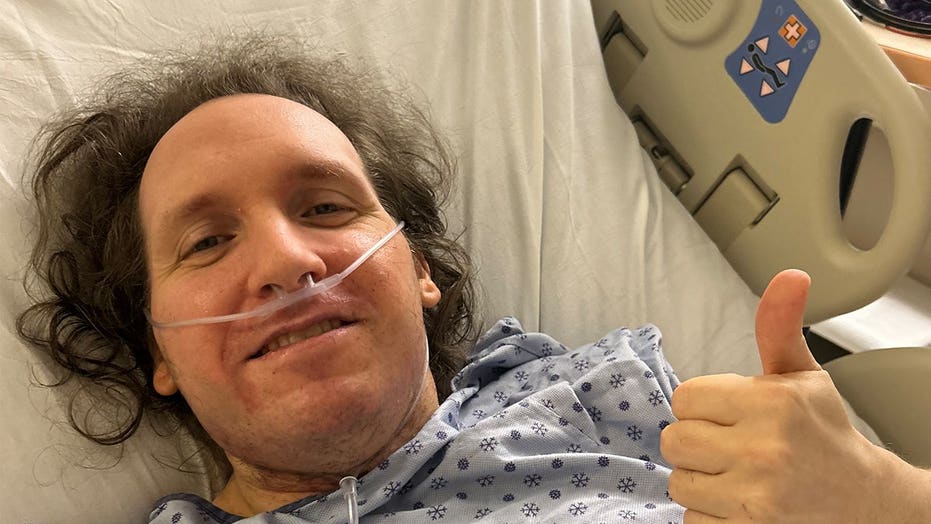
A Canadian man battling a debilitating neurological disease told Fox News Digital that hospital staff repeatedly raised the possibility of medically assisted death while he was fighting for the home care he says he needs to survive.
Roger Foley, who has spinocerebellar ataxia, told Fox News Digital in a recent interview that the conversations began in 2016 at Victoria Hospital, part of the London Health Sciences Centre in Ontario, where he says he has remained hospitalized for years while seeking a self-directed home-care arrangement.
In a July 7, 2026, letter obtained by Fox News Digital, Foley's attending physician said he could safely leave the hospital if the Ontario government authorized an individualized home-care arrangement.
"By any reasonable clinical standard, you could be discharged from our hospital if you had adequate support at home," wrote Dr. George K. Dresser, an attending internal medicine physician at London Health Sciences Centre.
Dresser said Foley has been medically stable for much of his prolonged hospitalization, despite suffering hospital-acquired infections, and argued that conventional home-care programs have failed to accommodate his complex medical needs.
"You have been at London Health Sciences Centre because the unique needs that you have cannot be met by existing programs in the community," the physician wrote.
Dresser described Foley as "a square peg in a round hole," arguing that the hospital's standardized approach to care is poorly suited to a patient who requires consistent caregivers and highly individualized assistance.
The physician also suggested that keeping Foley hospitalized may be unnecessarily expensive for Ontario's healthcare system.
"A community-based, self-directed arrangement would in all likelihood cost substantially less than continued acute admission, while delivering far better-matched care," Dresser wrote.
He urged Ontario's Ministry of Health to authorize funding that would allow Foley to recruit, train and manage his own personal support workers, potentially ending his yearslong hospitalization.
Foley alleged that assisted dying was raised again during a disputed discharge process in 2017, when he says he was threatened with daily hospital charges of approximately $1,500 if he did not accept the care arrangements being offered.
POPE LEO CALLS OUT ‘FALSE COMPASSION’ OF MEDICALLY ASSISTED SUICIDE DURING FRENCH HOSPITAL VISIT
"I don't want to die," Foley told Fox News Digital, describing his determination to return to his apartment with caregivers of his choosing.
Foley also alleged that the hospital removed lighting accommodations for his neurological condition in May 2025, making it difficult for him to receive care and consume food and fluids.
Foley said the lighting dispute is particularly serious because his neurological condition makes him sensitive to certain wavelengths of light, including those emitted by fluorescent fixtures.
For years, he said, the hospital accommodated his condition with amber-spectrum lighting that allowed caregivers to assist him without triggering his symptoms.
But in May 2025, Foley alleged the hospital withdrew those accommodations and began requiring staff to provide care under fluorescent lighting.
He claimed the change has made it increasingly difficult to receive routine assistance, including help with eating and drinking, because he must wear large, heavy protective goggles that place additional strain on his already compromised neck.
CATHOLIC NUNS SUE NEW YORK, SAY ASSISTED SUICIDE LAW FORCES THEM TO VIOLATE THEIR FAITH
Foley said he has sometimes relied on personal support workers from outside the hospital to help him consume fluids and that financial limitations have prevented him from arranging enough outside assistance to meet all his needs.
He further alleged that some hospital employees have been instructed not to provide care unless fluorescent lights are turned on, even though he says other staff members have been able to assist him using the amber lighting without difficulty.
Foley also claimed hospital personnel began asking him questions about suicidal thoughts again around the time his lighting accommodations were withdrawn. Unlike his earlier experiences, he said he refused to engage in those conversations because he no longer trusted the hospital's intentions.
If you or someone you know is having thoughts of suicide, please contact the National Suicide Prevention Lifeline at 1-800-273-TALK (8255).
He said he does not refuse to discuss his mental health in general, and is not opposed to mental health assessments or receiving appropriate mental health support. However, he said previous experiences with hospital staff have made him wary of engaging in such discussions, especially because he said medical assistance in dying (MAID) had previously been raised as an option.
The allegations mark the latest chapter in what Foley described as a nearly decade-long struggle to obtain the kind of care that would allow him to leave the hospital and return to his own home.
Despite his prolonged hospitalization, Foley said he has never given up his apartment, which he described as accessible and equipped with a ceiling lift to assist with his mobility needs.
"I have my own apartment. I still pay all my bills," he told Fox News Digital.
"The last 10 years I haven't given up my apartment and I have wonderful community [personal support workers] that are ready to start working for me as soon as I get the self-directed funding," Foley said.
FAMILY SOUNDS ALARM AFTER 83-YEAR-OLD GRANDMA DIES UNDER CANADA'S ASSISTED-DEATH PROGRAM
Self-directed funding primarily refers to the Direct Funding (DF) Program for adults with physical disabilities and Family-Managed Home Care for broader home care services.
Under such a model, Foley explained, patients with disabilities would have greater control over choosing and managing their caregivers rather than relying exclusively on agencies selected through the provincial home-care system.
Foley argued that this would provide more consistent and safer care, particularly for patients with complex medical needs who require caregivers familiar with their individual conditions.
He said his physicians have supported his efforts to obtain alternative home-care arrangements, but he has been unable to secure the funding necessary to put his plan into action.
Foley said that the existing system has left him caught between remaining hospitalized indefinitely and accepting community-care arrangements he believes would place his health at risk.
"I'm not giving up," he said. "I don't want to die, my daughters know I don't want to die, my physicians have always been very explicit and direct that it's not safe to put me in that type of close model that I need direct funding."
In the letter from Dresser, Foley's attending physician, he writes in part, "I am therefore advocating that the Ministry to consider authorizing an individualized, self-directed funding arrangement that would enable you to be discharged from acute care and to arrange and direct your own care in the community. I am very willing to meet with Ministry staff, to provide whatever clinical documentation is required, and to work collaboratively on the design and safeguards of such an arrangement."
Before his illness progressed, Foley said he had built a career in banking, worked as a television host and comedian, and even trained as a professional wrestler.
He described earning recognition for his work before his deteriorating health eventually forced him to leave his career and go on long-term disability.
GRANDDAUGHTER SAYS GRANDMA REJECTED MAID BEFORE LETHAL PROCEDURE, ‘I DON’T WANT THE DEATH SHOT’
But Foley said he has continued looking for ways to contribute to society despite his physical limitations.
He is now involved with a project called "Bring Roger Home," which he said is working with a nonprofit organization to raise money for the care he needs to return to his community.
The effort also includes releasing music he recorded years earlier, with proceeds intended to support his home-care needs and eventually help other people facing similar circumstances.
One of the songs, "Limitless with Limitations," reflects the philosophy he said helped him come to terms with his condition.
"Just because you're not the person that you were doesn't mean that the person you are can't be limitless and achieve positive things and goals," Foley said.
He also urged people living with disabilities or chronic illnesses not to lose hope, even when their medical circumstances become overwhelming.
"Don't give up who you are at your core and believe in yourself," he said.
Foley said his ultimate goal remains unchanged: to return home, reconnect with family and friends, and live as independently as his condition allows.
His experience has also shaped his opposition to Canada's Medical Assistance in Dying (MAID) system, which he argues cannot be adequately safeguarded when patients face serious gaps in medical care and social support.
According to the BBC, Canada’s MAID law, which legalized euthanasia in 2016, is responsible for one in every 20 deaths in Canada.
Foley contended that patients should have meaningful access to treatment, disability assistance and home-care alternatives before assisted death is considered.
For him, the central issue is not whether he has the ability to end his life, but whether he can obtain the assistance necessary to continue living it.
"Even in the darkest times," Foley said, "you can still find a light at the end of the tunnel to go towards."
Fox News Digital reached out to London Health Sciences Centre (LHSC), which operates Victoria Hospital, Ontario Health atHome, the Ontario Ministry of Health, and Dresser, Foley’s physician, for comment but did not immediately receive responses.
Cheshire Independent Living Services declined to comment.