
Health
She pioneered breast care nursing in Singapore and, at 74, still cares for breast cancer patients
Key Points
She pioneered breast care nursing in Singapore and, at 74, still cares for breast cancer patients After establishing breast care services at Singapore General Hospital in 1992, Nagalingam Saraswathi trained nurses from other hospitals and started a support group for breast cancer patients. More than three decades later, caring for them remains a huge part of her life. Imagine getting a breast cancer diagnosis – the shock, uncertainty and range of emotions that follow, and the many questions...
She pioneered breast care nursing in Singapore and, at 74, still cares for breast cancer patients
After establishing breast care services at Singapore General Hospital in 1992, Nagalingam Saraswathi trained nurses from other hospitals and started a support group for breast cancer patients. More than three decades later, caring for them remains a huge part of her life.
Imagine getting a breast cancer diagnosis – the shock, uncertainty and range of emotions that follow, and the many questions about what happens next.
This is where a breast care nurse (BCN) comes in, guiding patients on their treatment journey and providing emotional support. In Singapore, the woman who first made it possible for patients to get this care is Nagalingam Saraswathi, the country’s first BCN.
In 1992, Saraswathi, or Sister Sara as she’s known to patients and colleagues, was an oncology nurse at Singapore General Hospital (SGH).
The hospital’s head of surgery had seen a presentation on breast care nursing during a conference in the United States and put up a proposal to the nursing department for a specialty nurse in breast care.
Saraswathi was sent to England for a 10-week training course – the only nurse from Singapore. There, she learnt counselling techniques, what information to give patients about their surgery, and how to address common myths.
She also learnt how to develop policies, as she would be setting up SGH’s breast care nursing services that year.
“On the flight back, I wrote everything I needed to do in my little diary – which I kept,” she said.
TRAINING BREAST CARE NURSES IN HOSPITALS
Over the next few years, Saraswathi conducted six-week training courses for nurses from other public and some private hospitals, sharing information on chemotherapy, radiotherapy and counselling. That is how BCN services began in Singapore in the 90s.
“I’m very happy that I developed a lot of breast care nurses,” Saraswathi told CNA Women.
For 10 years, Saraswathi was the only BCN in SGH, so her job involved long hours.
“At first, I saw around 100 patients a year, and within two or three years, it was around 500 a year,” she said. “I don’t remember leaving work at 5pm; I worked 12 to 15 hours a day.”
The 74-year-old added: “I had a wonderful husband who never asked me to drop everything and go home. He took care of our two children and picked me up from work at 10pm.”
At the beginning, when the role of a BCN wasn’t well known, Saraswathi said younger patients, especially, reacted positively when they received information and support.
She also managed to bond with older patients when they found out she could speak Hokkien, which she learnt as a trainee nurse in the early 70s to communicate with the many patients who spoke the dialect.
“Sometimes, patients were crying when they met me and I’d tell them, ‘You can call me when you feel more settled and we can talk’,” she said. “It makes a lot of difference to them to feel that they have been heard – they then opened up to me more.
“We ask how much they’ve understood about what the doctor told them and explain what life is going to be like for them after this diagnosis and how they can cope,” she said.
FIRST BREAST CANCER SUPPORT GROUP IN SGH
Saraswathi recalled how, when she was an oncology nurse, she would go to a patient’s house on Sundays to dress her fungating wound. These are wounds that result from a cancerous tumour breaking through the skin’s surface.
“My husband drove me there and waited in the car for 45 minutes while I looked after her,” she recalled.
When the patient’s wound was smaller, Saraswathi referred her to a clinic as she was heading to England for her breast care nursing course.
“To my surprise, she showed up at the airport with her husband and children to wish me a safe journey,” she added. “My eyes filled with tears then and, even now, when I talk about it, I cry.”
Saraswathi recalled another patient who didn’t want male health professionals treating her fungating wound.
“She sometimes waited for me for two or three hours without complaining. When she died a few years later, I went to the funeral parlour to pay my respects.”
Saraswathi also started SGH’s first breast cancer support group in 1992 with around five patients. As membership grew, she teamed them into groups named after flowers such as jasmine and orchid. Around 10 years later, the support group became known as Blossoms – it still functions in SGH today.
“These women have gone through a lot; they fought their illness and won, and they continue to help other patients,” said Saraswathi.
Before post-mastectomy bras were available commercially, Saraswathi made soft padding that patients could insert into their bras. She bought the materials and got the women from Blossoms – who were patients too – to cut them into shape, stuff them and sew them up.
In the mid to late 90s, she also conducted programmes at community centres and got support group members involved in educating the public about breast cancer.
“I PROVIDED THE SERVICE WITH MY HEART”
As a child, Saraswathi loved caring for others – she even dressed her family members’ and neighbours’ wounds.
When she went to secondary school, she joined St John’s Ambulance as a co-curricular activity. On Sundays, the uniformed group would volunteer at Kwong Wai Shiu Hospital, tending to elderly patients.
“I always had this passion for caring. I met an amazing nurse who was very kind to students like us. I was inspired by her, the way she took care of patients,” said Saraswathi.
She began nursing training in 1972 and worked in the intensive care unit, then became interested in oncology several years later.
“I met a prostate cancer patient while on a night shift and we became friends. He was in pain a lot of the time and I didn’t know much about cancer. So, in 1989, when the first oncology course was conducted in Singapore in School of Nursing, I immediately applied.”
Saraswathi has received several accolades during her more than five decades as a nurse. Among them was the President’s Award for Nurses in 2001, the highest accolade in the nursing profession.
“I didn’t expect any awards, they all just came along,” she said. “I provided the service with my heart; it was a true feeling for the patients. I spent a lot of time with them and many patients became my friends.
“Even today, sometimes they come up to me at hawker centres. I may not recognise them but they [recognise me] and that’s a lovely feeling.”
STILL SPREADING BREAST CANCER AWARENESS
Saraswathi retired in November 2025 after 54 years as a nurse but is still active in breast cancer awareness.
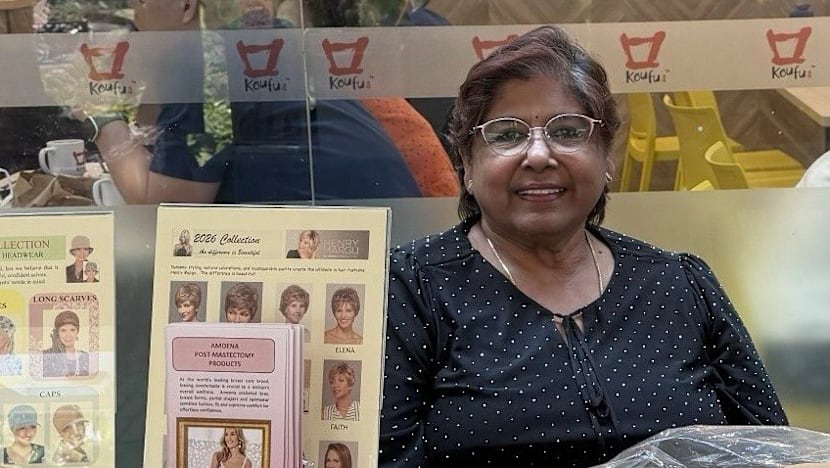
She works three-and-a-half days a week at a boutique, fitting bras and prosthetics for mastectomy patients. She also serves as a locum nurse once a week for 365 Cancer Prevention Society and still attends meetings and activities in SGH’s Blossoms.
“My daughter complains that I’m more busy now than before I retired,” she laughed. “The truth is, I hope to keep myself happy and healthy and still working for breast cancer patients till my last breath.
“I feel there’s a meaning to my birth; I have done something that is good for humanity,” she said. “I have made many people’s lives better, in a sense. Even now, I have support group members who tell me I saved their lives.”
She said she has learnt a lot from her patients. “We always take things for granted but because of cancer, these women value life and start to look at things differently. They inspire me to do more and learn to be brave – they’re very brave.
“And when you give them love, you’ll see how much love they give you too,” she added.
CNA Women is a section on CNA Lifestyle that seeks to inform, empower and inspire the modern woman. If you have women-related news, issues and ideas to share with us, email CNAWomen [at] mediacorp.com.sg.
[Image text:] Koufus
Koufus
Koufus
LECTION
HEADREAR
LONG SCARVES
2026 Collectisa
AMOENA
POSTMASTECTOMY
PROOUCES
CLENA
TAD
Koufus
Koufui