
Business & Finance
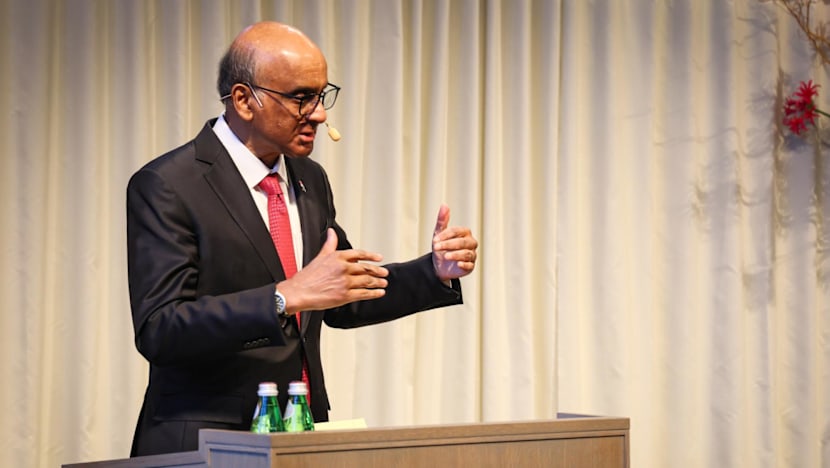
'Bridge-builders' like Singapore, Sweden key amid risk of fragmented world order: President Tharman
Key Points
'Bridge-builders' like Singapore, Sweden key amid risk of fragmented world order: President Tharman Without countries willing to bridge geopolitical divides, growing rivalry could push the world into competing blocs, Mr Tharman said in a lecture at the Stockholm School of Economics during his state visit to Sweden. SINGAPORE: Countries that can act as "bridge-builders", such as Singapore and Sweden, will become increasingly important as the old United States-led world order recedes and the...
'Bridge-builders' like Singapore, Sweden key amid risk of fragmented world order: President Tharman
Without countries willing to bridge geopolitical divides, growing rivalry could push the world into competing blocs, Mr Tharman said in a lecture at the Stockholm School of Economics during his state visit to Sweden.
SINGAPORE: Countries that can act as "bridge-builders", such as Singapore and Sweden, will become increasingly important as the old United States-led world order recedes and the risk of geopolitical fragmentation grows, President Tharman Shanmugaratnam said on Tuesday (Oct 20).
He warned that the world has yet to arrive at a stable multipolar order, and could instead see growing rivalry, the weaponisation of trade and materials, and a slide towards divided blocs.
Delivering a lecture at the Stockholm School of Economics during his state visit to Sweden, Mr Tharman said such bridge-builders can play various roles, such as bringing regions together in a world where trade and investment are at risk and finding common interests between the Global North and the Global South.
They can also build coalitions for "bolder and more urgent climate action, to prevent and prepare for pandemics, and to work together to guard against the worst harms that (artificial intelligence) can bring".
In addition, bridge-builders between the US and China can help preserve economic networks integral to both countries and move the world "towards a new, reformed multilateralism".
"We have to work on reforms to the existing multilateral institutions, but recognise that progress can be held up by the current system of decisions by universal consensus in several of these institutions – in other words, where every country has to agree before we can move forward," said Mr Tharman.
"We have to work on changing those decision-making rules and norms. But in the meantime, we have to move ahead through coalitions that work in parallel with the multilateral institutions."
Mr Tharman said that while the US-led unipolar world order was a thing of the past, the world has not yet arrived at a multipolar order.
He added that the world is seeing a shift in the US "from the belief and practice of enlightened self-interest, to a more narrow and immediate calculation of national interests", leading to the waning of US influence in Asia, Europe and around the world.
"There are more poles, but a thinning of global leadership," he said. "The simple fact of multipolarity does not assure us of a system. If anything, we are more likely than not to see growing suspicion, friction or conflicts, weaponisation of trade and materials, and a steady grind into a world of divided blocs."
On bridge-builders, he cited the example of Singapore, which is "by no means a middle power", but is working actively to improve cooperation between the Comprehensive and Progressive Agreement for Trans-Pacific Partnership (CPTPP) and the European Union, as well as between the Association of Southeast Asian Nations (ASEAN) and the EU.
Sweden, meanwhile, has a tradition of being a bridge-builder, Mr Tharman said, pointing to how former United Nations Secretary-General Dag Hammarskjold, a Swede, initiated the first UN peacekeeping force following the Suez Crisis in the 1950s.
"Sweden has also been building coalitions to support the health of the planet, starting more than half a century ago. And together with the other Nordic countries, is actively seeking to help Africa to make a green transition in ways that supports economic development," he said.
The president also cited Australia, Canada, Ghana, Japan and the EU as a whole as being bridge-builders.
NO SYSTEM POSSIBLE WITHOUT US, CHINA
Mr Tharman said that no system of world order would be possible without the US and China being integral to it.
"They have the largest markets. They are the largest sources of innovation. They have an overwhelming share of global AI compute. And they are essential, by virtue of their scale of carbon emissions, and in China's case, its technologies, to tackling climate change," he said.
"It may appear odd to say this, given the current political mood in the United States. But the US as many know, is never unchanging. It isn't just a matter of whether the Republicans or Democrats win elections. Change also depends on the body politic."
The president said that top surveys have consistently shown that the majority of Americans like the idea of global cooperation.
"We cannot expect the US to get back to the responsibilities it assumed under Pax Americana, but neither should we assume an unchanging political mood," he added,
The biggest difficulty in achieving a stable global order is that the world has two major powers which are "not only interdependent economically, but are close to being peers in competition", said Mr Tharman.
He outlined three things that would help the US and China achieve stability in their relationship.
First, both countries have to view interdependence and competition as a relationship to be managed, especially to constrain the weaponisation of materials and technologies, rather than a threat to be eliminated.
"It will surely be a more dangerous world if we end up with whole AI and technology stacks decoupled, and other supply chains and payment systems decoupled. It will make for a more profoundly dangerous world," he added.
Next, it has to be recognised that there is "no finishing line" in the AI race, Mr Tharman said.
"There is no point at which we can say that the US or China has won decisively and permanently. Equally, the common threats will only grow, for that the US and China and all of us – the threats not just of rogue AI agents, but of rogue human actors using AI to develop more powerful cyber," he said.
"And what AI has done is to reduce dramatically the gap between the ability of large, organised actors and lone, non-state actors, to develop powerful new cyber, biological or chemical weapons. No country can deal with this threat on its own."
Finally, the US and China have to recognise that their domestic imbalances, including deficits, have significant international consequences, said Mr Tharman. Reforms to reduce these imbalances are in the own domestic interests, as well of that of the rest of the world.
"The US cannot keep deferring the tough choices it has to make to reduce its deficits. They will exert a growing cost domestically, and be a source of instability," the president said.
"China, too, has to recognise that to continue to be a large source of supply of goods to the world, it will have to be a larger source of demand than it is currently.
"Reforms within China are underway, but it will need time to raise consumption. In the meantime, temporary management of China's exports, such as in its recent agreement with the EU on hybrid vehicles, and a shift in balance from exports to foreign direct investment in markets abroad, have useful roles to play."
NEW, INVIGORATED DOMESTIC SOCIAL COMPACTS KEY
Wrapping up his lecture, Mr Tharman said that the world cannot reach a cooperative international order without "new and invigorated social compacts" domestically.
"The social compact in many countries, particularly in the advanced world, is exhausted," he said. "Ideas which excited people 40, 50 years ago no longer excite today. And to repair and reinvigorate, it seems to me we have to go backwards as well as forwards."
Social democracy in its early days was "not fundamentally about the redistribution of benefits to individuals, but about investing in the public good", such as schools, health systems, transport systems and other amenities that benefit everyone, he said.
"Some redistribution was necessary, and is still necessary because inequality has to be mitigated. But investing in high-quality public services was itself a progressive act, because the people who benefit most from it are the poor and the middle class. It had an uplifting tone and effect," said Mr Tharman.
"But we also have to go forward. And the reality of a world of rapid technological change and global interdependence is that whilst societies have prospered as a whole, there will be groups of people who lose out."
As such, democracies have to act early to support communities that lose out.
While a nation may be doing well as a whole, the perceived losses of those whose jobs and communities have been displaced are real, and often have a greater impact on the body politic than the widely dispersed benefits enjoyed by the majority, Mr Tharman said.
"Markets do not relieve these problems quickly, and often not at all. The task of government is to not let such problems fester, and to intervene to help those displaced," he said.
"So, aggregates like (gross domestic product), overall income growth or overall unemployment rates are not all that matter in economic life, and especially not in politics.
"Losses matter, even if most people gain. We must avoid at all costs a K-shaped economy and society as we move into an AI era."
Singapore (LOCATION)
Sweden (LOCATION)
Tharman (PERSON)
Tharman Without (PERSON)
the Stockholm School of Economics (ORG)
United States (LOCATION)
Tharman Shanmugaratnam (PERSON)
the Global North (LOCATION)
the Global South (LOCATION)
US (LOCATION)
China (LOCATION)
Asia (LOCATION)
Europe (LOCATION)
poles (ORG)
Trans-Pacific Partnership (ORG)