
Politics
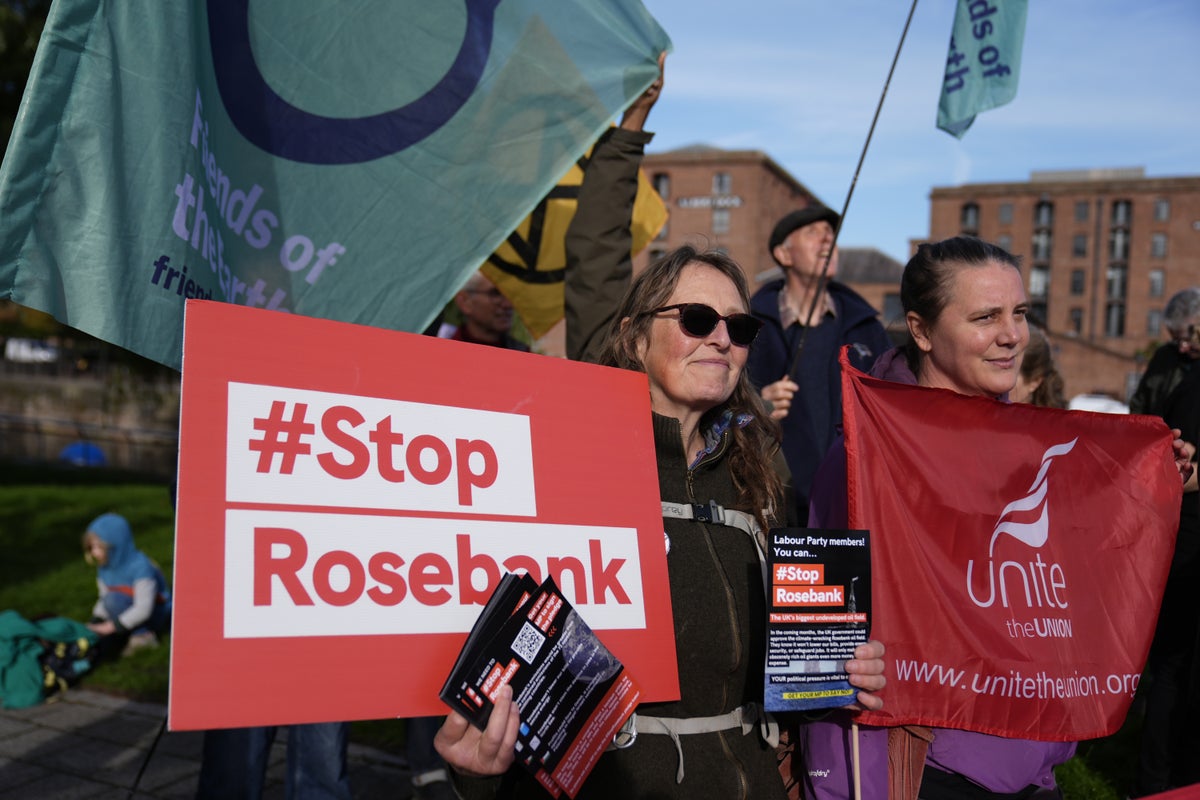
What does the government’s Jackdaw decision mean for Rosebank?
Key Points
What does the government’s Jackdaw decision mean for Rosebank? Rosebank is Britain’s largest remaining untapped oil field, located about 80 miles north west of the Shetland Islands - Bookmark - CommentsGo to comments Become an Independent member to bookmark this article Already a member? Log in The government has approved plans to begin drilling in the Jackdaw gas field in the North Sea in a bid to support the country’s energy security.
What does the government’s Jackdaw decision mean for Rosebank?
Rosebank is Britain’s largest remaining untapped oil field, located about 80 miles north west of the Shetland Islands
- Bookmark
- CommentsGo to comments
Become an Independent member to bookmark this article
Already a member? Log in
The government has approved plans to begin drilling in the Jackdaw gas field in the North Sea in a bid to support the country’s energy security.
Prime minister Andy Burnham said the decision will “protect hundreds of jobs and help keep millions of homes warm”, but stressed it would not hinder the government’s targets on renewable energy.
Groups representing the offshore industry have long called for the new development to be approved, highlighting the economic and energy security benefits.
But environmental groups say there is no case for new drilling if climate commitments are to be met.
However, the government has yet to decide on whether to approve production at the Rosebank oil field — Britain’s largest remaining untapped oil field, located about 80 miles north west of the Shetland Islands.
Here, The Independent breaks down what this latest decision on Jackdaw could mean for Rosebank.
What is the history behind the oil and gas fields?
Jackdaw was approved in 2022 by the Conservative government, while Rosebank was given the green light in 2023.
Both these decisions were struck down by the Scottish courts after a challenge from environmental campaigners.
The move followed a Supreme Court ruling that developers had to account for the climate impact caused by burning fossil fuels in their planning applications.
Operator Adura, a joint venture formed by energy companies Shell and Equinor, has since shared new information on the emissions from the end use of gas and oil extracted from Jackdaw and Rosebank.
Fresh public consultations on the proposals took place this year and closed in August and the government has made its final decision.
What will happen with Rosebank now that Jackdaw has been approved?
Pressure has increased on the government to approve the Rosebank oil field after the Jackdaw approval with Neil McCulloch, the boss of Adura, the firm behind the Jackdaw project, insisting approval of the second scheme should now follow.
He said: “Our attention now turns to Rosebank. It follows Jackdaw in the regulatory process, but the case for approval is equally strong. We believe that applying the same rigorous, evidence-based approach can lead to a similarly positive decision.”
Asked how confident he is that the Rosebank field will be approved, he added: “We’re very confident now... We believe we’ve done as good a job in arguing our case with Rosebank as we did with Jackdaw. Obviously, the economic benefits of Rosebank are different.
“It’s a bigger field. It will last longer than Jackdaw, and so I’m sure she’ll take that into account when she makes her decision in terms of the jobs and economic impact for the UK.”
But energy secretary Miatta Fahnbulleh said it was “important” the decision on Jackdaw is made separate to the Rosebank oil field.
She said: “Each project we have got to take on their own merits and I’ve got to look at them case by case in isolation. But they are two very difference projects.”
Scottish Tory leader Russell Findlay urged Mr Burnham to “stop dithering” and give Rosebank the green light without any further delay.
“Anything less would risk our energy security, harm investment, and be a kick in the teeth for families whose livelihoods depend on it,” he said.
Russell Borthwick, chief executive of Aberdeen & Grampian Chamber of Commerce, added that Rosebank is “every bit as vital to our energy security and every bit as ready to deliver for the UK supply chain anchored here in the north east of Scotland”.
But environmental campaigners have urged the government to reject the “even more damaging” Rosebank oil field.
Friends of the Earth Scotland’s head of campaigns Caroline Rance said: “Jackdaw must be the last new oil and gas field opened in the UK. Rosebank and any other new projects must be firmly rejected by the UK government. Oil and gas cannot be made compatible with our climate commitments.”
Ami McCarthy, head of politics for Greenpeace UK, said going on to approve Rosebank “would detonate an even bigger carbon bomb, releasing as much carbon as 56 coal plants operating for a year”.
Would Rosebank bring people’s bills down?
If production at Rosebank does go ahead, it won’t necessarily lower the price of household energy bills.
Resources are sold at prices dictated by international markets, which are influenced by factors such as the supply disruptions currently being caused by the Middle East crisis.
Most of the oil extracted at Rosebank will have to be exported abroad to be refined because the UK’s remaining refineries are unable to process the type of oil extracted from Rosebank.
If the UK were to use any of the refined products, such as diesel or jet fuel, they would have to be reimported back into the country.
Would it boost energy security?
At Rosebank about 90 per cent is oil, it will also produce some gas as well — but this is not enough to boost energy security.
The group Uplift, which campaigns for a transition away from oil and gas production in the UK, has found that Jackdaw would have no meaningful impact on the UK’s energy security — providing just 2 per cent of UK gas demand over its roughly 10-year lifetime.
Meanwhile, the small gas component of the Rosebank field would reduce UK gas import dependency by about 1 per cent on average, its analysis found.
Many environmentalists and experts have argued that only by boosting homegrown clean energy can the UK improve its energy security.
Could it create more jobs?
Bosses at Adura and industry stakeholders have argued the projects will result in billions in investment and support thousands of jobs.
Offshore Energies UK, an industry body, said if the government approved both Jackdaw and Rosebank the projects could provide £1.4bn in tax revenues by 2029, rising to £3.8bn by 2034.
It also claimed during the construction phase it could support 3,500 jobs and 880 jobs with an average salary of £85,850 over the lifetime of the fields.
Does this break Labour’s manifesto promise?
Although the Labour party vowed to not issue new licences to explore new fields in the North Sea basin, it also said it would honour licences granted before it came to power.
This includes Jackdaw which was approved in 2022 and Rosebank which was approved in 2023.
Are there any other oil fields being considered?
Adura chief executive Neil McCulloch has said the company is “looking beyond Jackdaw and Rosebank” at other oil and gas fields to invest in.
Join our commenting forum
Join thought-provoking conversations, follow other Independent readers and see their replies
Comments
[Image text:] dsof
th
#Stop
Rosebank
Labour Party members!
You can...
unite
#Stop
Rosebank
theUNION
www.unitethenion.org
Rosebank (ORG)
Britain (LOCATION)
the Shetland Islands - Bookmark - CommentsGo (LOCATION)
Independent (ORG)
the North Sea (LOCATION)
Andy Burnham (PERSON)
Groups (ORG)
the Shetland Islands (LOCATION)
Jackdaw (PERSON)
Conservative (ORG)
Scottish (ORG)
Supreme Court (ORG)
Adura (PERSON)
Shell (ORG)
Equinor (PERSON)