
Technology
Rising phone prices fuel repairs and second-hand sales in Singapore as consumers delay upgrades
Key Points
Rising phone prices fuel repairs and second-hand sales in Singapore as consumers delay upgrades The average selling price of a mobile phone in Singapore has risen nearly 12 per cent since 2023, reaching S$1,000 this year, data shows. SINGAPORE: As handset prices rise, consumers in Singapore are holding on to their mobile phones for longer, driving demand for repairs and second-hand devices. Since 2023, the average selling price of a mobile phone in Singapore has risen nearly 12 per cent,...
Rising phone prices fuel repairs and second-hand sales in Singapore as consumers delay upgrades
The average selling price of a mobile phone in Singapore has risen nearly 12 per cent since 2023, reaching S$1,000 this year, data shows.
SINGAPORE: As handset prices rise, consumers in Singapore are holding on to their mobile phones for longer, driving demand for repairs and second-hand devices.
Since 2023, the average selling price of a mobile phone in Singapore has risen nearly 12 per cent, from S$898 (US$700) to S$1,000 in 2026, according to market research firm NielsenIQ.
New phone sales, however, fell nearly 14 per cent between 2023 and 2025, dropping from 1.34 million units to 1.16 million as consumers delayed upgrading their devices.
Ms Louise Hawley, NielsenIQ’s Asia Pacific tech and durables managing director, told CNA that more than two-thirds of smartphones sold this year cost over S$1,000, up from just over half three years ago.
Consumers are taking various steps to manage the rising cost of new phones, Ms Hawley noted.
"One of those is the increased or elongated replacement cycle," she said, adding that people now typically use their phones for three to four years, up from about two-and-a-half years previously.
REPAIRING INSTEAD OF REPLACING
That trend has fuelled demand for repair services.
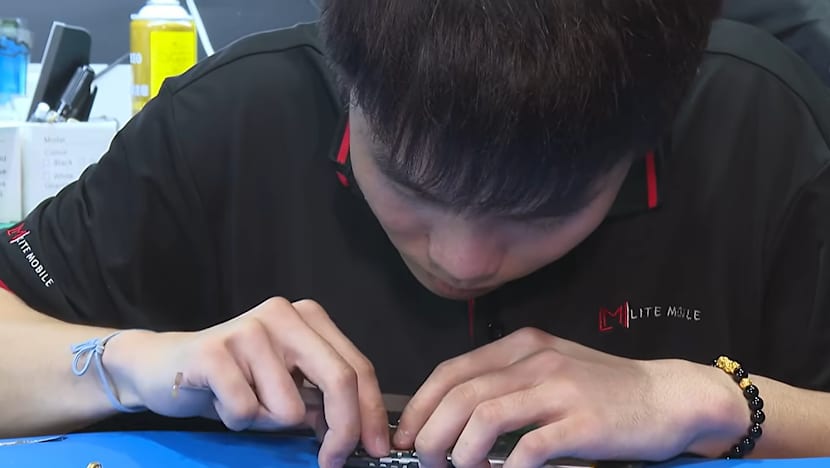
Retailer Litemobile handles between 4,000 and 5,000 phones each month across its seven outlets, with battery replacements the most common job, followed by screen and charging-port repairs.
"Usually after two years, they will change the battery and then they'll continue using it," said the company’s director Desmond Goi.
"But after four years, due to newer updates, OS (operating system) updates, older phones might not be able to support the software, so they will have no choice (but) to change."
Mister Mobile, which according to its website operates 20 outlets islandwide, has seen a similar shift towards repairs. Such jobs across its branches increased by 46 per cent between 2023 and 2025, and are up a further 12 per cent so far this year.
Mister Mobile currently handles about 7,000 repairs on a monthly basis, said CEO Alan Tan.
Most repairs involve phones that are between three and five years old.
The firm said a simple battery replacement could extend an older phone's lifespan by another year or two, allowing consumers to get more use out of their devices while avoiding the cost of buying a new one.
SECOND-HAND MARKET GROWS
The move away from frequent phone upgrades has also benefited Singapore's second-hand phone market, with affordability remaining the "number one trigger" for consumers choosing refurbished phones, according to Ms Hawley.
Mister Mobile said the number of used phones it took in rose by 33 per cent between 2023 and 2025.
The company currently takes in more than 10,000 phones for trade-in each month, according to Mr Tan.
About 95 per cent of trade-in devices are resold to new owners, while the remaining 5 per cent are sent for recycling, Mister Mobile added.
RECOVERING VALUABLE MATERIALS
At e-waste recycler Virogreen, workers take apart the phones, separating components such as screens, batteries and printed circuit boards into different boxes.
The circuit board is where personal data is stored and contains some of a device's most valuable materials, including small amounts of gold, platinum and silver.
To ensure sensitive information cannot be retrieved, the boards are first punctured using a hydraulic press before being shredded.
"That will completely destroy all the data or the motherboard beyond recovery,” said Virogreen sustainability and recycling consultant Vincent Quck.
The company said that e-waste recycling volumes, particularly for mobile phones, are increasing as awareness grows.
"For the first eight months of 2026 compared with the whole of last year, there is a 10.7 per cent increase in volume of mobile phones," said Virogreen.
According to Mr Quck, between 80 and 90 per cent of a phone's materials can be recovered, depending on the make and model.
The recovered materials are sent to other recyclers and refineries in Singapore and overseas.
Aluminium and other mixed metals can be further processed locally, while the precious metals in circuit boards are extracted abroad and reused in new products.
The remaining material that cannot be recycled or recovered is then incinerated.