
Health
Woman who cleans strangers’ graves reveals why she lets the dead choose her
Key Points
Woman who cleans strangers’ graves reveals why she lets the dead choose her Caitlin Abrams has gained attention for her videos cleaning 18th and 19th-century headstones in Vermont cemeteries - Bookmark Become an Independent member to bookmark this article Already a member? Log in Equipped with a sturdy small brush and a large pump sprayer, Caitlin Abrams paused before two contrasting burial sites in a quiet cemetery in western Vermont. Autumn colors blanketed a nearby hillside beneath...
Woman who cleans strangers’ graves reveals why she lets the dead choose her
Caitlin Abrams has gained attention for her videos cleaning 18th and 19th-century headstones in Vermont cemeteries
- Bookmark
Become an Independent member to bookmark this article
Already a member? Log in
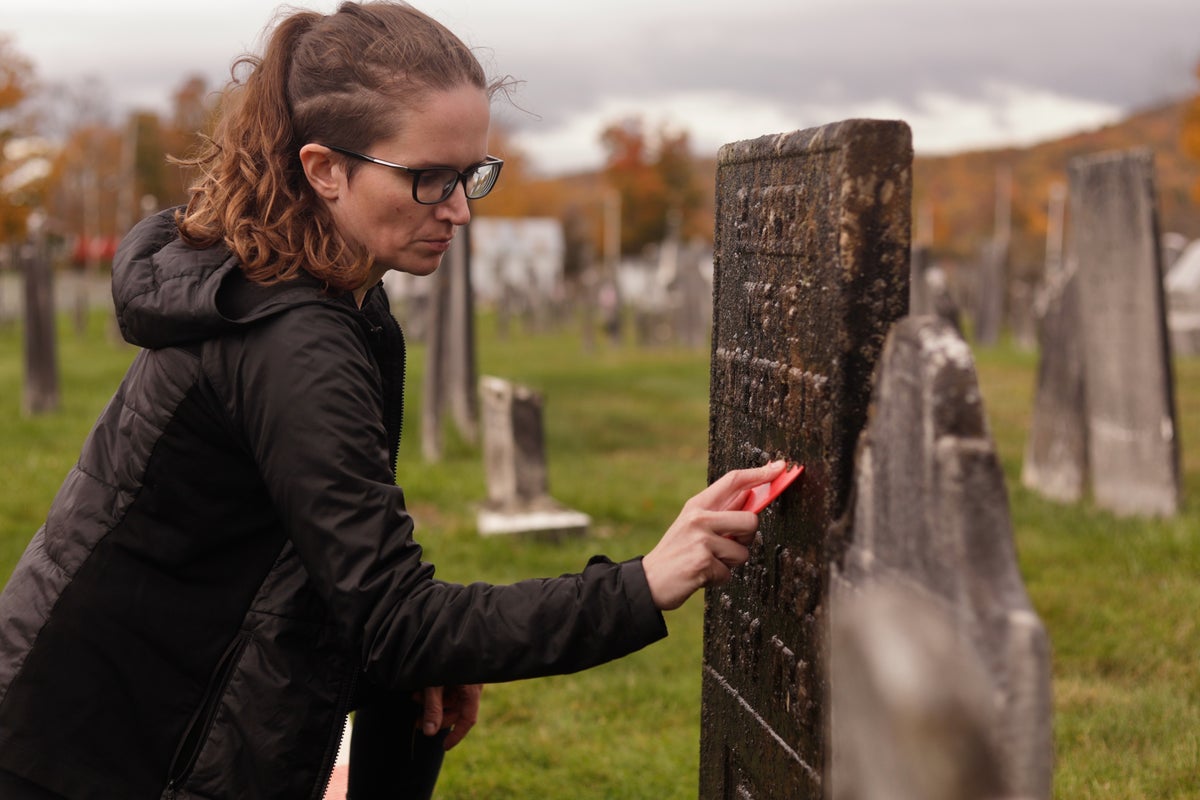
Equipped with a sturdy small brush and a large pump sprayer, Caitlin Abrams paused before two contrasting burial sites in a quiet cemetery in western Vermont. Autumn colors blanketed a nearby hillside beneath low-lying gray skies.
A year ago, Abrams carefully restored the headstone of Mary Bailey, who died in 1852 at age 21. That gleaming white marble marker now sharply contrasted with the adjacent grave of her sister, Eliza, which remained coated in decades of accumulated grime and moss.
Applying swift, light strokes, Abrams used her spraying bottle and brush to clear away layers of dirt concealing floral engravings on Eliza’s marker before turning to another stone.
"Sometimes you can definitely see a difference right away," she said. "Other times, it’s a month later you’ll come back and go ‘oh my gosh, it’s beautiful.’"
Abrams belongs to a growing group of online content creators who have built substantial followings by publishing videos of tombstone maintenance. These clips attract wide audiences, appealing to fans of cleaning footage and viewers seeking soothing, repetitive audio known for its calming effect.
Gravestone cleaning gained momentum during the pandemic
The practice gained significant traction during the COVID-19 pandemic, when people sought low-risk outdoor activities, creating unexpected points of connection around mortality.
However, the movement has drawn disapproval from critics who worry that strangers are using gravesites for online gain without informing descendants or risking physical damage to historic sites.
Abrams, however, offers more than just cleaning routines. As she washes away moss and organic buildup on camera, she narrates historical details she has uncovered about the deceased.
Her videos concentrate on 18th- and 19th-century markers in secluded Vermont cemeteries, connecting with viewers who appreciate her historical research and honest reflections on mortality.
"I let them pick me," Abrams said, referring to how she selects which graves to clean. "I’m drawn to it and kind of look at it and see how I feel."
She often highlights the lives of young women and children, drawing on her perspective as a mother of two in a historical landscape where male narratives often dominate.
Uncovering these histories requires extensive research. Abrams cross-references public records of births, marriages, and deaths alongside old newspaper archives.
"It’s like journalism, but for dead people," she joked.
Countless personal histories lie across American cemeteries
Although no single government database tracks every U.S. burial site, data visualization specialist Joshua Stevens mapped over 144,000 graveyards nationwide. Many of these locations require not just basic cleaning, but broader restoration and long-term preservation efforts.
While digital interest in cemetery upkeep is promising, it carries inherent risks, John Appell, CEO of Atlas Preservation and a professional monument restorer, noted.
"This is not a blanket statement, but there’s certainly a significant number of people that seem to be out there that kind of just want fame," he said.
Inexperienced handlers risk causing permanent harm to fragile markers through harsh scrubbing or rough handling, he warned. In 2021, an amateur genealogist acknowledged damaging about 200 gravestones at a cemetery in Maryland because of improper cleaning techniques.
Educational workshops offer volunteers a way to learn appropriate methods before working in local graveyards. For instance, hundreds of volunteers gathered in Louisiana in 2016 to help restore a Civil War-era cemetery.
"Cleaning is just one aspect of a much bigger subject," Appell said, pointing to the need to preserve monuments and structures inside historic cemeteries as well.
Gravestone maintenance forms a traditional ritual across cultures
Abrams concurred that using safe cleaning methods and obtaining proper permission from cemetery authorities are essential requirements before undertaking any work.
Maintaining burial markers is an established practice in various cultures worldwide. In Mexico, families gather to clean and adorn graves with vibrant orange marigolds during Day of the Dead celebrations. The observance starts Oct. 31 to honor accident victims, followed by Nov. 1, dedicated to deceased children, and concludes Nov. 2, honoring adults.
Historically, American cemeteries functioned as early public parklands where community members gathered, Abrams noted, though that connection has diminished over time. She hopes her content helps alleviate societal anxieties around burial grounds.
"I like the idea of a cemetery as a place where people can come and be and exist with the people who have passed before us," she said.