
Weather
Snowy 2.0 to cost 12 times more than initial budget with further delays
Key Points
Review finds Snowy 2.0 hydropower project could cost up to $25b with delays to late 2029 In short: A major review into Australia's biggest renewable energy project has found it could cost up to $25 billion, which is about 12 times the original price. Snowy 2.0 was initially set to cost $2b and come online in 2021. The project is now expected to be delivered in 2029.
Review finds Snowy 2.0 hydropower project could cost up to $25b with delays to late 2029
In short:
A major review into Australia's biggest renewable energy project has found it could cost up to $25 billion, which is about 12 times the original price.
Snowy 2.0 was initially set to cost $2b and come online in 2021.
What's next?
The project is now expected to be delivered in 2029.
The cost of delivering Australia's biggest renewable energy project has doubled since the last estimate and is now set to become fully operational a year later than expected, according to a major review.
Snowy Hydro has released its much-anticipated cost reassessment for the Snowy 2.0 hydropower project, revealing it could cost up to $25 billion, with first power expected in early 2029 and the project to be fully operational later that year.
While the Commonwealth-owned company has set a target cost of $22 billion, it is allowing for an additional $3 billion to be spent on the project if required.
Snowy 2.0, which started being built seven years ago, had an initial budget of $2 billion and was originally expected to start operating in 2021.
Those figures were revised as part of a "project reset" three years ago, which projected first power would be delivered in late 2027 and Snowy 2.0 would be fully operational a year later, at a cost of $12 billion.
Late last year it was announced that the project's contractor Future Generation Joint Venture (FGJV) would conduct a "line-by-line reassessment", which has now been released three months later than initially expected.
Snowy Hydro CEO Dennis Barnes said he was "incredibly disappointed" with the update.
"We had a project that was stalled and had billions of dollars of claims on the table in 2023," he said.
"I'm pleased we've got progress, progress doubled in the first year after the reset.
"What I'm disappointed about is obviously the resultant costs of the progress we're making."
Mr Barnes said the "design immaturity" that was faced before the 2023 reset had contributed to the latest cost blowouts.
"We've understood that we're going to need a lot more people for a lot longer to deliver this job," he said.
"This job is 80 per cent people costs, we've got 5,000 people on the job now working across multiple work fronts and that's obviously a lot more than we thought in 2023."
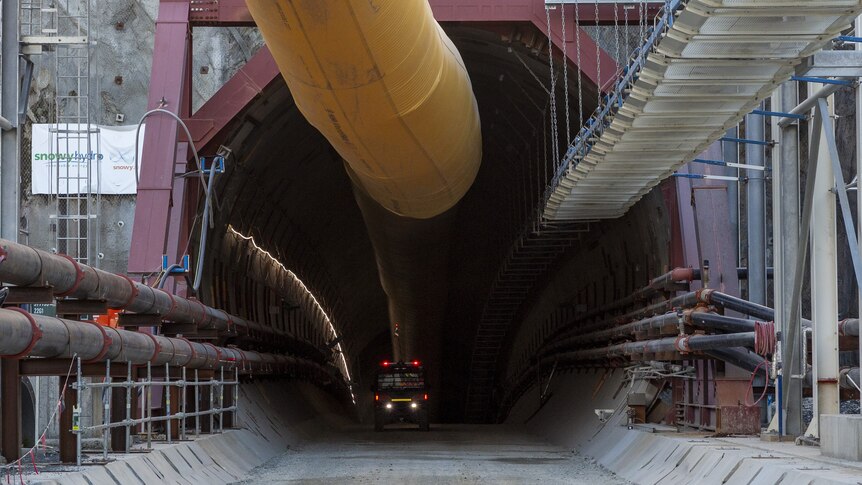
The review found 65 per cent of machine tunnelling and 90 per cent of cavern excavation had now been completed and work to build the underground power station was underway.
While Mr Barnes said the project was in its "strongest position yet", he could not rule out further cost blowouts beyond the most recent targets.
"There's never any guarantees with mega projects, we're doing a world first thing in many respects in really complex conditions," he said.
"But the project is hitting its milestones of late, we have a lot of the risks behind us."
How did Snowy 2.0 get here?
Snowy 2.0 is designed to underpin Australia's electricity security and affordability over coming decades, as the country transitions away from fossil fuels.
Based in the New South Wales Snowy Mountains, it will link two dams through about 27 kilometres of tunnels and include an underground pumped hydro station the size of the Sydney Opera House.
The project will act like a giant battery, pumping water upstream when electricity is cheap and releasing it back downstream to generate power when demand is high.
It has a total capacity of 2,200 MW and is expected to power three million homes for a week, the equivalent of about 26 million household batteries.
Unlike batteries, pumped hydro offers long-duration storage, meaning it is designed to be a renewable energy insurance policy during days when there is limited sun or wind.
But Snowy 2.0 has been embroiled in controversy since it was announced by former Prime Minister Malcolm Turnbull in 2017, including cost blowouts, missed deadlines, scrutiny over safety issues and contractor disputes.
A major setback came after one of the initial three tunnel boring machines, Florence, got stuck in early 2023 for 11 months after hitting soft ground and creating a sinkhole.
The National Audit Office gave Snowy 2.0 a glowing review in 2022 but the most recent audit, released earlier this year, found "significant deficiencies" in the management of the hydropower project.
In a submission to a parliamentary inquiry examining the project's delivery, Snowy Hydro said initial "design immaturity" and the project's "inherent complexity" had been the primary drivers of additional costs.
"Productivity underperformance and cost escalation have also been significant factors," the submission read.
"Others have related to project-specific complexities that have developed during delivery.
"Snowy Hydro has learned and taken action in response to these challenges."
A submission from Future Generation Joint Venture (FGJV), the group responsible for the project's construction, said "unprecedented geotechnical uncertainty" and "significant geopolitical upheaval" had contributed to cost escalations.
"Unlike metropolitan tunnelling projects, where initial ground investigations are typically well-developed, ground investigations within a national park are necessarily limited," the submission said.
"As a result, conditions only become fully apparent as excavation progresses."
Project benefits report released
Along with the cost reassessment, Snowy Hydro has also released an economic study conducted by engineering consultant GHD.
It found the project will contribute $18 billion to Australia's economy during the delivery phase and reduce wholesale electricity costs by more than $7b by 2075.
Mr Barnes said all technologies were needed for the energy transition, including batteries, pumped hydro and gas for firming.
"We issued a report earlier in the year to show what the grid looked like with and without Snowy 2.0 and on those periods, which are pretty common, where we get no wind and we get no sun for days on end, batteries run out of juice, they don't get recharged," he said.
"We actually saw that in January in South Australia, there was a period where the batteries run out of juice and prices went very high.
"So with Snowy 2.0 in the grid, we see that the prices in those periods were $7,000 a MWh lower."
A joint statement from Energy Minister Chris Bowen and Finance Minister Katy Gallagher said abandoning the hydropower project would "undermine grid reliability", scrap 5,000 jobs and lead to higher electricity bills.
"Once completed, Snowy 2.0 will be an incredible national asset, supporting Australia's energy security, price stability and the transition to renewable energy," the statement said.
"The pumped hydro expansion of the Snowy Scheme will provide more than half of the total energy storage the grid needs by 2050, strengthening energy security and putting downwards pressure on energy prices."