
Business & Finance
Canada and Turkey forge ‘strategic partnership’ in push to cut US trade reliance
Key Points
Canada and Turkey forge ‘strategic partnership’ in push to cut US trade reliance During the ceremony, Canadian and Turkish ministers finalized several cooperation agreements covering energy, defense, and air transportation - Bookmark - CommentsGo to comments Become an Independent member to bookmark this article Already a member? Log in NATO allies Canada and Turkey formally elevated their diplomatic relationship to a "strategic partnership" during the first official visit by a Canadian prime...
Canada and Turkey forge ‘strategic partnership’ in push to cut US trade reliance
During the ceremony, Canadian and Turkish ministers finalized several cooperation agreements covering energy, defense, and air transportation
- Bookmark
- CommentsGo to comments
Become an Independent member to bookmark this article
Already a member? Log in
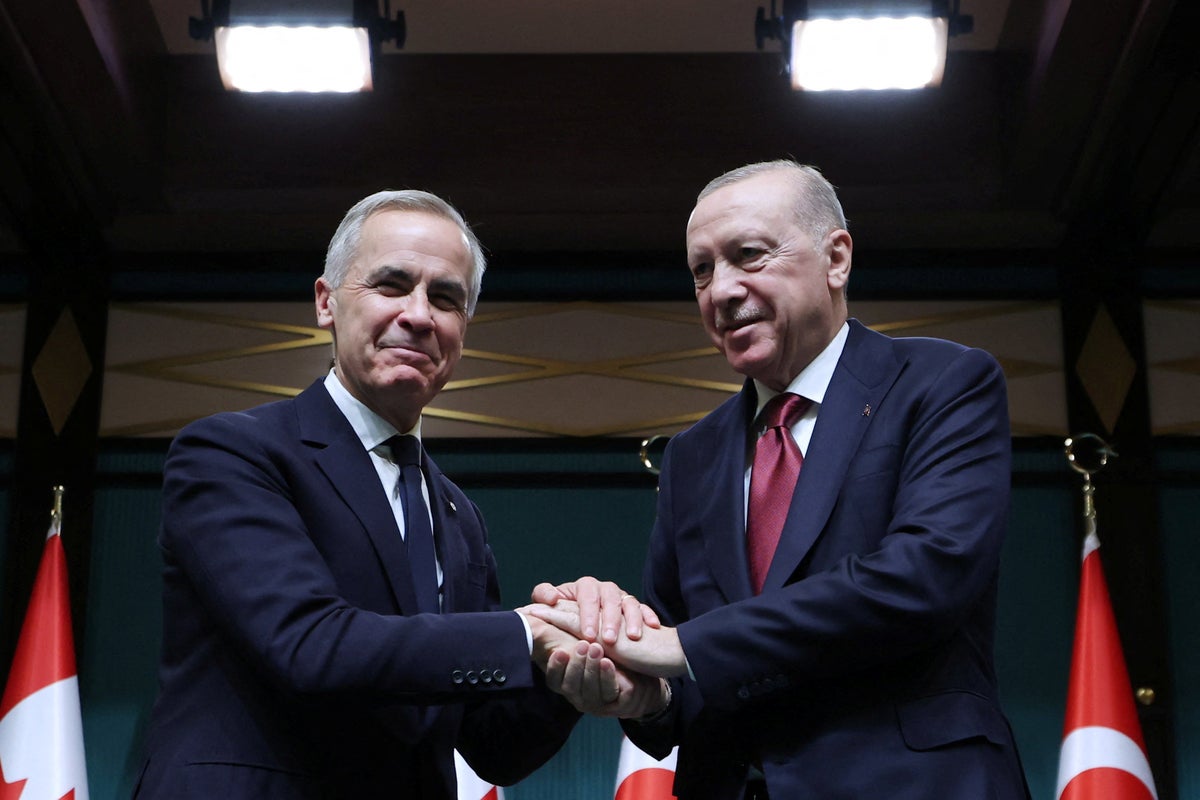
NATO allies Canada and Turkey formally elevated their diplomatic relationship to a "strategic partnership" during the first official visit by a Canadian prime minister to the country on Thursday, as Mark Carney actively pursues new international trade channels to decrease reliance on the United States.
The accord, concluded in Ankara between Carney and Turkish President Tayyip Erdogan, marks a notable warming in bilateral ties that were previously strained by Canadian concerns over human rights and a past ban on arms shipments to Turkey.
The new partnership focuses on four key areas: trade and investment, defense and security, energy, and social and diplomatic ties.
The agreement aims to generate jobs and open fresh commercial opportunities for Canadian and Turkish firms to increase joint business operations.
Carney is currently conducting a broader international trade push designed to shield Canada from potential trade disputes with the U.S., where President Donald Trump has introduced broad tariffs and raised questions regarding the neighboring nation's sovereignty.
Appearing alongside Erdogan at the presidential palace in Turkey, Carney stated that the strategic partnership rests on four pillars and incorporates a three-year action plan.
"We've planted the seeds of something new: a strategic partnership that will create new opportunities for our workers and businesses, and greater security and prosperity for both our peoples. With care and commitment, it will grow for generations to come," Carney said.
During the ceremony, Canadian and Turkish ministers finalized several cooperation agreements covering energy, defense, and air transportation.
Turkey, an emerging market economy and major regional military power, is seeking fresh foreign investment and partnerships for its growing defense sector, planned nuclear power stations, and mining industry.
Erdogan, who has governed Turkey for 23 years, commended Carney as a leader demonstrating "common-sense and acumen" on the international political stage.
"Today, we have alleviated the long-standing Turkey-Canada disconnect. Now, we are starting a new era between Turkey and Canada," Erdogan said. He added that both nations intend to expand bilateral trade volume from $3 billion initially to $5 billion and eventually to $10 billion, though no timeline was specified.
Negotiators from both countries will start the initial round of free trade negotiations next month in Ankara, Carney announced, adding that Export Development Canada and Turkey's Eximbank will sign a new agreement to support joint corporate projects in third-party countries.
Carney emphasized the necessity of advancing relations with Turkey amid a broader global "rupture" and an emerging "new world order," though neither leader made direct reference to the United States. Carney is set to meet leading Turkish business executives and investors in Istanbul on Friday.
In the energy sector, both nations pledged to expand cooperation in areas including nuclear energy, critical minerals, and liquefied natural gas (LNG).
Reuters previously reported this week that both nations intended to sign a formal declaration deepening bilateral ties across the four primary areas announced on Thursday.
Although total merchandise trade between the two nations remains relatively modest—with Turkey accounting for under 0.3% of Canada’s total trade at C$4.34 billion ($3.09 billion)—bilateral trade has grown by nearly 50% over the last five years.
However, Canada still directs roughly 70% of its total exports to the US market.
"This trip is part of the geopolitical necessity of signalling to Americans that we are not sitting around waiting for them," said Bessma Momani, a political science professor at the University of Waterloo.
Over the past year, Canada has concluded more than 20 trade agreements as part of Carney’s strategy to double non-US exports within the next decade.
This effort included a visit to China aimed at restoring strained relations, which drew criticism after Canadian officials previously asserted that Beijing had interfered in at least two federal elections. China maintains that it does not intervene in the internal affairs of other nations.
Meanwhile, Turkey's measures against political opposition since 2024 and recent arrests targeting the LGBTQ+ community since September have drawn criticism from human rights groups and European officials. Officials in Ankara maintain that the judiciary operates independently, denying that court cases or investigations are politically driven.
Analysts suggest Carney has placed less focus on human rights matters than his predecessors.
"Carney will have to walk a very fine line in Turkey between opening new economic possibilities for Canada while trying to maintain Canada's middle power role in fighting for equality," said Anna Agathangelou, a politics professor at York University.
At the NATO leaders' summit in July, Carney and Erdogan launched formal free-trade talks, while Turkey also agreed to join Canada’s Defence, Security and Resilience Bank as a founding member.
Turkey has conducted discussions with Canadian engineering firm AtkinsRealis alongside South Korea's Korea Electric Power Corporation and China's State Power Investment Corporation regarding the potential construction of its planned second and third nuclear power facilities.
In 2024, Canada lifted weapons-export controls on Turkey, including restrictions on optical technology used in drones exported by Turkey to numerous countries. Canada's primary exports to Turkey currently consist of lentils, aircraft, and electronics, while importing medical devices, fishing vessels, aircraft engines, and jewelry.
Join our commenting forum
Join thought-provoking conversations, follow other Independent readers and see their replies
Comments