
Health
World-first personalised cancer vaccine slashes risk of death and disease returning
Key Points
World-first personalised cancer vaccine slashes risk of death and disease returning Melanoma is the most aggressive form of skin cancer causing about 2,600 deaths a year in the UK - Bookmark - CommentsGo to comments Become an Independent member to bookmark this article Already a member? Log in A personalised cancer vaccine given alongside a widely used immunotherapy drug can cut the risk of patients dying or skin cancer returning by 42 per cent in what has been hailed a “major breakthrough”....
World-first personalised cancer vaccine slashes risk of death and disease returning
Melanoma is the most aggressive form of skin cancer causing about 2,600 deaths a year in the UK
- Bookmark
- CommentsGo to comments
Become an Independent member to bookmark this article
Already a member? Log in
A personalised cancer vaccine given alongside a widely used immunotherapy drug can cut the risk of patients dying or skin cancer returning by 42 per cent in what has been hailed a “major breakthrough”.
The phase three trial of the mRNA jab coupled with immunotherapy, which tracked more than 1,100 patients, found it reduced the risk of melanoma — the most aggressive form of skin cancer causing about 2,600 deaths a year in the UK — spreading by 38 per cent over two years compared to the use of immunotherapy alone.
Normally, only around a third of patients with the worst form of the disease live for five years after diagnosis.
The success has been celebrated as the start of a new era for personalised cancer vaccines and frug manufacturers MSD and Moderna said the combined approach was now being tested on other types of cancers, including kidney, bladder and lung.
“The personalised cancer vaccine uses exciting technology to stimulate the patient’s own immune system to recognise and attack any tumour cells remaining after surgery,” Professor Pippa Corrie, a consultant medical oncologist who helped run part of the study with patients at Addenbrooke's Hospital in Cambridge, said.
“It is a whole new approach to cancer treatment which is designed to improve outcomes compared with standard anticancer drug treatments that don't take into account individual differences, and this trial was the first proof of principle,” she added.
For the study, 1,137 adults were given Keytruda, an immunotherapy drug which helps the immune system find and attack cancer cells. About two-thirds were also given the experimental vaccine and the rest were given a placebo.
The vaccine, called Intismeran, is personalised to each patient and uses cells from own tumour to train their immune system to spot the cancer cells that need to be targeted.
Two years after starting the trial, patients who were given the experimental jab were less likely to see their melanoma return.
Among those who received the vaccine paired with Keytruda, 82.2 per cent remained cancer-free after two years, compared to 70 per cent of those who received Keytruda alone.
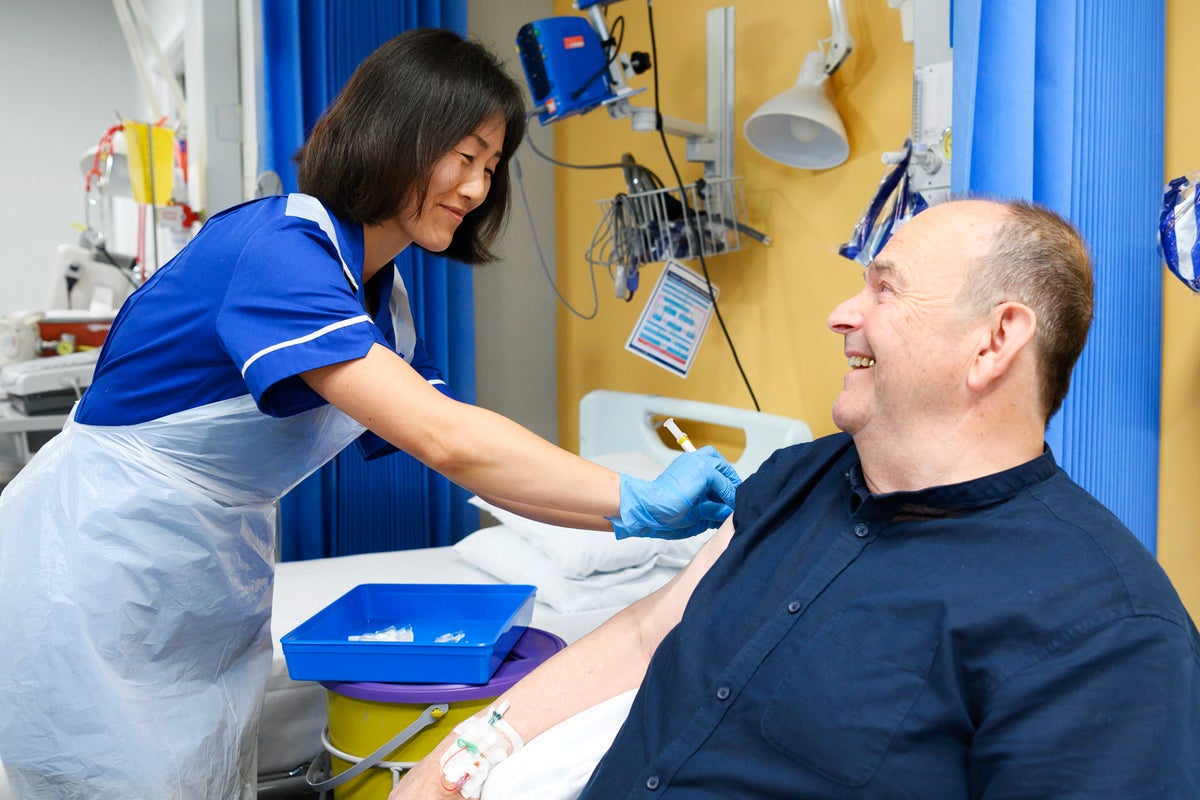
Tony Chapman, 75, who was diagnosed with stage three cancer in 2019 took part in the international trial at Addenbrooke's Hospital.
The retired businessman from North Northamptonshire had a melanoma removed from his chest following his diagnosis, but four years later he discovered a lump under his armpit and needed surgery to remove the lymph nodes.
Mr Chapman does not know if he received the vaccine or placebo, alongside the immunotherapy drug, Keytruda. But since taking part in the trial and finishing treatment at the NIHR Cambridge Clinical Research Facility last year, he remains cancer free.
“I couldn’t get over how groundbreaking it sounded. The opportunity to play a small part in furthering scientific research and potentially helping others along the way, was too exciting to miss out on,” he said.
Although cancer experts who were not part of the study are impressed with the outcomes, they believe more studies are needed to find out which treatments help patients live longer and test it on other cancers.
Alan Melcher, professor of translational immunotherapy, at The Institute of Cancer Research, London, said: “Melanoma is leading the way, but vaccines are being investigated in many other cancers, including cancers that are very difficult to treat and don’t respond well to current immune-based treatments. The challenge now is working out which cancers and which patients are most likely to benefit, and which are the best vaccine targets to go for.
“We’re closer to cancer vaccines becoming part of routine treatment than we’ve ever been, but they are not going to replace existing treatments across the board. The more realistic prospect is that they become another powerful tool that we can combine with treatments such as immunotherapy,” he added.
“This is a major breakthrough for cancer vaccine research,” Dr Lennard Lee, Associate Professor of AI and Cancer Vaccine Research at the University of Oxford, said.
“Perhaps the biggest implication is that the future of cancer vaccines may be personalised. Every patient’s cancer is different. Every person’s immune system is different. Rather than giving everyone the same medicine, this trial demonstrates the potential of designing cancer vaccines around the unique genetic fingerprint of an individual patient’s tumour,” he added.
Join our commenting forum
Join thought-provoking conversations, follow other Independent readers and see their replies
Comments
World-first (EVENT)
UK (LOCATION)
Independent (ORG)
MSD (ORG)
Moderna (ORG)
Pippa Corrie (PERSON)
Addenbrooke's Hospital (ORG)
Cambridge (LOCATION)
Keytruda (ORG)
Intismeran (ORG)
Tony Chapman (PERSON)
North Northamptonshire (LOCATION)
Chapman (PERSON)
the NIHR Cambridge Clinical Research Faci (ORG)