
Politics
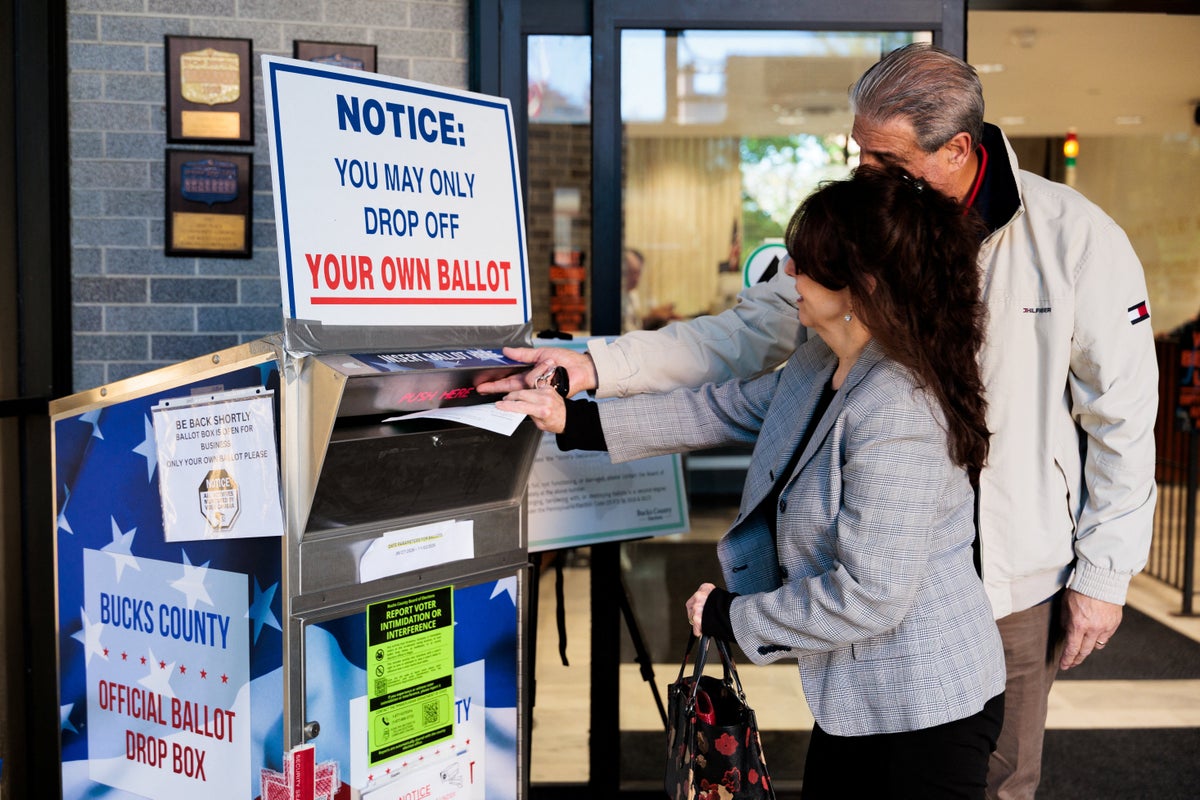
Fear of Trump challenging mail-in ballots appears to be flooding early voting sites
Key Points
Fear of Trump challenging mail-in ballots appears to be flooding early voting sites More than 22 million Americans have already voted. Did Trump’s threats to voting by mail backfire? - Bookmark - CommentsGo to comments Become an Independent member to bookmark this article Already a member?
Fear of Trump challenging mail-in ballots appears to be flooding early voting sites
More than 22 million Americans have already voted. Did Trump’s threats to voting by mail backfire?
- Bookmark
- CommentsGo to comments
Become an Independent member to bookmark this article
Already a member? Log in
Early voting turnout for this year’s midterm elections is shredding records across the country.
The surge comes as mail-in ballot returns are plummeting compared to previous midterm election years, a likely reaction to Donald Trump’s threats to voting by mail and his attempts to take control of the nation’s elections, according to voting rights groups and election experts.
As of Friday morning, more than 22 million Americans have already cast their ballots with less than two weeks before Election Day, according to the Election Lab at the University of Florida, the leading authority for independent voting data. More than 45 percent of all ballots cast thus far came from Democratic voters.
But several states with close races that could determine the balance of power in Congress are reporting sharp declines in the number of mailed ballots compared to the same period in the 2022 midterms — even as they report record-breaking turnout.
In Ohio, mail-in ballot requests this year declined by roughly 28 percent even as early in-person voting increased by nearly 200 percent. In Georgia, more than 69,000 mail ballots were accepted by election officials as of Thursday, marking a more than 50 percent decline from the same period in 2022, while in-person turnout continues to break records.
“We continue to break records each day of early voting,” Georgia Secretary of State Brad Raffensperger said this week. “This is evidence that Georgians trust our election process.”
Raffensperger, a Republican, was at the center of the president’s failed attempts to overturn election results in the state in 2020, opening a sprawling investigation into Trump’s efforts to reverse his election loss, which he has attributed to baseless allegations of widespread fraud.
The president has waged a years-long crusade against mail-in voting, a process he has labeled “inherently corrupt,” a form of “cheating” and “sad” and “crazy.”
“ELECTIONS CAN NEVER BE HONEST WITH MAIL IN BALLOTS/VOTING,” Trump wrote in August, just weeks before the Supreme Court rejected his attempt to restrict mail voting before midterm elections.
Trump’s plan would have required states to use a standardized envelope design and submit lists of eligible voters through an online portal. The U.S. Postal Service would then be allowed to refuse delivery of mail-in ballots from any state that failed to comply with these rules.
The ruling delivered a major blow to Trump’s attempts to centralize control of the nation’s elections, which would have given the nation’s postal agency expansive authority to decide who gets to vote in an unprecedented shakeup of election administration.
He also failed to convince Republicans in Congress to pass legislation to overhaul election administration and has not ruled out the possibility of emergency actions to restrict ballot access before Election Day.
Elections officials and voting rights groups have warned that the president’s threats and contradictory statements — he’s still encouraging Republicans to vote by mail, sensing major losses in November — have not only confused voters about the rules but have also cast doubt about the security of their ballots.
An NBC News poll this summer also showed that fewer than one-quarter of Democratic voters said they planned to vote by mail this year, amounting to a double-digit drop from 2024, when 34 percent of Democrats said they were planning to cast their ballots by mail for that year’s presidential election.
But election officials are reporting a significant spike in early voting turnout as a sign of voter enthusiasm, particularly in states with tight races for the House and Senate.
In Texas, early voting is up 74 percent compared with 2022, according to state election officials. In Kansas, early voting turnout has more than doubled. Maine and North Carolina are also seeing increases of more than 30 percent compared to the same period in 2022.
Michael McDonald, a political science professor at the University of Florida, found that while requests for mail ballots are down, voters are returning them fast.
“The punchline is that if Donald Trump’s attacks on mail balloting shifted some Democrats to voting in-person or casting ballots earlier, he probably did Democrats a favor since rejected mail ballots are the most frequent way voters disenfranchise themselves,” he wrote.
Still, even without the fallout from the president’s failed attempts to rewrite the rules for mail-in ballots, cost-cutting measures across USPS that have forced mail sorting facilities and post offices to consolidate could be leading to significant delays — particularly for rural voters.
For example, in 11 predominately rural counties in eastern Washington, nearly 2,000 ballots have arrived later, compared to about 600 in 2022, according to an investigation from ProPublica.
Those delays could endanger the validity of voters’ ballots and potentially lead to rejections without enough time for voters to correct any errors.
Democratic members of Congress are also pressing social media companies for details on how they plan to stop election misinformation from spreading on their platforms.
In letters to Google, Meta, TikTok and X this week, Rep. Jamie Raskin, the top Democrat on the House Judiciary Committee, warned that any posts “suggesting that a lawfully cast mail-in ballot will not be counted — even if made by senior Republican officials — are not a matter of opinion.”
“They are false statements that clearly fall within your own prohibitions and standards,” he wrote Friday.
“We plan to exercise vigilant oversight of your platform and other social media companies to ensure that propaganda and fabrications indeed do not work to prevent Americans on your platform from participating in our democratic process,” he added.
Join our commenting forum
Join thought-provoking conversations, follow other Independent readers and see their replies
Comments