
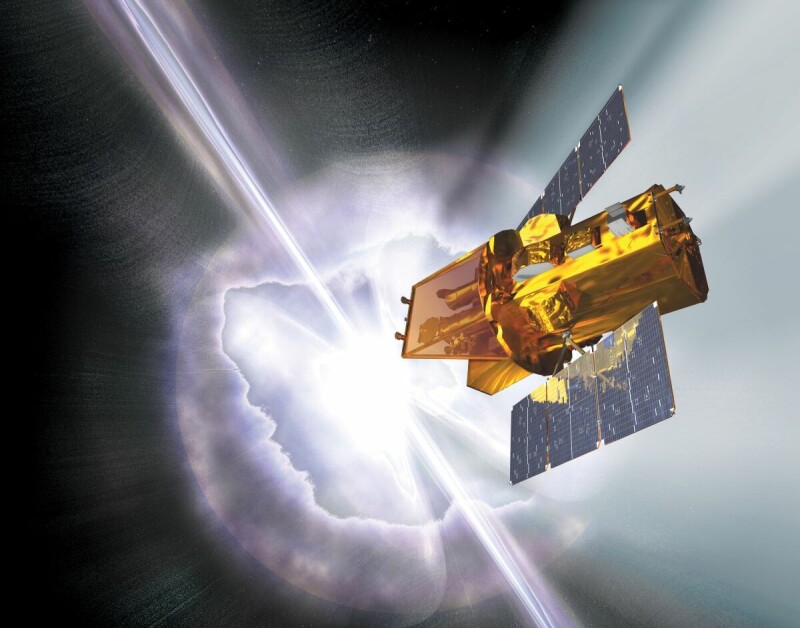
NASA's Swift observatory made its final observation on October 20 and is expected to re-enter the atmosphere in the next few weeks after a failed rescue attempt over the summer.
Designed to study gamma-ray bursts, Swift was launched on November 20, 2004, on a two-year mission. It has lasted almost 22 years, but atmospheric drag is inexorably lowering the spacecraft's orbit, so reentry is likely just shy of the vehicle's 22nd anniversary. Swift has no propulsion system to save itself.
Swift is now orbiting at an altitude of less than 171 miles above Earth's surface, meaning it cannot keep its telescopes steady when pointing at astronomical targets.
Because the spacecraft could no longer compensate for the increased drag, it dropped into safe mode. A command was then sent from the ground that, according to NASA, "effectively ended Swift operations to prepare it for re-entry."
The descent of Swift has accelerated in recent years due to increased solar activity. Last year, NASA awarded Katalyst Space a contract for a high-risk, high-reward mission to boost the observatory to a higher orbit. Swift's science operations were curtailed to maximize opportunities for Katalyst Space's LINK spacecraft, but alas, a rendezvous never happened, and engineers opted to reactivate operations to eke out as much science as possible.
The expected side effect was increased drag on the spacecraft and, as expected, Swift sank rapidly until operations had to cease.
Swift has been an astonishingly productive instrument during its long life. According to NASA, it has observed more than 2,000 gamma-ray bursts and more than 1,400 supernova explosions. It has conducted an all-sky X-ray survey and seen stars shredded by black holes.
The full Swift archive comes to approximately 12 terabytes. Not too bad for something that was only supposed to last two years.
NASA now faces the problem that it has no direct replacement for Swift. As well as paying tribute to the observatory's contributions, Shawn Domagal-Goldman, director of the Astrophysics Division at NASA Headquarters in Washington, said in a statement:
"To support rapid response to cosmic events in a post-Swift world, we're exploring our ability to use and augment NASA's fleet of existing space telescopes, from fast-to-orbit commercial capabilities to efficient, innovative new missions." ®