
Science
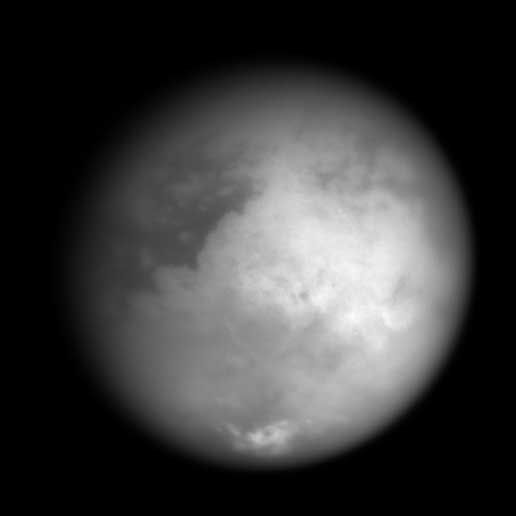
On this day in space! Oct. 26, 2004: Cassini spacecraft takes 1st-ever closeup photos of Saturn moon Titan
Key Points
On this day in space! Cassini spacecraft takes 1st-ever closeup photos of Saturn moon Titan At the closest point of this flyby, Cassini was 745 miles (1,200 kilometers) away from the surface of Titan. On Oct. 26, 2004, NASA's Cassini spacecraft took the first close-up images of Saturn's largest moon Titan.
On this day in space! Oct. 26, 2004: Cassini spacecraft takes 1st-ever closeup photos of Saturn moon Titan
At the closest point of this flyby, Cassini was 745 miles (1,200 kilometers) away from the surface of Titan.
On Oct. 26, 2004, NASA's Cassini spacecraft took the first close-up images of Saturn's largest moon Titan.
The Cassini spacecraft would later drop off a probe on Titan named Huygens, which was a European spacecraft that hitched a ride to the Saturn system with the Cassini mission. But before Cassini dropped off its robotic passenger, it flew by Titan a few times and took some amazing photos.
Cassini completed its first flyby on July 3, 2004, but when it swung by a second time on Oct. 26, it got about 300 times closer than it did the first time. At the closest point of this flyby, Cassini was 745 miles (1,200 kilometers) away from the surface of Titan. The spacecraft took hundreds of photos during this flyby, and these were the highest resolution views of Titan anyone had ever seen.
Why it mattered
Astronomers knew Saturn's moon Titan had an atmosphere before Cassini arrived at the smog-shrouded moon, but the spacecraft's first photos (and innumerable more that followed) revealed a strange world that looked eerily similar to what scientists suspect a young Earth might have been like.
The first close-up views of Titan by Cassini showed a large continent-sized region that scienitsts called Xanadu. It included bright features that hinted at a mountain range, as well as a large basin and smooth plains regions.
In all, Cassini would make 127 close flybys of Titan during its 13 years at Saturn before the mission ended in 2017. The probe even dropped the European Huygens lander on Titan, which landed in January 2005, to see the moon's surface first hand.
This flyby image of Titan (and other instrument observations taken at the same time) allowed scientists to measure Titan's atmosphere density and composition to better plan the path and descent for the Hygens lander.
Want more space history? Check out our full On This Day In Space Story archive and watch our On This Day In Space videos on YouTube.
Hanneke Weitering is a multimedia journalist in the Pacific Northwest reporting on the future of aviation at FutureFlight.aero and Aviation International News and was previously the Editor for Spaceflight and Astronomy news here at Space.com. As an editor with over 10 years of experience in science journalism she has previously written for Scholastic Classroom Magazines, MedPage Today and The Joint Institute for Computational Sciences at Oak Ridge National Laboratory. After studying physics at the University of Tennessee in her hometown of Knoxville, she earned her graduate degree in Science, Health and Environmental Reporting (SHERP) from New York University. Hanneke joined the Space.com team in 2016 as a staff writer and producer, covering topics including spaceflight and astronomy. She currently lives in Seattle, home of the Space Needle, with her cat and two snakes. In her spare time, Hanneke enjoys exploring the Rocky Mountains, basking in nature and looking for dark skies to gaze at the cosmos.
- Tariq Malik Editor-in-Chief
You must confirm your public display name before commenting
Please logout and then login again, you will then be prompted to enter your display name.