
UK News
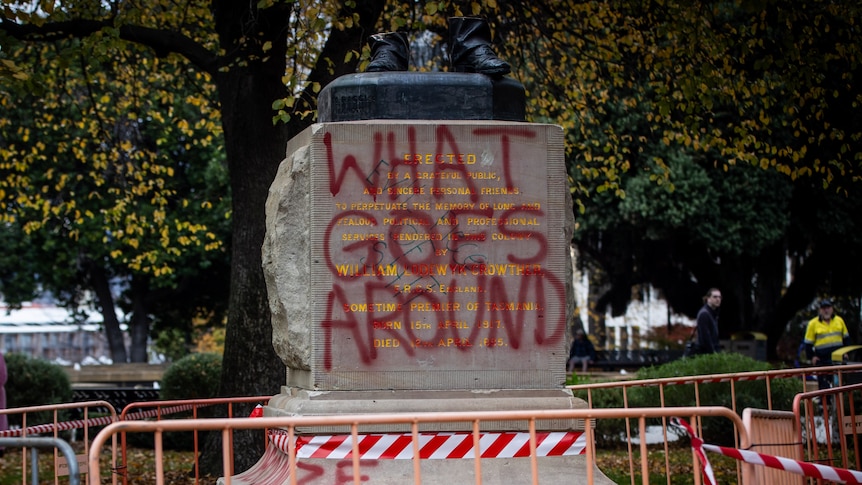
Should we replace controversial colonial statues? Hobart just did
Key Points
Hobart unveils permanent replacement for toppled William Crowther statue In short: Hobart has unveiled the replacement for the statue of William Crowther, which was toppled by vandals in 2024. It involves a native garden within a bronze ring, inscribed with the history and legacy of the statue. The project is being touted as potential inspiration for how other councils may deal with similarly controversial statues.
Hobart unveils permanent replacement for toppled William Crowther statue
In short:
Hobart has unveiled the replacement for the statue of William Crowther, which was toppled by vandals in 2024.
It involves a native garden within a bronze ring, inscribed with the history and legacy of the statue.
What's next?
The project is being touted as potential inspiration for how other councils may deal with similarly controversial statues.
The divisive statue of a colonial figure, which was toppled in a Tasmanian park, has been replaced with a native garden surrounded by a "ring of truth telling", in a project believed to be the first of its kind in Australia.
Vandals cut down the statue of William Crowther at Hobart's Franklin Square in mid-2024, hours before the Tasmanian Civil and Administrative Tribunal upheld a council's decision to organise its removal.
Crowther was a surgeon and politician during the 1800s, who most historians agree broke into a morgue and stole the skull of deceased Aboriginal man William Lanne for pseudoscience.
The permanent replacement for his statue, unveiled by the City of Hobart today, incorporates a native garden and circle of bronze around the vacant plinth which once held the statue.
The bronze ring has been inscribed with contributions from three writers: one on Crowther and colonial life, one on Lanne and Palawa history, and one offering social commentary about statues.
Despite the vandalism, the project is believed to be the first example of an Australian council deciding to remove a colonial statue through a democratic process.
In a statement, Hobart's Lord Mayor Anna Reynolds said the installation was the result of more than five years of consultation with the community and it provided a "more honest and complete" understanding of the city's history.
"It's not about erasing history, but rather providing even more information, context and a broader range of perspectives that have often been absent from public spaces,"Cr Reynolds said.
"This new installation demonstrates how complex — and at times controversial — issues can be addressed through respectful engagement, thoughtful design, democratic decision-making and proper legal processes."
Design invites people to walk 'meditatively' around garden
Mat Hinds, the architect commissioned to design the reinterpretation, said the native garden was a reference to the area's past as an "open flowering field" before colonisation.
He said the bronze ring was a reference to the material of the original statue and to Lanne's work on whaling ships, on which bronze was an essential material.
"It's been repurposed as a ring of truth telling, effectively like a halo of light, and the three narratives run in that," Mr Hinds said.
"What it requires is that people walk in a circular way, almost meditatively, around the perimeter of the garden and take in the messaging of what's been written."
The architect said the decision to keep the original plinth in place was an "echo" of the decision to remove the original statue.
Mr Hinds said the reinterpretation was a "sophisticated" approach to sharing local history, as statues were a "really dumb way of retaining communal memory".
"For what they show, in equal measure, they hide, and more often than not, statues are out of proportion with the actual person," he said.
Aboriginal experience 'reflected in this space'
One of those who contributed to the inscription was Nunami Sculthorpe-Green, a Palawa and Warlpiri woman, who wrote about William Lanne and life for Aboriginal people in Tasmania during the 1800s.
Ms Sculthorpe-Green said the project gave her a chance to "re-centre" the life of Lanne within this story.
"After decades of calling for change, the Tasmanian Aboriginal community can now see our experience and humanity reflected in this space," she said.
History writer Alison Alexander contributed to the ring with some words about Crowther, which she said was important as the city "can't pretend the story didn't happen".
"There was a statue there, it's been taken down in this more enlightened age, and so I think it's important to tell that story and to say, right, we are putting the past behind us," Dr Alexander said.
The final contribution was from arts writer Andrew Harper, who wrote about the history of statues being toppled and how "history is action and not objects".
Mr Harper had tried to find another city-led project where Aboriginal artists were asked to respond to a colonial statue with a "problematic" history, but he could not find one.
"That's a huge achievement for this city and for the people that drove the project and for the artists that took part in it and even for the people who objected to it," he said.
"We did something that might be new, something we can share with the entire world, because there are people all over the world asking, 'What do we do about this?'"
Each writer had to limit their contribution for the ring to just 250 words, however a longer piece of text is available on the City of Hobart website and accessible through a QR code on the site.
Statues at centre of global debate
Statues have become a major point of public debate, protest and political action in Australia and across the world, as modern communities question who should be honoured in public spaces.
Protesters in the United Kingdom pulled down a bronze statue of merchant and slave trader Edward Colston, before throwing it into Bristol's harbour during a Black Lives Matter demonstration in 2020.
A statue of British explorer James Cook in the Melbourne suburb of St Kilda was sawn off at the ankles by vandals on the eve of Australia Day in 2024.
Other statues of Australian colonial figures, including Melbourne founder John Batman and New South Wales governor Lachlan Macquarie, have been the subject of fierce debate.
While some believe they should be removed, others have argued this would be silencing, erasing or rewriting the nation's history.
The reinterpretation of the Crowther statue in Hobart was the culmination of a multi-year public arts project, which involved temporary artworks by Palawa artists and community consultation.
The original bronze statue of William Crowther has been restored, with the ankles re-welded to the main body, though it was still being kept in storage by the City of Hobart.
[Image text:] Warel
GOES
AROUMT
Hobart (PERSON)
William Crowther (PERSON)
Tasmanian (ORG)
Australia (LOCATION)
Franklin Square (LOCATION)
the Tasmanian Civil (ORG)
Administrative Tribunal (ORG)
Crowther (PERSON)
Aboriginal (ORG)
William Lanne (PERSON)
the City of Hobart (LOCATION)
Lanne (PERSON)
Palawa (PERSON)
Australian (ORG)
Anna Reynolds (PERSON)