
Weather
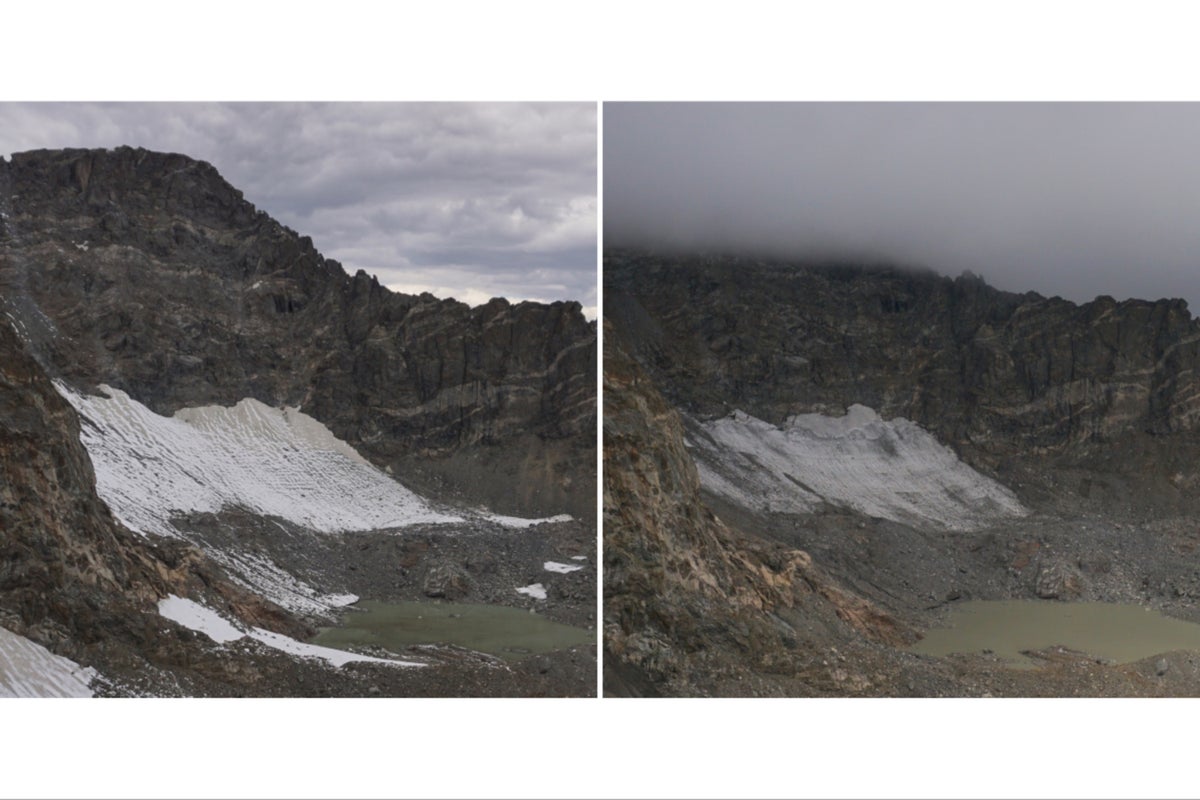
Colorado's glaciers thinned dramatically in 2026 and could soon disappear entirely, scientists warn
Key Points
Colorado's glaciers thinned dramatically in 2026 and could soon disappear entirely, scientists warn One glacier thinned by over 12 feet (3.7 meters) in just one year - Bookmark Become an Independent member to bookmark this article Already a member? Log in Unprecedented warm weather and historically low snowfall over the past year caused significant thinning across Colorado’s most notable glaciers, new findings show. This decline mirrors global trends of ice loss, where rising temperatures...
Colorado's glaciers thinned dramatically in 2026 and could soon disappear entirely, scientists warn
One glacier thinned by over 12 feet (3.7 meters) in just one year
- Bookmark
Become an Independent member to bookmark this article
Already a member? Log in
Unprecedented warm weather and historically low snowfall over the past year caused significant thinning across Colorado’s most notable glaciers, new findings show.
This decline mirrors global trends of ice loss, where rising temperatures speed up melting while diminished snowfall fails to rebuild ice. The worldwide contraction threatens vital water supplies, heightens risks in mountainous areas, and drives up sea levels.
Although ice changes are usually tracked over extended periods, Colorado State University glaciologist Dan McGrath examined the single year of 2026 due to its extreme climate conditions. The Rocky Mountains’ permanent ice fields were left vulnerable after the state experienced its lowest recorded snowpack, followed immediately by record-breaking summer heat.
Data from McGrath indicates that the Andrews Glacier thinned by over 12 feet (3.7 meters) in just one year, while the Arapaho Glacier shed almost 10 feet (3 meters) and the Isabelle Glacier shrank by around 6.5 feet (2 meters). These losses represent double the rate of thinning recorded in the preceding five years, compared to earlier annual losses of just one foot or less per year during the prior decade.
Meanwhile, St. Mary's Glacier, a long-standing snowfield widely used by outdoor enthusiasts including hikers and skiers, melted away entirely by September.
"What we’re witnessing is the loss of that part of Colorado’s identity. And it’s not just Colorado," said McGrath, who specializes in glacier dynamics. "Obviously we see it in the Alps and we’re seeing it in other mountain ranges in the western U.S., the European Alps and globally. There are very clear, consistent patterns across these ranges."
Climate change is shrinking glaciers faster than ever
More than 7 trillion tons of ice (6.5 trillion metric tons) has been lost worldwide since 2000, according to research, a slow-motion disaster that sometimes provokes sudden devastation: More than 1,300 people were killed in August after a massive section of rock and overlying glacier collapsed near Nepal’s border with China.
Glaciers in Switzerland lost 5.5% of their ice volume this year, the second-biggest percentage drop on record, due to heat waves and low winter snowfall. The GLAMOS Swiss glacier monitoring service and Swiss Academy of Sciences said this month that alpine glaciers have no chance of surviving long-term under such conditions. Switzerland is home to the most glaciers in the Alps.
In Washington state, researchers with the North Cascade Glacier Climate Project have surveyed six glaciers on Mount Baker during an annual summer trip. Director Mauri Pelto said this year's survey shows the fastest average retreat since 1950 with the collapse of several large ice caves, which form as warm air circulates in retreating glaciers.
Mountain glaciers in the contiguous United States average just 0.16 square miles (0.41 square kilometers), or about 100 acres (about 40 hectares), and are widely distributed at high elevations. Since the mid-1900s, about one-quarter of them have disappeared and the remnants have lost a third of their area and volume, according to a new study co-authored by Brian Menounos, an earth sciences professor at the University of Northern British Columbia.
The runoff supplies water to high alpine and downstream ecosystems across the western United States, and eventually these areas may become more vulnerable to extreme drought as the glaciers disappear, he added.
And in a “one-two punch,” wildfires also are hastening the melting by darkening the surfaces of glaciers with soot and dust, Menounos said, making them more vulnerable to absorbing sunlight.
Glaciers could re-form if carbon pollution declines substantially and temperatures drop enough to enable snowfall to build year-round, eventually compressing again into glacial ice, but that may take several hundred years, Menounos added.
Colorado's glaciers may not have much time left
Looking at how much ice Colorado's remaining glaciers have lost, McGrath thinks they could soon disappear. The Andrews Glacier has already lost half of its ice since 2017, he said.
“This past decade has showed us that these glaciers are out of balance with the climate here in Colorado, in the western U.S., and they’re thinning at a rate that could lead to their demise in the next 20 years,” he said.
Harlan Ulmer, 20, is a student at Colorado State University who has photographed the glaciers annually since 2022 and volunteers with McGrath’s research project. He said it's sad to see their decline, but important to record.
“Being Gen Z, I came in too late to ever see the glaciers at their largest,” he said. “But I think we have the opportunity, I have the opportunity, to sort of document the changes that are taking place in my time to preserve them for future generations and for posterity.”
Colorado (LOCATION)
Independent (ORG)
Colorado State University (ORG)
Dan McGrath (PERSON)
The Rocky Mountains’ (LOCATION)
McGrath (ORG)
Arapaho Glacier (LOCATION)
the Isabelle Glacier (LOCATION)
St. Mary's Glacier (PERSON)
Alps (LOCATION)
U.S. (LOCATION)
European (ORG)
Nepal (LOCATION)
China (LOCATION)
Switzerland (LOCATION)