
World News
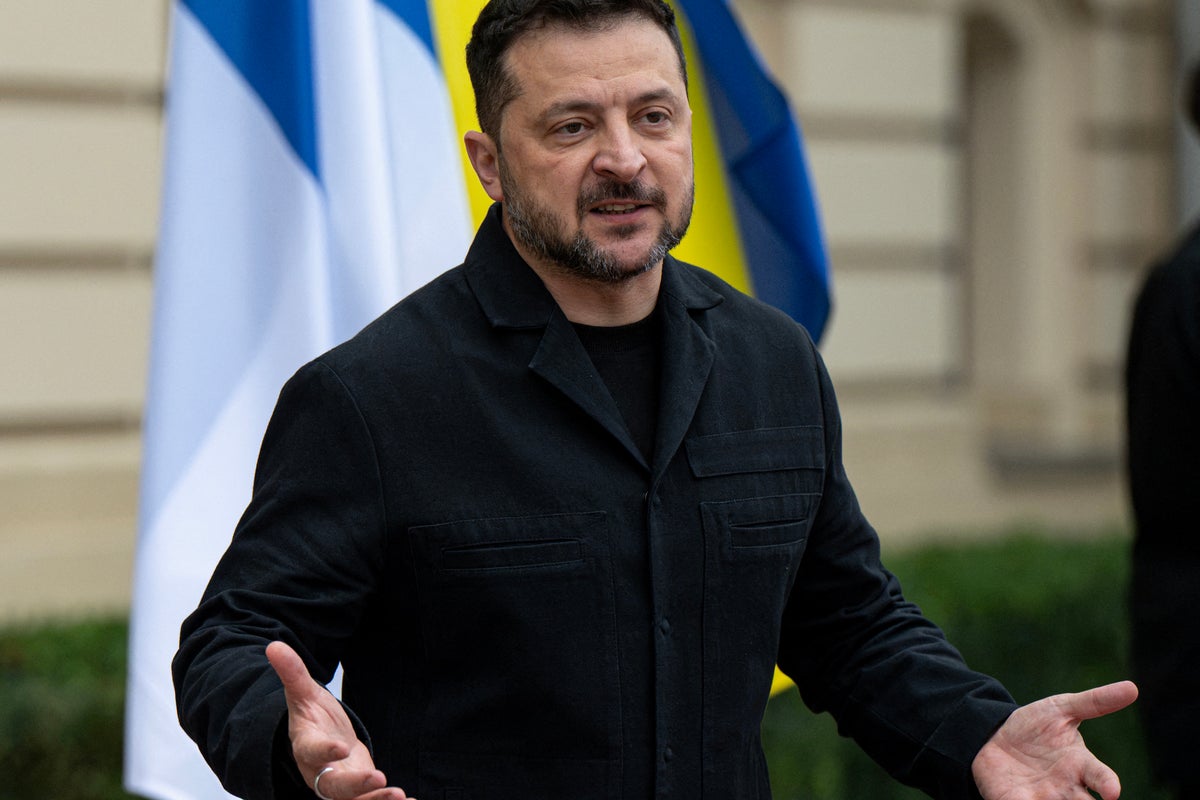
Ukraine-Russia war latest: Zelensky says frontline positions strongest in a long time after territory recaptured
Key Points
Ukraine-Russia war latest: Zelensky says frontline positions strongest in a long time after territory recaptured Finnish president defends calling Putin, saying ‘ending the war requires direct discussions’ - Bookmark - CommentsGo to comments Become an Independent member to bookmark this article Already a member? Log in Volodymyr Zelensky says Ukraine's battlefield position is the strongest it has been in some time, after his forces recaptured territory through a series of offensives....
Ukraine-Russia war latest: Zelensky says frontline positions strongest in a long time after territory recaptured
Finnish president defends calling Putin, saying ‘ending the war requires direct discussions’
- Bookmark
- CommentsGo to comments
Become an Independent member to bookmark this article
Already a member? Log in
Volodymyr Zelensky says Ukraine's battlefield position is the strongest it has been in some time, after his forces recaptured territory through a series of offensives.
Zelensky revealed details of the previously secret Operation Veles, where Ukrainian troops used underground gas pipelines to outflank Russian positions near Kupiansk in the northeast.
He also referred to an air assault operation in eastern Ukraine and Operation Vivaldi further north, aimed at preventing Russian advances in key areas.
His remarks came as Finland's president and the Norwegian prime minister held a rare direct phone call with Russian president Vladimir Putin.
Finnish president Alexander Stubb and Norway's Jonas Gahr Stoere spoke to Putin for around 90 minutes on Tuesday before holding a separate conversation with Zelensky.
While Kyiv says it was involved in planning for the phone call, it has drawn criticism from other European leaders, many of whom are opposed to direct engagement with the Russian leader.
The Kremlin showed no indication of any softening in its position during the call, insisting that any lasting peace must "unconditionally" take Russia's interests into account.
France temporarily sends maritime patrol plane to Black Sea after cargo ship attacks
France has temporarily relocated a maritime patrol aircraft to Romania to help identify navigation dangers and bolster the protection of critical energy infrastructure in the Black Sea, Romania's defence ministry said on Tuesday.
At least eight cargo ships have been hit near the coast of Nato members Romania and Bulgaria in the past three weeks, with some 34 sailors reported dead or missing.
Romanian F-16 fighter jet pilots shot down two of the latest generation of Russian drones over Romanian territorial waters earlier this month, and Nato said it will send more maritime patrol aircraft, radar systems and drones to the Black Sea.
France relocated its Atlantique 2 maritime patrol aircraft to the Mihail Kogalniceanu air base in Romania on 18 October. It will conduct surveillance missions over the western part of the Black Sea until 6 November.
The purpose is "to identify dangers to navigation and increase the ability to protect critical infrastructure in Romania's exclusive economic zone", the ministry said
Romania's defence ministry said the response from Nato and the French Navy added to measures enforced by Romanian naval forces including increased maritime patrol missions with ships, helicopters and drones.
Romanian naval forces are also continuously updating navigators about dangers and recommended routes, the ministry said.
Recap: Finnish and Norwegian leaders hold rare call with Putin to urge end to Ukraine war
The leaders of Finland and Norway have held rare direct calls with Russian president Vladimir Putin, urging him to end the war in Ukraine as diplomatic efforts gain momentum ahead of fresh peace negotiations.
Finnish president Alexander Stubb and Norwegian prime minister Jonas Gahr Stoere spoke to Putin for around 90 minutes on Tuesday before holding a separate conversation with Ukrainian president Volodymyr Zelensky.
The call marked a significant departure from the approach taken by most Western European leaders, who have largely avoided direct contact with the Kremlin since Russia's full-scale invasion of Ukraine in February 2022.
“The discussion (with Putin) was frank and substantive. We are neighbouring countries to Russia. The outcome of this war will have a direct impact on our and the broader European security. Ending the war requires direct discussions,” Stubb said.
Stoere said he and Stubb had "stressed the importance of de-escalation." Both voiced strong support for Ukraine.
The two leaders said the initiative was linked to planned peace talks between Russian, Ukrainian and US officials in Abu Dhabi next month.
However, the Kremlin showed no indication of softening its demands, insisting that any lasting peace must fully take Russia's interests into account.
The diplomatic outreach also exposed divisions among European leaders, with Danish prime minister Mette Frederiksen warning against countries acting alone and Sweden's Ulf Kristersson expressing little hope of a breakthrough.
Ukraine welcomed the initiative, saying the talks had been coordinated with Kyiv.
Zelensky touts Ukraine's strong battlefield position after recapturing territory
President Volodymyr Zelensky has said that Kyiv’s battlefield position is the strongest it has been in some time after his forces retook territory through a series of offensives.
It includes one operation previously unannounced in which Kyiv's troops used gas pipelines to outflank Russian positions.
Zelensky, speaking in his nightly video address, cited a report by senior commanders to say that, for the first time, the "Veles" operation used pipelines in Ukraine's northeast.
He also referred to an air assault operation in eastern Ukraine and the "Vivaldi" operation further to the north, designed to prevent Russian advances in key areas.
He said Operation Veles was conducted near Kupiansk, a city in northeastern Kharkiv region recaptured by Ukrainian forces in late 2022, but which has been under constant Russian pressure.
"It is a strong operation, well planned and technology-driven. The Russians tried to use underground gas pipelines to advance past our positions," Zelensky said.
"Our fighters turned this tactic against the Russians and used the underground infrastructure against the occupiers with extraordinary success," he said.
In the Vivaldi offensive, one senior commander reported last month that Ukraine's Third Army Corps had cleared an area of 75 square kms (29 square miles) of Russian infiltration groups and recaptured a further 10 square kilometres.
That operation was focused on the north of the key strongholds in the region, the so-called "fortress belt" of the cities Sloviansk and Kramatorsk. Their capture would bring Russia closer to its goal of seizing the entire Donbas region.
Watch: Russian missiles strike university grounds and residential areas in Kyiv
Ukraine wants 'new momentum' in peace talks, FM says
Ukrainian Foreign Minister Andrii Sybiha called on Tuesday for new momentum in peace talks.
"We need to get new dynamics in our peace efforts, to speed them up, to find even new momentum, how to get this new energy in our peace efforts," he told reporters.
He said that President Volodymyr Zelensky had asked the leaders of Finland and Norway to convey to Russian President Vladimir Putin the necessity of a ceasefire and a Ukraine-Russia summit.
In depth: Putin targets Ukrainian civilians in barbaric ‘safari’ attacks as Trump turns blind eye
Vladimir Putin is targeting Ukrainian civilians in a surge of barbaric attacks across the country despite Donald Trump claiming that Russia is acting “fine” in the war.
New figures released by the UN this week show the number of Ukrainian civilian casualties in September rose by 85 per cent compared with the year before.
First-person drones, long-range glide bombs, ballistic rockets and new jet-powered Shahed cruise missiles are being used in the attacks as winter closes in. No one is off limits. Children, babies, mothers in the park, elderly fruit vendors.
From Kherson to Kharkiv, Kyiv to Kramatorsk, “hunting drone safaris” picking off ordinary people are taking the war far beyond the front lines.
Of the 328 people killed and 2,105 injured last month, 53 per cent of casualties were caused by missiles and long-range drones while 23 per cent were caused by short-range drones.
Putin targets civilians in barbaric ‘safari’ attacks as Trump turns blind eye
Kyiv plans to build water crossings as Russia escalates bridge strikes
Ukraine's Kyiv plans to allocate 1 billion hryvnias ($22 million) to build water crossings over the River Dnipro that divides the capital into two parts, the city mayor said on Tuesday, as Russia escalates its attacks on bridges.
Russia has significantly stepped up its strikes on logistics in and around Kyiv in recent months, and in October it struck bridges, disrupting transportation for hundreds of thousands of people.
Mayor Vitali Klitschko said on Telegram that the city's defence council discussed "the project to build combined water crossings over the River Dnipro and the access roads leading to them."
Independent: Premium: We cannot fight until the last Ukrainian – time to call Putin’s bluff
The surge in civilian casualties in Ukraine shows how the West, including the UK, must defend Kyiv’s airspace or face worse in the future, explains world affairs editor Sam Kiley
We cannot fight until the last Ukrainian – it’s time to call Putin’s bluff
Kyiv coordinated European call with Putin, says Ukrainian FM
A call by the leaders of Finland and Norway with Russian President Vladimir Putin was coordinated with Kyiv, Ukraine's foreign minister said on Tuesday.
"We welcome such active support for our diplomatic efforts and peace process. This call was coordinated with us, and this is the right approach," Andrii Sybiha told reporters.
Join our commenting forum
Join thought-provoking conversations, follow other Independent readers and see their replies
Comments