
Politics
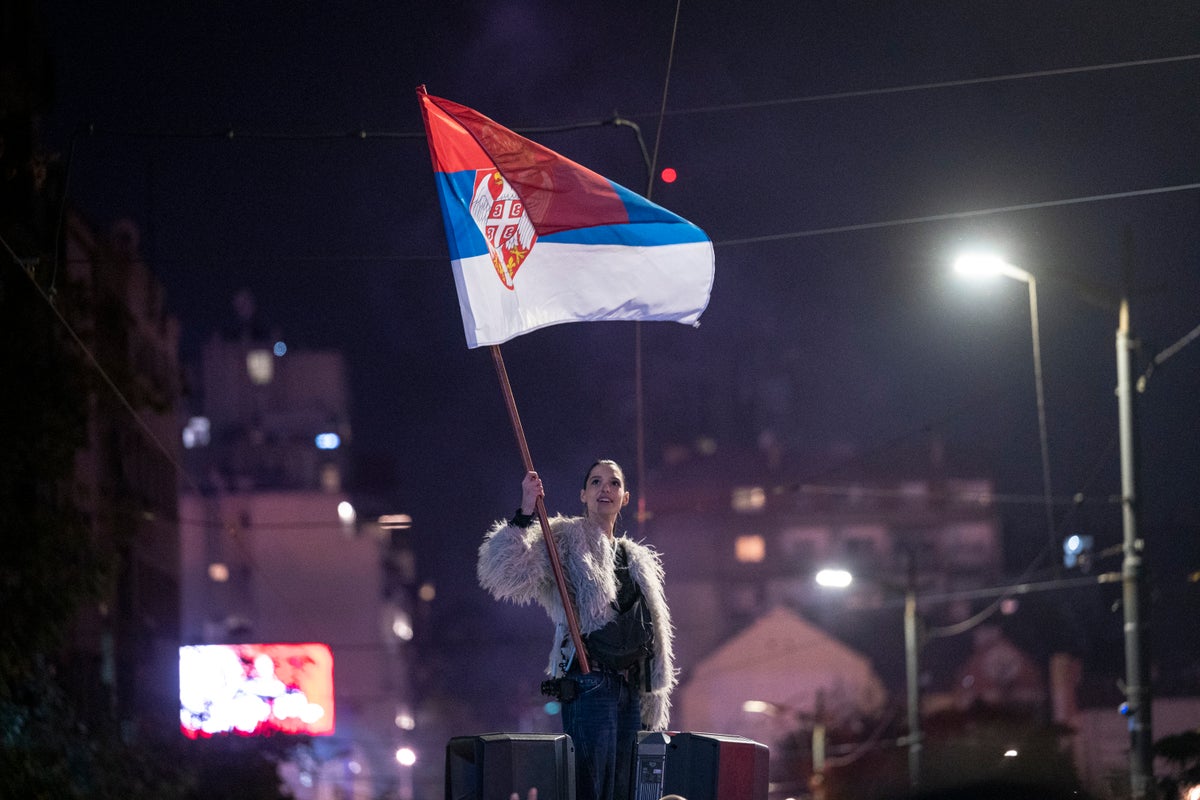
From basketball stars to bankers: Meet Serbia's new leaders after historic student movement
Key Points
From basketball stars to bankers: Meet Serbia's new leaders after historic student movement Four leading men are in contention for Serbia’s vacant prime minister slot after former president Aleksandar Vucic was ousted from office in a snap election - so who are they? - Bookmark - CommentsGo to comments Become an Independent member to bookmark this article Already a member? Log in Serbia’s right-wing populist leader Aleksandar Vucic conceded defeat this week after a snap election forced him...
From basketball stars to bankers: Meet Serbia's new leaders after historic student movement
Four leading men are in contention for Serbia’s vacant prime minister slot after former president Aleksandar Vucic was ousted from office in a snap election - so who are they?
- Bookmark
- CommentsGo to comments
Become an Independent member to bookmark this article
Already a member? Log in
Serbia’s right-wing populist leader Aleksandar Vucic conceded defeat this week after a snap election forced him out of office.
The ex-president said it is “clear we have lost these elections” after a student movement won 2.25 million votes compared to the ruling party’s 1.67 million.
The students will now choose a new prime minister and other key ministerial positions as their leaderless movement forms a government.
Their movement was created two years ago in response to a railway station disaster, in which 16 people died after a canopy collapsed in front of Novi Sad station.
Protests were triggered by the tragedy, which was blamed on corruption and negligence.
So who are the students’ candidates battling for the prime ministerial post?
DEJAN SOSKIC
Dejan Soskic, 59, an economist and professor at the University of Belgrade's Faculty of Economics, served as governor of the central bank between 2010 and 2012, before resigning in protest at legislative amendments that he argued compromised the institution's independence.
He has for years been a vocal opponent of Vucic's government.
Soskic, who was an avid biker in his youth but has mellowed into a softly spoken reformer, has frequently criticised the country’s institutional weaknesses under Vucic.
In 2021, he said, without offering evidence, that systemic corruption in the Balkan state was more widespread than in neighbouring countries and that it was deterring domestic and foreign direct investment.
Vucic and his Serbian Progressive Party have repeatedly denied accusations of corruption.
Soskic says that prudent public finances will create a stable foundation for a permanent increase in wages and pensions.
Pro-government media have criticised Soskic’s central bank record, accusing him of triggering the depreciation of the dinar during his tenure. Soskic has defended the depreciation as a reflection of the mandatory monetary policies of the time rather than a personal failure.
Nonetheless, during the election campaign, in order to increase export competitiveness, Soskic proposed correcting, or weakening, the exchange rate of the dinar - which is in a managed float against the euro - to make domestic goods cheaper in foreign currencies. An alternative, he suggested, would be to maintain a fixed, stronger exchange rate but lower costs by cutting wages.
ILIJA SRDANOVIC
Ilija Srdanovic, 55, a practising cardiologist, professor at the University of Novi Sad Faculty of Medicine and a keen cyclist, became the student movement's lead candidate when the ballot list was finalised in September.
Srdanovic’s transition to frontline politics began during the student-led anti-corruption demonstrations, where he frequently appeared as a public speaker. The physician participated in the movement's "Guardians of the Constitution" bicycle tour across the northern Vojvodina province.
Srdanovic campaigned with the promise of a decentralised health system "at the service of citizens and based on equality for all patients".
In an interview with the Belgrade-based FoNet news agency, Srdanovic said his political objective was building "a better Serbia, nothing else is important".
He declined an invitation from Vucic to participate in a televised debate during the campaign.
However, some of his policies do not represent a sharp departure from some of Vucic's. He stressed the Student List position that Kosovo, which declared independence from Serbia in 2008, remains an integral part of the country. He also said that European Union integration is not a current priority and that the immediate focus for the incoming administration must remain on domestic anti-corruption reforms and national "existential survival".
DEJAN BODIROGA
Dejan Bodiroga, 53, the former captain of the Yugoslav national basketball team and current EuroLeague president, is one of the student movement's most prominent public speakers.
He described Sunday's election as a fight "for the return of a country that has been hijacked".
The step into politics is the latest chapter in a life that has gripped the basketball-mad nation - from capturing back-to-back FIBA World Championship gold medals in 1998 and 2002 and leading the then Yugoslav team to an Olympic silver medal at the 1996 Atlanta Games to entering senior sports administration upon his retirement as a player in 2007 and being appointed as EuroLeague president in 2022.
During the election campaign, Bodiroga appeared at student rallies and took part in open-air folk dancing in rural municipalities. His fans frequently cheered him with a 1990s slogan "We have our God, his name is Bodiroga."
RADOMIR SAICIC
Radomir Saicic, 64, an organic chemistry professor and a member of the Serbian Academy of Sciences and Arts (SANU), was the face of the students' election win on Sunday, taking the podium at their headquarters after Vucic conceded defeat to hail the outcome as a "citizens' victory".
He is a specialist in medicinal chemistry whose research focuses on the synthesis of chemotherapy treatments and antiviral therapies, including a special Covid-19 project in collaboration with the Pasteur Institute.
Saicic joined the student-led anti-corruption protests that followed the 2024 collapse of a railway station canopy in the northern Serbian city of Novi Sad. He became a target for pro-government tabloids after signing a petition with 24 other academics demanding Vucic's resignation, and in May 2026 he walked out of a SANU gallery exhibition to protest an appearance by Nikola Selakovic, the minister of culture.
During the campaign, he told crowds that Serbia was "occupied from within" and said he was ready to put "even his life" at the disposal of the student movement.
Saicic says Kosovo is a "temporarily occupied territory" and backs energy ties with Russia.
Political analysts and local media have tipped him as a contender in the presidential election, which will also be triggered by Vucic's recent resignation from the post.
Join our commenting forum
Join thought-provoking conversations, follow other Independent readers and see their replies
Comments
Serbia (LOCATION)
Aleksandar Vucic (PERSON)
Independent (ORG)
Novi (ORG)
Dejan Soskic (PERSON)
the University of Belgrade's (ORG)
Faculty of Economics (ORG)
Vucic (LOCATION)
Soskic (PERSON)
Balkan (ORG)
Serbian Progressive Party (ORG)
SRDANOVIC Ilija Srdanovic (PERSON)
the University of Novi Sad Faculty of Medicine (ORG)
Srdanovic (PERSON)
poli (ORG)