
Photographs by Elizabeth Renstrom for The Atlantic
In the early 1990s, when I was in elementary school, a fancy catalog would arrive in the mailbox of our 1950s split-level in Philadelphia four times a year, and I’d hurry to my room to pore over its elaborate spreads. Tea caddies, Windsor chairs, writing quills, ice-cream churns. We didn’t have any antiques in our home, but the lure of the past was so strong that sometimes my sisters, five and seven years older than me, crammed onto my bed to dog-ear the pages too. Most of all, we looked forward to checking in with the girls arrayed there, whose stories we knew so well: Samantha, Molly, Kirsten, Felicity, Addy, and, later in the decade, Josefina.
They were the American Girl dolls, preadolescents just slightly older than me, and I was enthralled by the pictures of their period dresses, tiny school supplies, and exotic waxed lunch foods. My own doll was the farm girl Kirsten Larson, a Swedish immigrant to 1850s Minnesota. She had come in a burgundy box, with a slim book titled Meet Kirsten tucked in beside her. I promptly begged for the five other Kirsten books; the historical-fiction series followed the same pattern for each doll, ushering her through a year’s worth of life events, tailored to her personality and time and place. I remember playing with Kirsten in the backyard and having her trace out symbols in the dirt, just as she did with her new friend, a Dakota girl called Singing Bird, in the second book, Kirsten Learns a Lesson. To have such a doll was to own a whole world and the narratives within it.
In my blue-collar neighborhood, we lucky doll owners felt that our Boomer parents had entrusted us with a valuable possession, and they had. When they were first introduced, in 1986, American Girl dolls cost a shocking $68 (roughly $208 today). Almost every Millennial I know who once spent hours with her American Girl doll has kept it, lovingly, into adulthood.
The dolls’ hardscrabble backstories piqued curiosity about the past. Kirsten’s best friend died of cholera on the journey from Sweden; Samantha Parkington, the wealthy “Victorian beauty” living in 1904 Westchester County, New York, was an orphan; Molly McIntire’s doctor father was off serving in World War II England. Each doll confronted challenges in her young life that felt at once intimate and unfamiliar. Add well-made accessories and vivid history to the mix, and girlhood acquired an allure that Barbie seemed to bypass on her way to her plastic Dreamhouse.
Yet as American Girl’s 40th anniversary arrives, the brand finds itself in something of a midlife crisis. In 1998, Pleasant Rowland, the former teacher and textbook writer who’d dreamed up the dolls, sold Pleasant Company to an unlikely steward: Mattel, the company behind Barbie and her stilettos. A quarter century later, the heyday of preteen devotion to playmates from bygone eras seems like, well, a bygone era. Mattel’s dire balance sheets for the American Girl line confirm that the magic has faded.
Might a surge of celebratory attention to the Pleasant Company past be the secret to renewed relevance? It certainly could not be better timed, with the Millennial faithful now in their childbearing—and toy-buying—years.
With Rowland’s spare-no-effort ethos of product creation clearly in mind, Mattel has released The Making of American Girl, a chronicle of Pleasant Company’s origin story that resembles the sumptuous catalogs of my childhood, only far grander in scale. The coffee-table book is a canny paean to the dozen years of Rowland’s leadership. Extolling her “courage and conviction,” it dwells on her commitment to craftsmanship. The scrapbook-style spreads showcase mock-ups of her early brainstorming, the fabrics she insisted on, the dovetailed furniture joints and delicate details on all those teeny accessories that girls craved and parents put on their credit cards. Designed as a nostalgia trip for Millennials, it works. My 9- and 4-year-old daughters showed the book off to their playmates one weekend afternoon, but it was those girls’ 40-something mom who lingered over it with me, comparing notes on the expensive items we had known better than to ask for in childhood, such as the bisque plate and mug for Kirsten, made by the renowned Rowe Pottery Works in Wisconsin.
But what about the rest of the story of the doll that had become America’s second-most-popular by the late ’90s? That’s left to Amanda FitzSimons, a journalist who did not have the cooperation of Mattel, or of the now-85-year-old Rowland, for her smart and colorful cultural analysis, An American Girl: How a Billion-Dollar Doll and Its Unlikely Founder Changed Girlhood Forever. That means she’s free, after exploring how the dolls and books became unexpected hits, to describe how the American Girl brand’s identity eventually grew so muddled that it has become barely recognizable.
FitzSimons starts with Rowland’s big idea, conceived on a trip to Colonial Williamsburg in the early 1980s and transformed into an elaborate business plan over a weekend at her northern-Wisconsin cabin, where the woodstove and outhouse had her thinking about life in the past. The books, “for girls about girls,” came first—they were “the heart of” the American Girl collection, in Rowland’s words.
A boss who looked for tenacity in her employees as well as her dolls, Rowland liked to say that her initials, PTR, stood for “Prepare to Redo”; a researcher at the company devoted a day, for example, to conferring with poultry-science experts to determine the exact hour at which Kirsten’s hens would lay eggs. With that attention to detail, Rowland turned the business into a high-volume, high-value sensation. Over time, Pleasant Company offered ever more accessories, such as carefully constructed craft kits (I had my eye on a wooden loom for weaving a doll sash), stationery, and matching outfits for dolls and their girls. But above all, what Rowland sold was the idea that girlhood was important, in need of preservation.
Her American Girl enterprise, FitzSimons argues, was a mission to rescue an endangered phase of life. Girlhood was slipping away. The term tween, which encompasses kids as young as 8, was popularized as a marketing tool in the ’80s and quickly became shorthand for a child who didn’t act like a child. Late-20th-century girls, Rowland worried from the start, “turn on the television set and the world comes down on them hard. It’s sexually explicit, it’s dangerous and violent, it’s angry, complaining, discouraging.” By the mid-’90s, the phenomenon of kids aging out of pastimes earlier was well documented.
FitzSimons credits Rowland with an astute insight amid rising calls to shore up girls’ self-confidence: “It wasn’t that girls wanted to be older,” she writes; “it was that they wanted to be understood, feel important.” The dolls’ figures never matured, and the books didn’t include periods or crushes; friends, school, and adventure occupied the girls’ imaginations. Samantha fights back when a local menace puts salt in her birthday ice cream; colonial-era Felicity Merriman befriends the daughter of a Loyalist family despite her father’s Revolutionary politics.
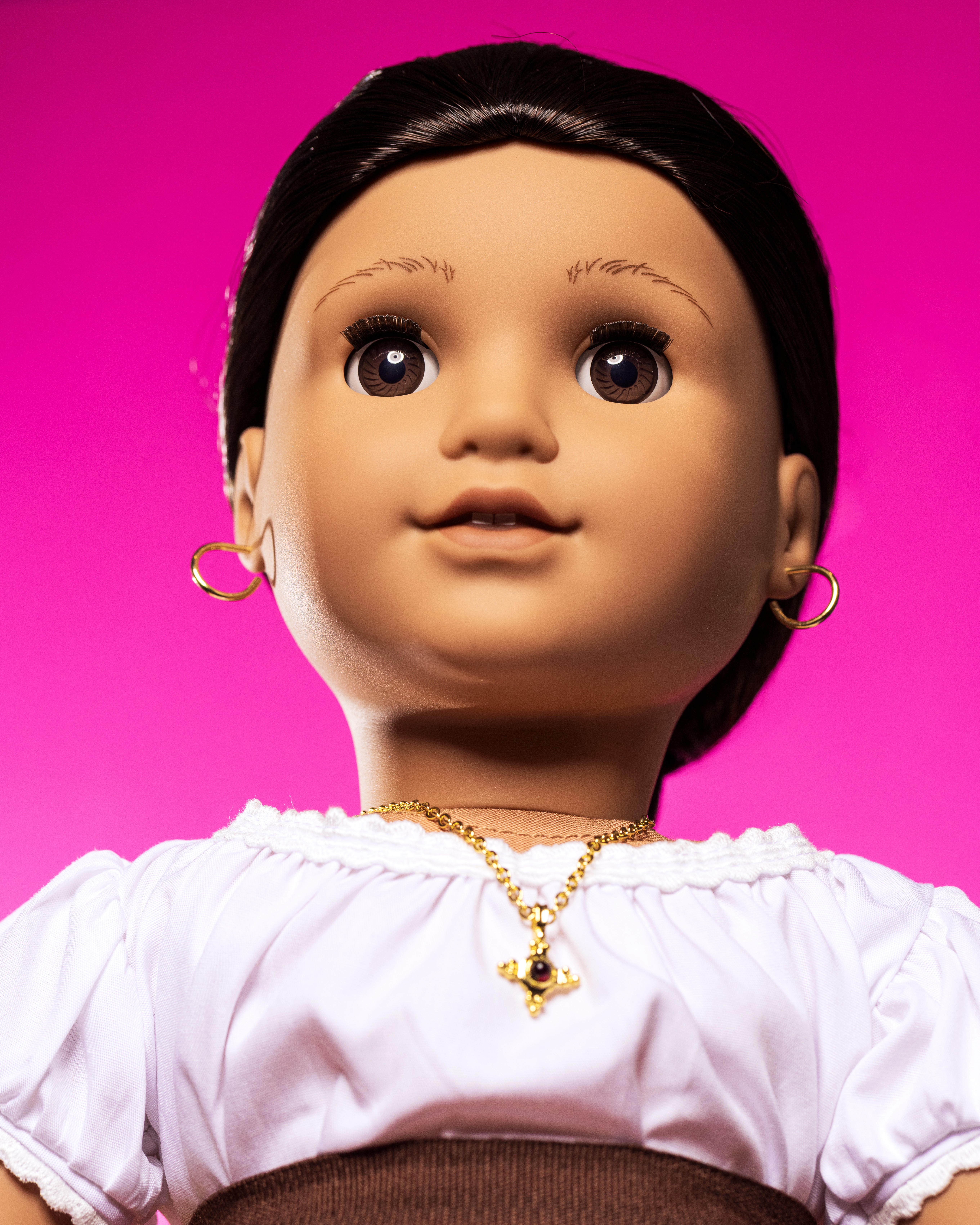
In aiming to transport girls to other worlds, Rowland had more than innocent fantasy and vivid Americana in mind. Her goal was to encourage play that felt immersive and incorporated historical adversity. The books included plotlines about children working in factories and the displacement of Native people in the Midwest. Her cast expanded to include a second trio of dolls—Felicity, as well as Josefina Montoya, who lives on a New Mexico rancho in 1824, and Addy Walker, an enslaved girl who escapes to 1864 Philadelphia.
Elizabeth Renstrom for The AtlanticJosefinaElizabeth Renstrom for The AtlanticAddyThe panels of scholars hired to help vet the dolls’ backgrounds and physical appearance had their socially charged work cut out for them. Lonnie Bunch, later the founding director of the National Museum of African American History and Culture, was part of the committee advising on Addy, whose development stirred plenty of debate over her storyline (whether American Girl’s only Black doll should have been born into slavery, for example) and over specifics (which hair texture was appropriate, how cheerful faces should look in book illustrations). People argued about her suitability as a possession for white girls. (Endorsed by Oprah in time for Christmas 1993, Addy was a commercial success that year.)
[Read: American Girls aren’t radical anymore]
The original six American Girls telegraphed a spirit of optimism about the very idea of being a girl. Rowland’s characters were intrepid and resourceful but still gracious; free to be tomboyish while also engaged with feminine traditions, such as Kirsten’s quilting. Breaking down gender stereotypes wasn’t Rowland’s goal, and “feminism was never mentioned in the room,” the creative director of American Girl magazine told FitzSimons. But the “girls can do anything” spirit of third-wave feminism, cresting in the ’90s, was the backdrop of the brand’s rise: empowerment and education in one finely crafted package. As Rowland put it in a letter addressed to parents in an early catalog, “Growing up in America is, has been, and can always be an experience to treasure.”
“I don’t care if a girl grew up in Colonial times, Victorian times, in 1950, or today,” Rowland once said. “The emotional experiences of childhood are absolutely true and constant.” Thanks in part to my own exposure to her dolls’ stories, I confess I can’t quite believe that she ever really meant this. The hardships entailed in Kirsten’s months-long sea voyage stunned snack-happy 8-year-old me; I was suddenly aware of the many conveniences and freedoms that I took for granted. Our kinship was strong—we even shared a birthday (June 8)—but our attachment, I felt, was also about imagining how different my days and moods were from hers.
When Rowland sold her venture (for $700 million), the business was just expanding into American Girl stores and cafés, an old-fashioned “mecca,” she called it, for mother-daughter doll bonding (and buying). The world’s virtual horizons had barely begun to be mapped, and the looming kids-getting-older-younger landscape was soon Mattel’s problem to worry about. Over the past two decades, according to one study, the average age at which children begin to be interested in “adult-oriented topics such as fashion and technology” has decreased from age 12 to 8. In 1990, little girls were hoping for $50 nightgowns to match the one their doll wore; now they’re pining for $90 Drunk Elephant glycolic serum to slather on their faces before bed.
For Mattel at the turn of the millennium, adultified competition arrived in an unnervingly direct and provocative form: Bratz dolls, aimed at young girls. With their pillowy lips, heavy eye makeup, and distorted big-head-small-body proportions, they were mutant Barbies, accelerants for the idea that brasher and sexier were better. By 2006, they accounted for 40 percent of the fashion-doll market.
The American Girl heritage was buried as Mattel played catch-up. Except for Addy and Josefina, the original dolls were retired. Catalogs shrank; chic burgundy gave way to hot pink. Proliferating doll lines—Best Friends, Truly Me, WellieWishers—shifted the focus away from the bond between a girl and her doll, as a New Yorker article noted, and onto friendship networks. Instead of intriguing relics from earlier times—a miniature oil lamp or a friendship quilt—the Girl of the Year doll (the run is limited, so buy her fast) had plastic-tchotchke versions of things such as a cellphone and a Stanley-style water bottle.
New dolls that were added to the historical American Girl line soon hailed from more recent times; Courtney Moore, who “never met a mixtape she didn’t like,” was from 1986, the year the brand was launched. The accompanying books became perfunctory, a scattershot array of graphics and a story that gestured at history but never dove in. Even as doll prices rose, American Girl revenue cratered, reportedly falling by 61 percent from 2016 to late 2023.
In a recent Instagram post, a mom vented about a visit to the books section at an American Girl store: “Excuse me. Where are the boxed sets. Where are the SACRED TEXTS. The Library of Alexandria, again.” Mattel notably hasn’t bothered to reissue the full book series, though the six original dolls have been rereleased for the brand’s anniversary. Instead, targeting its Millennial fan base, the company commissioned a new book in the Samantha series from the best-selling historical novelist Fiona Davis, whose other work for adults features adventurous young women in glamorous and gritty 20th-century New York City.
Elizabeth Renstrom for The AtlanticA Modern Era Kirsten doll, now with space buns and an updated dress, and the six original American Girl dollsIn Samantha: The Next Chapter, Davis locates her subject in 1920. Now 25, Samantha is down on her luck in New York (her family’s fortune has been stolen) and working as a shopgirl. But she soon finds the thieves and helps the suffragists’ cause, championed by her Aunt Cornelia in the original books. For some readers, Davis’s aim of evoking “sweet nostalgia” and inspiring “wonder at the women you’ve become,” as she has put it, may prove rewarding. Yet her American Girl audience is ambivalent, too. Reared on Rowland’s vision of boldly imaginative girls eager to play their part in an America that was constantly improving, Millennials are also dealing with disenchantment: The country they now inhabit hasn’t delivered on the optimism that powered the world of the dolls and books they loved.
Davis’s grown-up Samantha, though a tribute to the brand’s history-infused approach, is likely to disappoint. She is stuffed with generically desirable attributes of womanhood and faces conventional emotional dilemmas: She’s determined to remain independent while looking for love, forward-thinking yet happy with her lot. It’s a formula for tame likability rather than conflicted maturity.
Earlier this year, the latest American Girl catalog landed on my doorstep—it was a re-creation of the first catalog cover, which showed a girl curled up with her doll on a chintz-covered window seat, intently reading a book. But inside, after a few pages dedicated to the historical dolls, was a torrent of brand collaborations (with Hill House Home dresses, Disney princesses, Polly Pocket) and a spread welcoming the Modern Era collection—the classic dolls, now offered in shrunken, all-vinyl versions with oversize heads, and dressed up in trendy contemporary outfits.
American Girl has a tough needle to thread (the cliché seems apt): make the dolls of good quality, but not too costly; repackage American history, but don’t offend anyone; get Gen Alpha girls interested, but remember that Millennials now hold the credit cards. I’ve deemed my 4-year-old too young for a $175 doll, and my Harry Potter–obsessed 9-year-old considers my vintage Kirsten books too slender to take seriously. But when an old 1995 catalog I’d ordered for research arrived, both pored over it, fascinated by Samantha’s miniature brass lunch pail and Felicity’s coal bed warmer. I explained that the company no longer makes those items; we can get them only for astronomical sums on resale sites. “But this is all so perfect,” my elder daughter said. “It almost makes them come alive.”
This article appears in the December 2026 print edition with the headline “Kirsten’s Midlife Crisis.”