
World News
Reality of Ukraine's train travel: Russian drones, forced evacuations and risk of random death
Key Points
Reality of Ukraine's train travel: Russian drones, forced evacuations and risk of random death As Ukrainians seek to go about their everyday lives, train travel is still popular - even though passengers must weigh up the risk of being killed by Russian drone strikes - Bookmark - CommentsGo to comments Become an Independent member to bookmark this article Already a member? Log in Passengers who still use Ukraine’s train network take their life in their hands every time they step onboard -...
Reality of Ukraine's train travel: Russian drones, forced evacuations and risk of random death
As Ukrainians seek to go about their everyday lives, train travel is still popular - even though passengers must weigh up the risk of being killed by Russian drone strikes
- Bookmark
- CommentsGo to comments
Become an Independent member to bookmark this article
Already a member? Log in
Passengers who still use Ukraine’s train network take their life in their hands every time they step onboard - with Putin’s Russian drones prowling overheard.
The country, which has been defending itself from Russian hostility since the war started in February 2022, has had its transport system heavily disrupted by drone strikes.
But many Ukrainians still need to travel across the country for business.
Ukrainian beauty salon owner Antonina Viter is getting used to having her travel plans disrupted by the threat of Russian drone attacks, as she criss-crosses the country by rail to keep her business going.
"Every third trip, we end up evacuating once, twice or even three times," she explained on board a train from the southeastern city of Dnipro to Odesa on the Black Sea.
"What can you do? How else do you get to your client?"
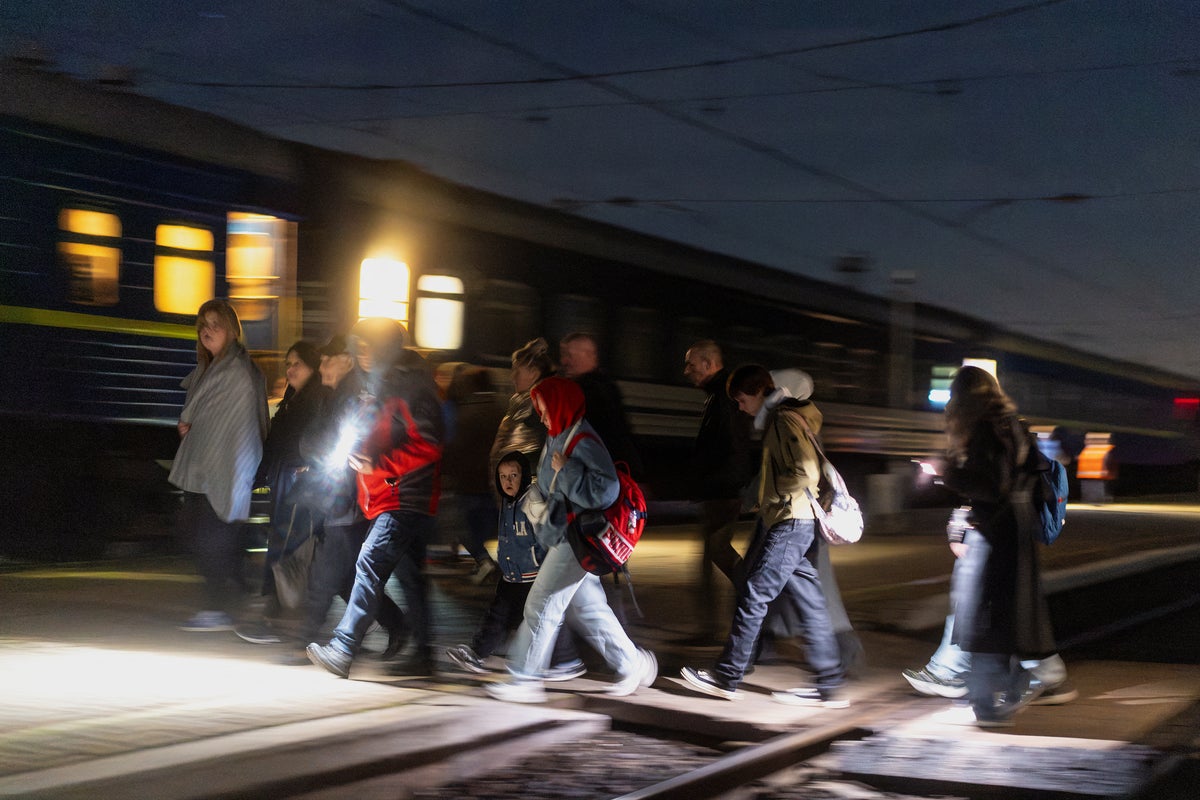
Kyiv has set new rules for rail passengers during air-raid alerts and, sure enough, soon after she spoke, the 36-year-old was standing outside under a pitch-black October sky, wrapped in a blanket, waiting for the "all-clear".
In a country long reliant on its vast rail network, hours-long delays and repeat evacuations when air-raid sirens sound are another way in which Russia's escalating missile and drone attacks are wrecking everyday life for civilians.
New Russian jet-powered drones that are hard to shoot down have attacked everything from shopping centres and filling stations to power plants and other critical infrastructure. And the railways are no exception.
UKRAINIAN RAILWAYS ATTACKED 1,700 TIMES THIS YEAR
The state operator, Ukrzaliznytsia, says Russia has attacked more than 1,700 rail facilities this year, including stations, locomotives and passenger wagons. Russia says its targets are objects used by Kyiv's military.
A trip on the line from Dnipro to Odesa, some 400 km (250 miles) to the southwest, showed how Ukrainians are coping with those disruptions.
The outward journey featured eight evacuations of roughly 30 minutes each, the return journey - one more.
Direct attacks, like the drone strike that killed two train drivers on the Dnipro-Odesa line on August 13, are an ever-present threat.
But air-raid alerts can unexpectedly double the travel time on any route, and some stations in the east and south have been shut indefinitely as fighting creeps closer.
The prospect of being hit is one that 41-year-old IT worker Larysa Konstantynova - who was travelling from Dnipro to Odesa with her teenage son at the start of a holiday trip to Europe - prefers not to think about.
Like Viter, who travels at least six times a month to manage two salons in Kyiv and Dnipro, she says she is adapting.
"It's how your mind works: you just try to be positive and survive with the way things are."
Other attacks have included a strike on a Warsaw-bound train near the Polish border in September.
For some, overnight rail journeys - once opportunities to unwind with few distractions - are now spent in anxious anticipation.
During air raid alerts, passengers can be jolted awake and forced to scramble into fields or up and down embankments, sometimes with children or pets in tow. In the winter, temperatures are often below freezing.
RAILWAY JOURNEYS HAUNTED BY RISK OF RANDOM DEATH
Huddled outside her train with a colleague, Viter tracked a nearby drone on a cell-phone app after hearing its distinctive 'whoosh' overhead.
It was the third evacuation in two hours.
"Better to stand in a field for an hour than to risk never getting to see the next hour," she said, knowing she had to teach a beauty workshop in Odesa the next day.
In fact, although delays of 5 to 12 hours are not unusual on the Dnipro-Odesa route, this train arrived just an hour and 20 minutes late.
Nevertheless, the risk of random death has soared as Russia has broadened its drone and ballistic-missile campaign, exploiting Kyiv's shortage of air defence missiles.
More than 50 railway workers have died on duty this year alone, according to Ukraine's infrastructure minister, and dedicated staff have had to adapt their routines to maintain a network that appears to be close to their hearts.
At the beginning of each journey, conductors sweep through the carriages closing curtains to block out light that might alert a Russian drone.
"They can see us, so we have to hide a bit," said train attendant Olha Boniuk, 49, with the air of a mother soothing her child.
After each evacuation, chief conductor Mykola Zakharchenko, 47, sits in his cramped booth diligently recording the interruption.
All the same, he smiles recalling conversations with passengers, and still enjoys watching dawn break through the carriage window: "Train work, as they say, is romance."
Locomotive driver Mykola Kovalenko put it another way.
"If I quit," he said, "who will drive the trains?"
Join our commenting forum
Join thought-provoking conversations, follow other Independent readers and see their replies
Comments