
Politics
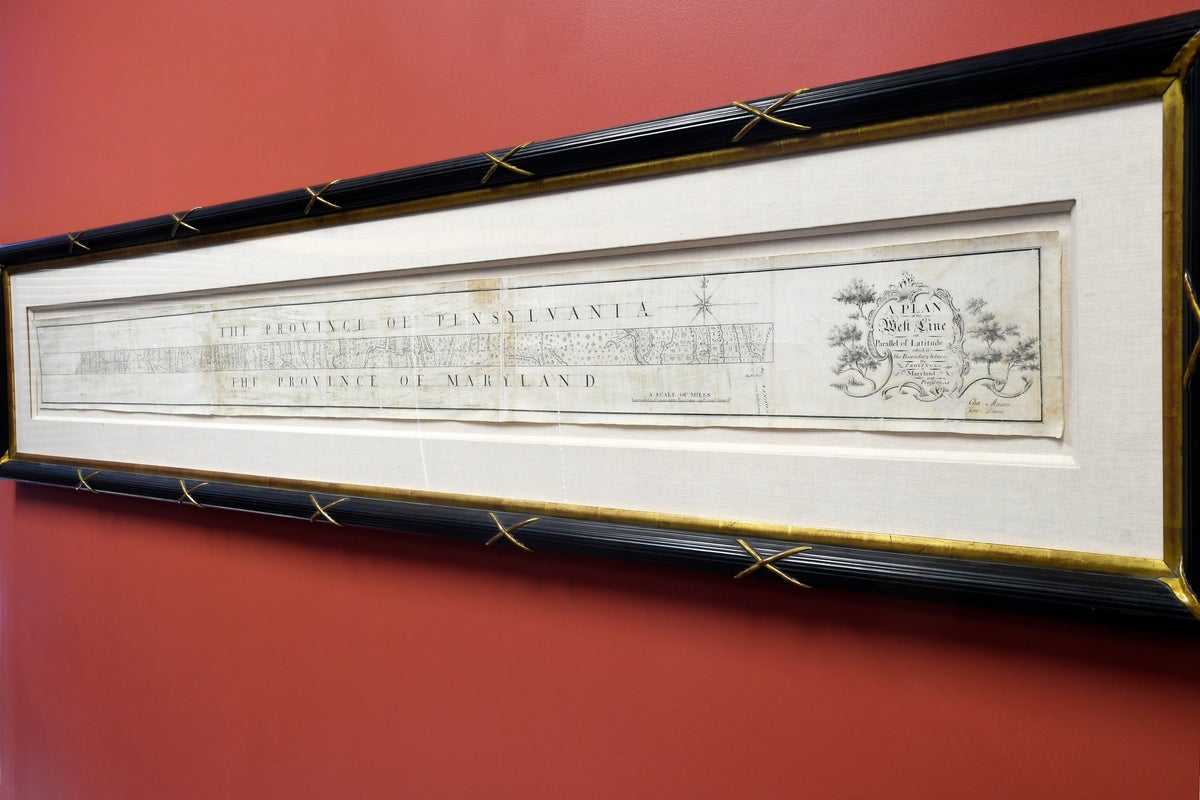
'Dixie' map that divided US goes up for auction after Library of Congress was forced to turn it down
Key Points
'Dixie' map that divided US goes up for auction after Library of Congress was forced to turn it down It’s perhaps the most consequential map in American history - Bookmark - CommentsGo to comments Become an Independent member to bookmark this article Already a member? Log in A hand-drawn chart of the Mason-Dixon Line, the boundary that came to divide the free states from the slave states, goes under the hammer on Thursday.
'Dixie' map that divided US goes up for auction after Library of Congress was forced to turn it down
It’s perhaps the most consequential map in American history
- Bookmark
- CommentsGo to comments
Become an Independent member to bookmark this article
Already a member? Log in
A hand-drawn chart of the Mason-Dixon Line, the boundary that came to divide the free states from the slave states, goes under the hammer on Thursday.
The sale of the document, which has been remounted on backing made of Japanese rice paper, will be livestreamed. Lauren Brunk, vice president of Brunk Auctions in Asheville, North Carolina, expects it to fetch anywhere between $800,000 and $1.2 million.
“It’s not that often that you can really get this close to something that is so historically important," said Brunk. “And it was awe-inspiring, really.”
The map is a strip of linen-backed paper measuring 76 inches (193 centimeters) long and 6.5 inches (16.5 centimeters) tall. Soon after it was drawn, it was given to the family of attorney Benjamin Chew, who represented the descendants of Pennsylvania founder William Penn.
The Chew family kept the map until 1982, when the late publisher Malcolm S. Forbes bought it for $360,000, outbidding the Library of Congress, Brunk said. At the time, it was said to have been the highest price ever paid at auction for an American map.
The map changed hands again in 2002. A vertical section showing the Delaware-Maryland border is housed at Princeton University.
The survey behind the document was carried out by Charles Mason and Jeremiah Dixon. Their work was originally meant to settle a border dispute between the then-colonies of Maryland and Pennsylvania.
Its place in history was secured later, when the 1820 Missouri Compromise used the line to establish the limits of human bondage in the still adolescent United States. From there, it became synonymous with the fundamental divisions that exploded into civil war four decades later.
“The Mason-Dixon Line that most Americans know is this dividing line between the northern free states and the southern slaveholding states,” Brunk said. “But the line was not drawn for that reason.”
A popular theory holds that the term "Dixie" derives from Jeremiah Dixon, though the true origin is disputed.
Brunk said she reached out to officials at the Library of Congress to see if they wanted to bid on it again.
“I wanted them to be aware that this was coming back to the market,” she said. “And they said, at this point, budgets being what they are, they were just not in a position to buy it.”
But if some patriot out there wants to purchase it on the library's behalf, Brunk said, “they’d be happy to have it.”
Join our commenting forum
Join thought-provoking conversations, follow other Independent readers and see their replies
Comments
[Image text:] THE TROVIYCEOEPENSYLVANIA
THEPROVINCEOEMARYLAND
WdiSin