
Health
NHS pharmacy worker wins victimisation case after colleague fake award show prank
Key Points
NHS pharmacy worker wins victimisation case after colleague fake award show prank Amit Verma was made to pose for a camera and have his picture taken while holding an 'Invisible Employee' certificate - Bookmark - CommentsGo to comments Become an Independent member to bookmark this article Already a member? Log in A senior pharmacy worker in the NHS has won a victimisation case after colleagues made him the target of a cruel prank by making him attend a presentation so they could give him a...
NHS pharmacy worker wins victimisation case after colleague fake award show prank
Amit Verma was made to pose for a camera and have his picture taken while holding an 'Invisible Employee' certificate
- Bookmark
- CommentsGo to comments
Become an Independent member to bookmark this article
Already a member? Log in
A senior pharmacy worker in the NHS has won a victimisation case after colleagues made him the target of a cruel prank by making him attend a presentation so they could give him a certificate for 'Invisible Employee'.
Amit Verma was 'ridiculed' when his co-workers summoned him to a presentation ceremony and clapped him as they gave him the made-up award.
As other staff who were in on the joke watched on, Mr Verma was made to pose for a camera and have his picture taken while holding the 'Invisible Employee' certificate which was signed from 'Casper the Friendly CEO'.
Colleagues claimed it was a 'harmless joke' but Mr Verma said it was an attack on his work ethic as it made him look 'conspicuously absent, evasive oreven workshy'.
When 'humiliated' Mr Verma made a formal complaint, the process was dragged out for 95 days - eight times the length that NHS guidelines state.
At Manchester Employment Tribunal, Mr Verma won a victimisation case and is now in line for compensation from the NHS.
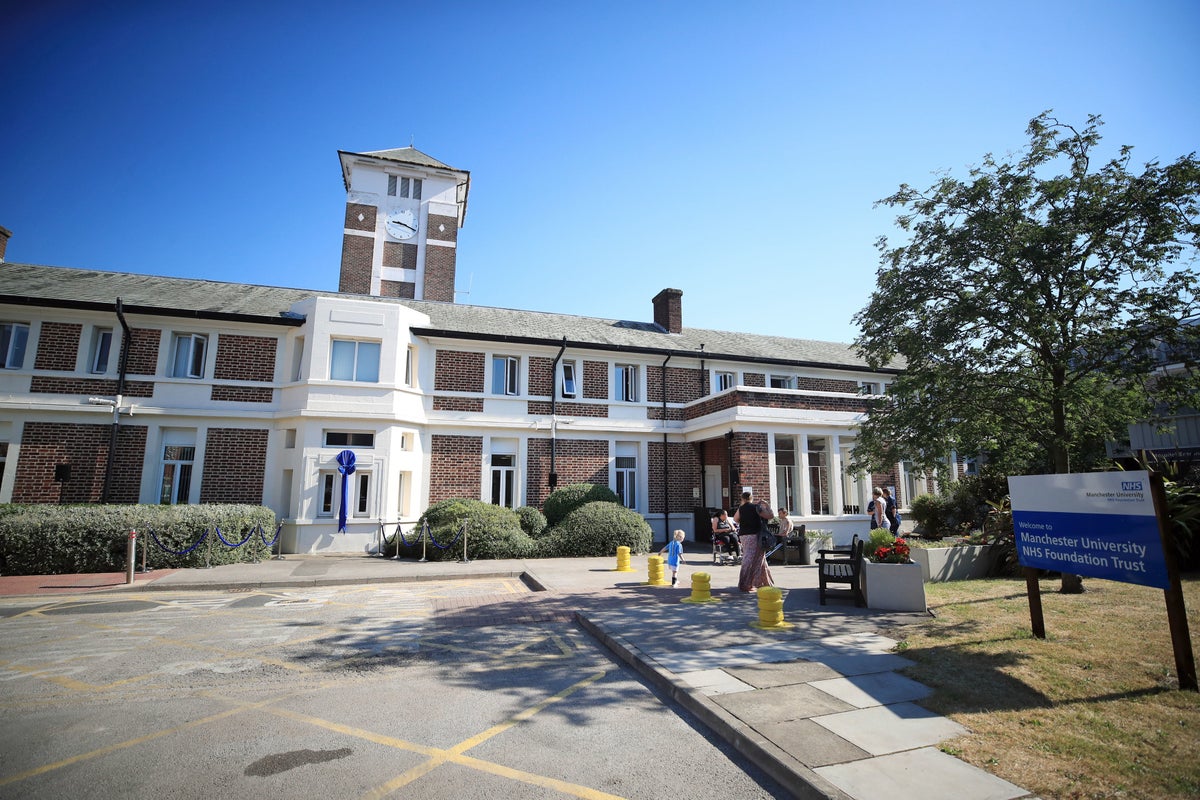
He started working at Manchester University NHS Foundation Trust in 2008 and at the time of the incident, he was a Band 3 Senior Pharmacy Assistant within the ward-based pharmacy service
Mr Verma is of Indian ethnicity and he is Hindu.
He claimed that Bushrah Ashraf had taken a dislike to him after he formally complained about her because she 'maliciously' failed to help him with patient discharges when she said she was on her way.
Mr Verma said there was a 'jokey' culture in the department that led to Ms Ashraf handing out awards to people that would sometimes cause embarrassment or offence.
She had planned to award Mr Verma with a certificate that said he was the 'Invisible Employee' and in January 2024 she got a colleague to call him into the satellite room to award him with the certificate.
Mr Verma wrote a formal complaint about the incident, saying that it was discrimination, harassment, bullying and victimisation because it suggested that he was not 'methodical or systematic'.
He said that the incident had a significant impact on his mental health.
Andrew Ablott was assigned to investigate the complaint, and he centred the findings around whether the award was intended as a joke rather than Mr Verma's concerns of race and religion discrimination.
Samantha Ekin continued the investigation, which continued for a total of 95 days after Mr Verma first lodged his complaint.
Employment Judge Gary Tobin ruled that the award had not been intended as a joke by Ms Ashraf and that Mr Verma did not complain at the time because he thought this would create an 'even more uncomfortable scene'.
He said: "[Mr Verma] received a message from [a colleague] asking him to attend the satellite room. We accept his evidence that the request conveyed a degreeof urgency.
"Nothing suggested that he was being invited to participate in a social event or workplace celebration. We find that he attended because he believed he was required there for work.
"When [Mr Verma] entered the room, he was presented with the certificate describing him as the 'Invisible Employee', signed 'Casper the Friendly CEO'.
"He had not previously seen the certificate.
"We reject the [NHS Trust's] suggestion that he immediately appreciated the episode as mutual banter. His surprise was genuine.
"[Mr Verma] was then asked to hold the certificate whilst photographs were taken. In our judgement this materially increased the humiliation.
"Once placed at the centre of the gathering, with colleagues watching, he had no realistic opportunity politely to refuse without creating an even more uncomfortable scene.
"His participation cannot fairly be characterised as willing consent.
"We accept that colleagues later applauded."
Judge Tobin added: "We are entirely satisfied that [Mr Verma] left the incident distressed. His reaction was not manufactured afterwards for the purpose of litigation.
"It is supported by the speed with which he complained, the detail of his complaint and the consistency of his account thereafter.
"We therefore reject the [department's] submission that [he] simply misunderstood an innocent joke.
"That submission fails to engage with the cumulative effect of the planning, the warning that the certificate should not be presented, the element of surprise, the public applause/ridicule, the photograph and the subsequent circulation of the image.
"Considered together, those matters lead us to conclude that humiliation was not merely foreseeable but intended."
Judge Tobin ruled that the investigation carried out by Mr Abblott and Ms Ekin victimised Mr Verma as it did not look into his complaint appropriately and was also very long.
He said: "Mr Ablott’s investigation failed to grapple with the central issue raised by [Mr Verma]. That failure fatally undermined his investigation.
"Mr Ablott was a reasonably intelligent and experienced manager. He was, we believe, an otherwise competent manager.
"He had access to a large and dedicated human resources department. We do not believe that his failure to understand and address the nature of [his] discrimination complaints were accidental or incompetence.
"He deliberately chose to avoid grappling with such an issue, particularly when the nature of the poor treatment alleged suggested that there might be some substance to the allegations."
He added: "The complaint was first raised on 14 January 2024. [Mr Verma] did not receive the outcome until 19 April 2024, approximately 95 days later.
"The [NHS's] own procedure said that this should have taken 12 days, so the [department] managers took eight times longer than the procedure permitted.
"Even allowing for practical difficulties, that delay was excessive and materially contributed to [his] frustration and loss of confidence.
"[He] was entitled to expect a more expeditious response to allegations of discrimination which he had repeatedly said were affecting his health."
Compensation will be determined at a later date.
Join our commenting forum
Join thought-provoking conversations, follow other Independent readers and see their replies
Comments
NHS (ORG)
Amit Verma (PERSON)
Independent (ORG)
Mr Verma (PERSON)
the 'Invisible Employee' (ORG)
Verma (PERSON)
Manchester Employment Tribunal (ORG)
Manchester University NHS Foundation Trust (ORG)
Band 3 Senior (ORG)
Indian (ORG)
Hindu (ORG)
Bushrah Ashraf (PERSON)
Ms Ashraf (PERSON)
Andrew Ablott (PERSON)
Mr Verma's (PERSON)