
Politics
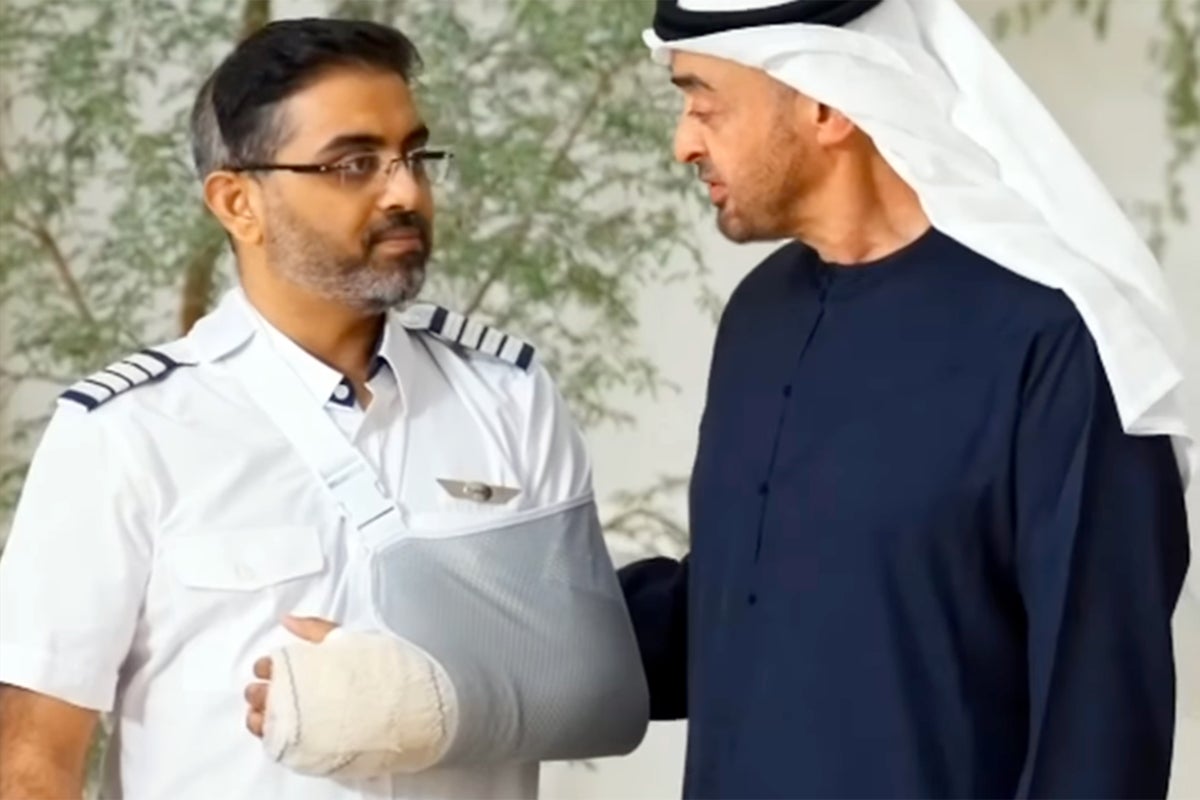
FlyDubai pilot who saved Tel Aviv flight from disaster reveals scars from co-pilot attack
Key Points
FlyDubai pilot who saved Tel Aviv flight from disaster reveals scars from co-pilot attack Smit Machchhar was honored for his bravery after he was set upon with an axe en route to Israel - Bookmark - CommentsGo to comments Become an Independent member to bookmark this article Already a member? Log in The brave captain who fought off his co-pilot during the attempted hijacking of a passenger jet last month has revealed his injuries from the savage axe attack. Smit Machchhar was awarded the...
FlyDubai pilot who saved Tel Aviv flight from disaster reveals scars from co-pilot attack
Smit Machchhar was honored for his bravery after he was set upon with an axe en route to Israel
- Bookmark
- CommentsGo to comments
Become an Independent member to bookmark this article
Already a member? Log in
The brave captain who fought off his co-pilot during the attempted hijacking of a passenger jet last month has revealed his injuries from the savage axe attack.
Smit Machchhar was awarded the UAE’s First Class Order of Zayed II on Wednesday for his bravery in helping to thwart what authorities believe was an attempted suicide attack targeting Israel’s Ben Gurion airport on September 30.
Flydubai Flight 1073 from Dubai to Tel Aviv plunged 16,000ft in 30 seconds before the attacker was overwhelmed and two other pilots who were on board were able to safely land in Saudi Arabia.
Capt Machchhar, still wearing a sling and with stitches in the back of his head, told UAE president Sheikh Mohammed during yesterday’s ceremony that it would still be another two months before he heals fully.
“I have an idea. When you heal, I want to have a session with you to train you how to fight,” the Emirati president told him, suggesting he would benefit from learning jiu-jitsu.
“It’s my biggest honour,” replied the captain.
The aircraft was in Saudi airspace when the co-pilot attacked Machchhar with a crash axe, typically kept in the cockpit for emergency use.
UAE public prosecutors have said the plan was inspired by the September 11, 2001, attacks on the United States.
Speaking from a hospital bed in Abu Dhabi earlier this month, Machchhar said that when the first blow landed, he thought something had gone “horribly wrong the aircraft structure”, before quickly realising he was being attacked.
“The next thought was I need to get help in here. My immediate action was to free myself from the seat belts and I tried to just block the blows as much as I could,” he said, pointing to his arm that was wounded as he defended himself.
“The blows were coming on the head. Immediately my hand went to the knob which opens the door and screaming for my colleagues, screaming his name. I believe that was the first time when I lost my consciousness.”
Machchhar was covered with blood and on the floor when he managed to open the cockpit door, a spokesperson for Israeli prime minister Benjamin Netanyahu said.
Yaniv Hayun, one of the men who incapacitated the attacker, described running to the cockpit as the plane nosedived.
“We pulled the assailant out, I pulled him out. After I pulled him out we took control of the plane, I pulled up the yoke (steering control of the plane), I straightened the plane out a bit,” he said.
Netanyahu earlier said that the co-pilot, whom he identified as an Omani national, had undergone radical Islamist indoctrination and was clearly suicidal, but that so far a motive for his actions had not been established.
Israel does not have official diplomatic relations with Oman, and Netanyahu has said pilots from such countries were not permitted to operate flights to Israel. It was not clear how the co-pilot came to be assigned to the flight to Tel Aviv.
Join our commenting forum
Join thought-provoking conversations, follow other Independent readers and see their replies
Comments