
Environment
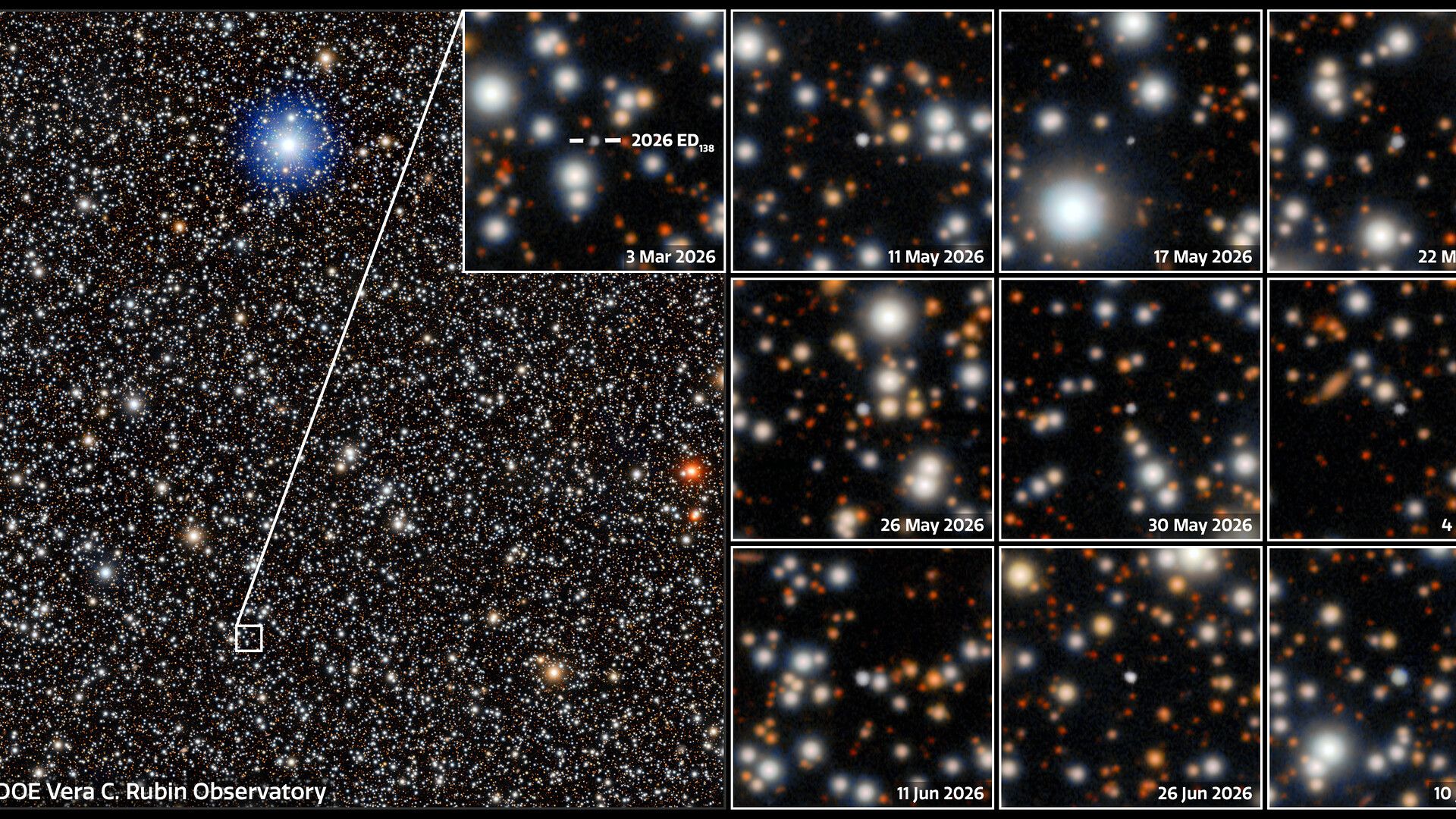
Bright object beyond Pluto may be the solar system's sixth dwarf planet
Key Points
Bright object beyond Pluto may be the solar system's sixth dwarf planet The Vera C. Rubin Observatory has found what might be a new dwarf planet in our solar system, orbiting the sun on an inclined plane past Pluto. The Vera C. Rubin Observatory has found what might be a tiny new world in the far reaches of our solar system, hidden beyond the orbit of Neptune — and it is among the largest and brightest objects ever discovered beyond Neptune. If confirmed, the miniature world would increase...
Bright object beyond Pluto may be the solar system's sixth dwarf planet
The Vera C. Rubin Observatory has found what might be a new dwarf planet in our solar system, orbiting the sun on an inclined plane past Pluto.
The Vera C. Rubin Observatory has found what might be a tiny new world in the far reaches of our solar system, hidden beyond the orbit of Neptune — and it is among the largest and brightest objects ever discovered beyond Neptune.
If confirmed, the miniature world would increase the number of officially recognized solar system dwarf planets to six. Upper estimates of the object's size place it at more than half the diameter of Pluto, the largest known dwarf planet.
"My first reaction was one of excited disbelief," Matthew Holman, an astrophysicist at the Smithsonian Astrophysical Observatory and member of the Rubin team who wrote the code that helped discover the prospective dwarf planet, said in a statement. "Objects like this are very rare, so I immediately started checking whether I or the code had done something wrong."
Hidden among stars
The potential dwarf planet, designated 2026 ED138, orbits the sun at roughly 46 times the distance between Earth and the sun. The potential new planetoid has been hiding behind galactic camouflage; with its orbit tilted at a 25-degree angle from the solar system plane, it's at just the right angle to get lost in the light from the inner Milky Way, the researchers said.
Many telescopes struggle to see past the millions of stars making up our galaxy's bulge. The Vera C. Rubin Observatory, however, images the entire southern sky every few nights with the largest digital camera ever built, sending out millions of nightly alerts for every object that has changed brightness or position. This makes it exceptional at identifying anything that moves, from solar system objects to transient events like supernova explosions.
The observatory had only just begun its 10-year mission of scanning the sky in July, and ED138 stood out in the data.
Holman works on the software algorithms that process the extreme amounts of data the observatory collects. The code he developed with his colleague, Kevin Napier, compares billions of observations to determine which ones are detections of the same moving object. Running data from Rubin through the code revealed the unusually large object.
Get the world’s most fascinating discoveries delivered straight to your inbox.
By looking at past data from Rubin and archival images from the Dark Energy Camera mounted on the Victor M. Blanco 4-meter Telescope at Cerro Tololo Inter-American Observatory (both in Chile), the team was able to map out ED138's orbit over the past 10 years.
Going beyond Neptune
The Kuiper Belt is a region of the solar system beyond Neptune that is a wild frontier of small, mostly icy bodies made from frozen methane, ammonia, water and rock. It ranges from roughly 30 to 50 times the distance between Earth and the sun, and is home to most of the known dwarf planets, including Pluto. Thousands of Kuiper Belt objects have already been discovered. These space rocks can be frozen time capsules that hold clues about the early solar system's formation.
Dwarf planets are the largest Kuiper Belt objects that we know of. Bigger than asteroids but not quite planets, dwarf planets are big enough to be rounded under the force of their own gravity but too small to clear their orbits like planets do. While the International Astronomical Union (IAU) has officially confirmed five dwarf planets — Pluto, Ceres, Eris, Haumea and Makemake — astronomers studying dwarf planets often recognize at least nine, with several more candidates whose properties are still unknown.
Related stories
Depending on which astronomer you ask, there could be anywhere from a handful to hundreds of dwarf planets in this part of the solar system. Identifying which Kuiper Belt objects are dwarf planets is tricky because they are often very dim and move very slowly from Earth's perspective, since their orbits are so large and distant. The likeliest candidates have high albedo (surface reflectivity) and diameters greater than roughly 370 to 500 miles (600 to 800 km).
What makes ED138 special is its size, inferred from its brightness, albedo and distance from the sun. It's estimated to have a diameter between 370 to 930 miles (600 to 1,500 km). For comparison, Pluto — the largest dwarf planet recognized by the IAU — is 1,477 miles (2,377 km) in diameter. Ceres, the smallest IAU-recognized dwarf planet, is 595 miles (958 km) in diameter. Future observations of ED138 will give researchers a more accurate idea of its diameter and density to determine if it's round enough to join the dwarf planet club.
"If confirmed as a dwarf planet, ED138 would join a very small family of worlds," Holman said in the statement. "Rubin will image the whole southern sky again and again for ten years, so any others hiding in the places earlier surveys skipped are now within reach."
Damien Pine (he/him) is a freelance writer, artist, and former NASA engineer. He writes about science, physics, tech, art, and other topics with a focus on making complicated ideas accessible. He has a degree in mechanical engineering from the University of Connecticut, and he gets really excited every time he sees a cat.
You must confirm your public display name before commenting
Please logout and then login again, you will then be prompted to enter your display name.
[Image text:] OE Vera.C.RubinObservator
3Mar 2026
11May2026
17May2026
22M
26 May 2026
30May2026
11Jun2026
26Jun2026
The Vera C. Rubin Observatory (ORG)
Neptune (ORG)
Pluto (EVENT)
Matthew Holman (PERSON)
Rubin (PERSON)
Earth (LOCATION)
ED138 (PERSON)
Holman (ORG)
Kevin Napier (PERSON)
the Dark Energy Camera (ORG)
the Victor M. Blanco 4-meter Telescope (LOCATION)
Cerro Tololo Inter-American Observatory (LOCATION)
Chile (LOCATION)