
Weather
Snowy 2.0 still has a place in a world of batteries
Key Points
Snowy 2.0 still has a place as batteries reshape Australia's power grid The origin story of Snowy 2.0 is a fitting metaphor for one of the most ambitious renewable energy projects in Australia's history. "We had a couple of Snowy Hydro execs having a beer in the corner, and the plans for Snowy 2.0 were just drawn out on a coaster," the publican of the Alpine Hotel in Cooma told the ABC's Four Corners program in 2023.
Snowy 2.0 still has a place as batteries reshape Australia's power grid
The origin story of Snowy 2.0 is a fitting metaphor for one of the most ambitious renewable energy projects in Australia's history.
"We had a couple of Snowy Hydro execs having a beer in the corner, and the plans for Snowy 2.0 were just drawn out on a coaster," the publican of the Alpine Hotel in Cooma told the ABC's Four Corners program in 2023.
As it turned out, it was not that easy.
A recent major review of the project cited design immaturities and building complexities among the reasons for the $25 billion price tag, about 12 times the original cost.
"It was a political announcement at the time," said Stephanie Bashir, a former AGL Energy executive and now CEO of Nexa Energy.
"If they had just taken a bit more time at the start … but I mean, that's history now and we've got to keep moving on."
Batteries getting bigger, able to run longer
It was March 2017 when then-prime minister Malcolm Turnbull announced Snowy 2.0, during a heated national debate around climate and energy policy that would eventually factor in to his political downfall.
It came in the months after a freak storm in late 2016 sparked the infamous South Australia blackout, exposing the fragility of a grid transitioning to renewables.
At the time, big grid-scale batteries did not really exist. Remember when Elon Musk and Mike Cannon-Brookes made a bet on Twitter to build the world's biggest battery in South Australia in 100 days?
Nearly 10 years on, the latest quarterly report from the Australian Energy Market Operator (AEMO) shows the contribution of big batteries to evening out power in Australia's biggest grid has more than doubled in a year, overtaking gas.
As a result, power prices in the last quarter fell to their lowest average since 2021.
Centralised power in a decentralised grid
Next to the Eraring, NSW coal-fired power station, which is set to close in 2029, Origin Energy is building a series of battery storage systems.
The latest is flagged to have 500 megawatts of capacity with the ability to supply power for eight hours — enough storage to run hundreds of thousands of homes.
AEMO has approved 3.6 gigawatts in battery projects, which will come online between 2028-29, about the same time Snowy 2.0 is set to be finished.
By then, rooftop solar and household batteries will be even more common. Apartment dwellers will soon be able to hang solar panels off their balconies and plug portable, esky-sized batteries into the wall.
Trials are also underway to plug electric cars into the home and connect them to the grid.
"We had centralised energy, and we're moving to more decentralised energy," Ms Bashir said
"Wind farms, solar farms, batteries, they can be located anywhere."
Where does this leave Snowy 2.0?
The relevant number with Snowy 2.0 is the one with the 'h' in it. It stands for hours.
Gigawatts (GW) measure how much power can be delivered at once. Gigawatt-hours (GWh) tell us how much energy is available to be delivered over time.
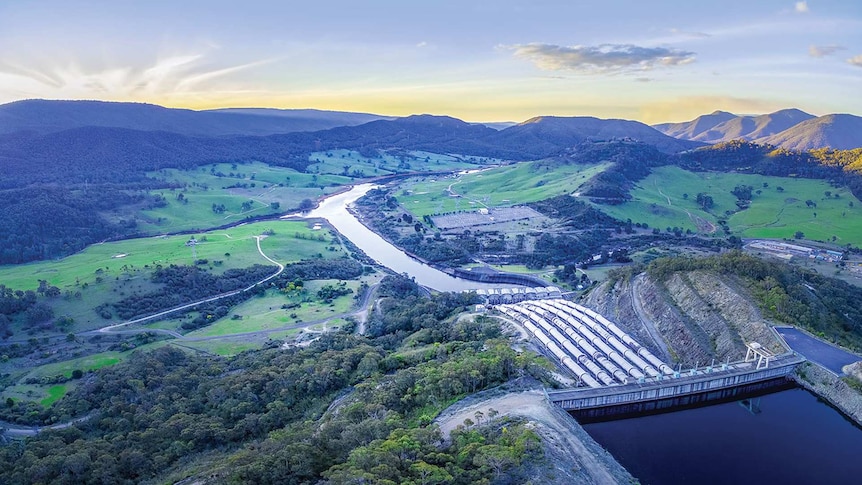
Snowy 2.0 has a generating capacity of 2.2GW, and the water stored in its reservoir provides 350GWh of energy storage, according to Snowy Hydro.
So while Origin might be building a battery that can run for about eight hours, Snowy 2.0 can run for about 160 hours — or as its promotional material suggests, about long enough to power 3 million homes for a week.
"We have so many batteries being installed, but it still adds up to being about kind of 30 gigawatt hours," professor Marnie Shaw, an energy infrastructure expert from Australian National University, said.
"It's really only one 10th of the size of Snowy 2.0 in terms of gigawatt hours."
AEMO's energy road map to 2050 says Australia needs about 650GWh of dispatchable storage, and with its 350GWh, Dr Shaw said Snowy 2.0 made up more than half of that.
"So the majority of our energy, our long-term energy storage in the future, is being supplied by Snowy 2.0," she said.
But Bruce Mountain from Victoria University has long questioned how useful that capacity would be in practice.
"The top reservoir does not have a water supply of its own," Dr Mountain told the ABC's Business Daily this week.
"The problem is you need to pump the water up to the upper dam, which means you need to have the water available in a lower dam, which only gets some water from a river."
"This fantastic ability to run flat out for a week is a service that is simply not practically usable because once you've done that, you've spent your resource."
Snowy as an insurance policy
There are also questions about how often Snowy 2.0's enormous storage capacity will be needed, according to associate professor Roger Dargaville, an energy systems and storage expert from Monash University.
"The idea that you would need to run the Snowy 2.0 for two weeks continuously, it's not very likely that would actually eventuate," he said.
"It's nice to have as an insurance policy in case."
But Snowy 2.0 does have an advantage because achieving the same amount of deep storage with batteries is much more expensive.
"The difference for pumped hydro is to have more hours of storage, you just make the reservoir bigger, which is only a small component of the total system," Dr Dargaville said.
"Whereas for batteries, if you want to double the storage, it is doubling the cost."
The future is modular
Snowy 2.0's cost blowout will continue to be a focus for critics, and nobody could have foreseen how fundamentally the energy landscape in Australia would change in just 10 years.
"At $24 or $25 billion, we're starting to question whether it makes sense anymore," Dr Dargaville said.
"And it's going to require really, really high volatility in the market for it to make its money back."
But Snowy 2.0 is built to operate for 150 years, long after the talk of cost blowouts has faded.
"There will always be volatility in the market in a renewable energy system, and storage will always be useful," Dr Dargaville said.
Ms Bashir said the lesson from Snowy 2.0 was that long-duration storage was needed in the energy grid, but future pumped hydro projects might be smaller and more modular.
"You can have pumped hydro projects that are actually much smaller, and they can be located much easier and built much faster and therefore at a lower cost," she said.
"We're so used to big builds, and we're used to centralised energy.
"We need to be thinking in the way that technology is going, which is smaller, flexible, and can be located in a distributed way rather than in a centralised way."