
World News
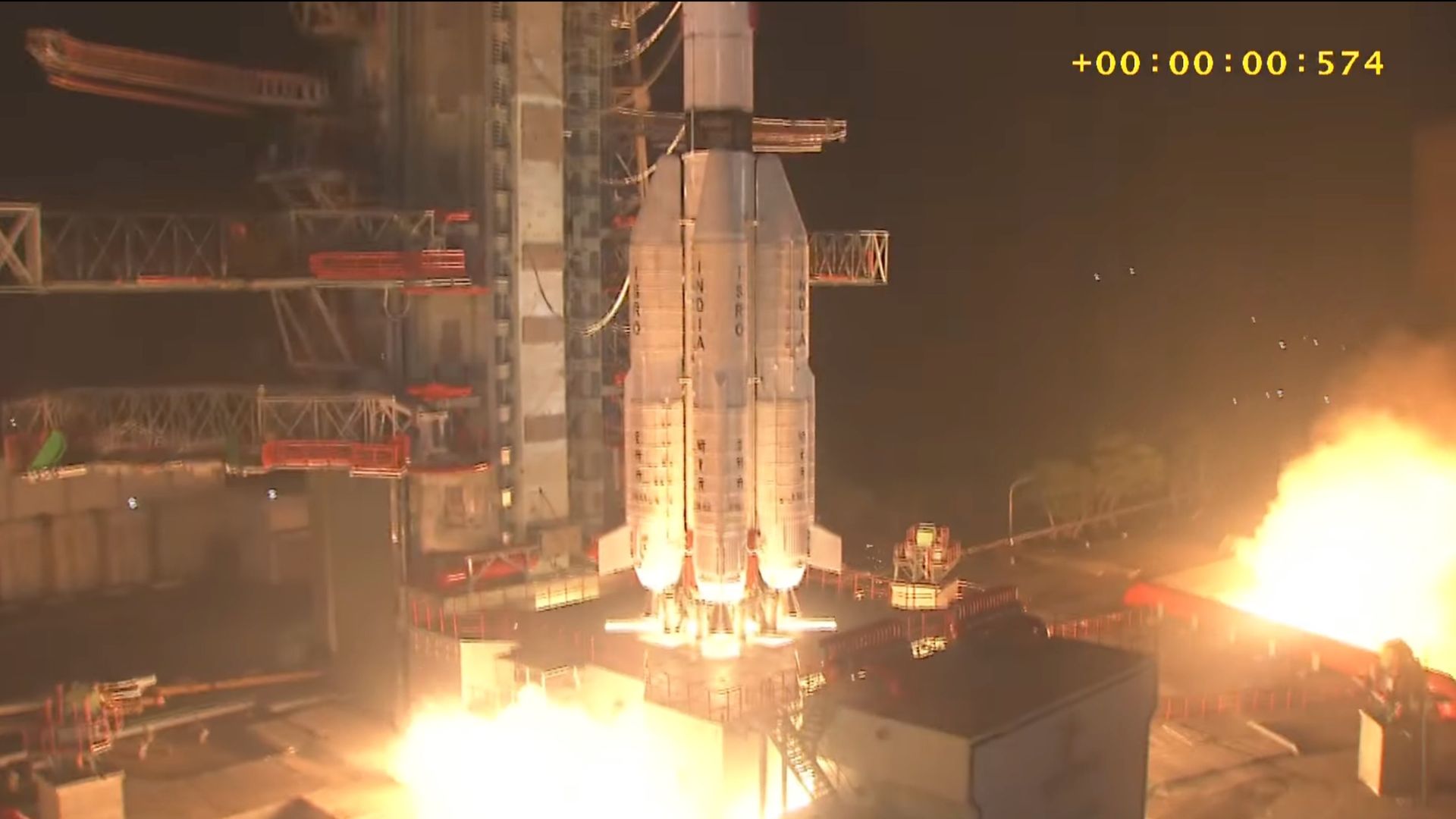
India launches next-gen navigation satellite to orbit (video)
Key Points
India launches next-gen navigation satellite to orbit (video) India bolstered its homegrown satellite-navigation system today (Oct. 30). A GSLV Mark II rocket launched the nation's NVS-03 satellite from Satish Dhawan Space Centre today at 2:21 p.m. EDT (1821 GMT and 11:51 p.m. India Standard Time). Everything went well: The rocket deployed NVS-03 into geostationary transfer orbit as planned, officials with the Indian Space Research Organisation (ISRO) announced on X about 30 minutes after...
India launches next-gen navigation satellite to orbit (video)
India bolstered its homegrown satellite-navigation system today (Oct. 30).
A GSLV Mark II rocket launched the nation's NVS-03 satellite from Satish Dhawan Space Centre today at 2:21 p.m. EDT (1821 GMT and 11:51 p.m. India Standard Time).
Everything went well: The rocket deployed NVS-03 into geostationary transfer orbit as planned, officials with the Indian Space Research Organisation (ISRO) announced on X about 30 minutes after liftoff.
NVS-03 is the third next-gen satellite that India has launched for the Navigation with Indian Constellation (NavIC), its version of the United States' Global Positioning System (GPS).
NavIC operates on a smaller scale than its American counterpart, however. It's "a regional navigation satellite system designed to provide accurate Position, Navigation and Timing (PNT) service to users in India as well as the region extending about 1,500 km [930 miles] beyond the Indian landmass, which is its primary service area," ISRO officials wrote in the NVS-03 launch brochure.
The Indian constellation currently consists of three fully functioning satellites, and it requires four to provide PNT services. So today's launch was a big deal — and a lot of eyes will be watching NVS-03's commissioning and checkout phase.
Today's launch was the 14th to date for the GSLV (Geosynchronous Satellite Launch Vehicle) Mark II, a three-stage rocket that stands 170 feet (52 meters) tall. Twelve of those 14 liftoffs have been successful.
The GSLV Mark II debuted in 2010, the same year its predecessor retired. That previous launchers, the Mark I, flew a total of six times, with two failures.
NVS-03 was the fourth Indian launch of 2026 and the third operated by ISRO. The fourth was mounted by Skyroot Aerospace, which in July became the first Indian company ever to successfully reach orbit.
Michael Wall is the Spaceflight and Tech Editor for Space.com and joined the team in 2010. He primarily covers human and robotic spaceflight, military space, and exoplanets, but has been known to dabble in the space art beat. His book about the search for alien life, "Out There," was published on Nov. 13, 2018. Before becoming a science writer, Michael worked as a herpetologist and wildlife biologist. He has a Ph.D. in evolutionary biology from the University of Sydney, Australia, a bachelor's degree from the University of Arizona, and a graduate certificate in science writing from the University of California, Santa Cruz. To find out what his latest project is, you can follow Michael on Twitter.
You must confirm your public display name before commenting
Please logout and then login again, you will then be prompted to enter your display name.
[Image text:] +00:00:00:574
India (LOCATION)
Satish Dhawan Space Centre (ORG)
the Indian Space Research Organisation (ORG)
Navigation (ORG)
the United States' (LOCATION)
NavIC (PERSON)
American (ORG)
Indian (ORG)
GSLV (ORG)
Geosynchronous Satellite Launch Vehicle (ORG)
Mark II (PERSON)
ISRO (ORG)
Skyroot Aerospace (ORG)
Michael Wall (PERSON)
Tech (ORG)