
Politics
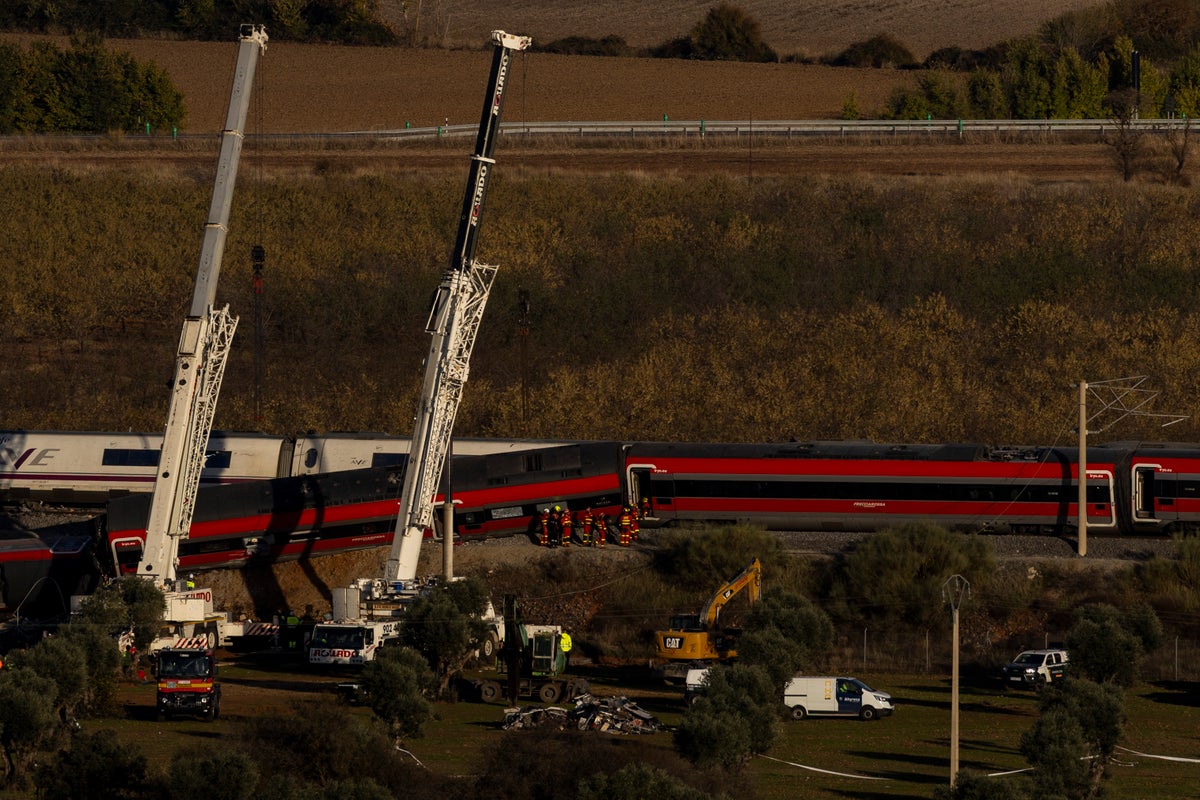
Traffic control errors blamed for Spain rail disaster: ‘They had a clear view of what was happening’
Key Points
Traffic control errors blamed for Spain rail disaster: ‘They had a clear view of what was happening’ Transport minister says operators cleared passenger train to accelerate to 100mph toward stationary carriages despite live warning displays - Bookmark - CommentsGo to comments Become an Independent member to bookmark this article Already a member? Log in A series of human errors by rail traffic controllers was the probable cause of the high-speed collision south of Toledo that killed at least...
Traffic control errors blamed for Spain rail disaster: ‘They had a clear view of what was happening’
Transport minister says operators cleared passenger train to accelerate to 100mph toward stationary carriages despite live warning displays
- Bookmark
- CommentsGo to comments
Become an Independent member to bookmark this article
Already a member? Log in
A series of human errors by rail traffic controllers was the probable cause of the high-speed collision south of Toledo that killed at least 69 people, Spain’s transport minister has said.
Traffic controllers in Madrid authorised a moving passenger train to accelerate to roughly 100mph directly toward a stationary train occupying the same track sector, transport minister Óscar Puente told a news conference.
A judicial inquiry is now underway to determine why operators failed to halt the service during a 17-minute period when control room displays showed one train stopped while the other bore down upon it.
“They had a clear view of what was happening,” Puente said Friday, after insisting he would not point the blame at individual workers.
The minister, who was refused to resign in the wake of the second major rail disaster in Spain this year, said controllers were operating under an emergency manual regime where basic verification protocols were bypassed. He also claimed technicians “had multiple opportunities to halt the trailing train before the impact occurred.”
The incident, Spain’s deadliest rail crash in more than a decade, occurred on Wednesday morning along a key central corridor south of Toledo. In addition to the 69 confirmed fatalities, dozens of passengers remain hospitalised across regional medical facilities, with 17 in intensive care.
The chain of events began at 8:31am when the regional automatic safety signalling network, known as the LZB system, suffered an unexpected failure. Under normal operating conditions, LZB regulates signal lights and automatically applies train brakes to enforce safe distances.
When the system shut down, emergency protocols brought all train traffic in the sector to an immediate halt. Because two passenger trains stopped within the exact same block of track, responsibility shifted entirely to manual coordination between Madrid operations staff and train conductors.
Under national railway safety regulations, a trailing train is strictly prohibited from entering or advancing along a track sector until the forward train has vacated the area. Furthermore, safety rules dictate that in the event of signalling outages, trains may only proceed at cautionary speeds of around 25mph, ensuring drivers retain sufficient visibility and braking distance to stop manually.
Instead, controllers made several critical departures from standard procedure, according to the timeline presented by the ministry.
At 8:36am, controllers cleared the rear train, operated by the state-owned rail company Renfe, to restart. Rather than instructing the driver to advance at cautionary speed, operators directed the service to resume regular operational speeds of up to 124mph.
Five minutes later, at 8:41am, controllers cleared the forward train, an express service operated by the private rail company Iryo, turning the signal ahead of it green.
However, the Iryo train suffered an immediate mechanical failure and was unable to move. At 8:48am, its driver radioed the Madrid operations centre to state explicitly that the carriages were stalled on the rails.
Despite logging the warning, controllers took no steps to halt the approaching Renfe service or revoke its track authorisation.
The manual clearance given to the forward train caused the signal behind it to turn green automatically, misinforming the oncoming Renfe driver that the tracks ahead were clear before the train struck the stationary Iryo carriages at high speed.
“Why, if it was possible to act and there was time to do so, was nothing done? I have absolutely no idea,” Puente said. “That is one of the things the investigation will have to clarify.”
The disaster has reignited scrutiny over Spain's railway infrastructure, coming after more than 40 people were killed in a crash in January. Railway worker unions have accused the transport ministry of operating control rooms with chronic staffing shortages and outdated technology.
Puente has pushed back against union accusations, stating the Madrid operations centre was adequately staffed and funded on the morning of the disaster.
He also defended the reliability of the ageing LZB signalling system, noting that while it had experienced roughly 170 outages this year – primarily due to cable theft, vandalism, and scheduled maintenance – its performance remained within normal European parameters ahead of a planned nationwide upgrade next year.
Facing mounting calls from opposition parties to resign ahead of general elections on 29 November, Puente instead announced an emergency package of technological upgrades intended to reduce reliance on human discretion in traffic control rooms.
Join our commenting forum
Join thought-provoking conversations, follow other Independent readers and see their replies
Comments